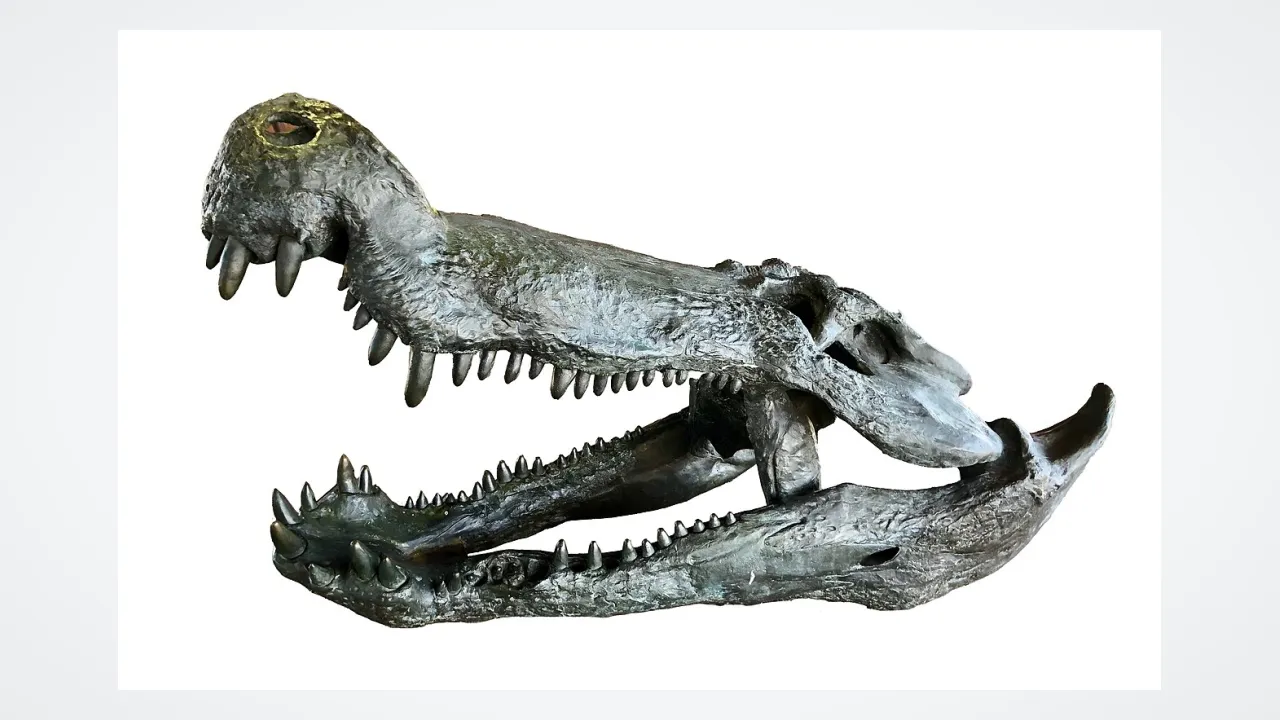
1. Which living animal did Deinosuchus look most like?
2. Why did Deinosuchus have thick, rounded teeth at the back of its jaws?
🤯 Mind-Blowing Fact • Grade 2
Even fossilized Deinosuchus droppings—called coprolites—are packed with crushed sea turtle shell bits and coastal snail shells!
✨ Word Sparks (Grade 2 Glossary)
Tap 🔊 to hear
Seaway
Wide shallow sea stretching across land
Coprolite
Fossilized animal droppings turned into stone
Puncture
Deep round hole pressed by a tooth
🪝
Why did an ancient alligator cousin have two mysterious extra holes right at the tip of its nose?
1
Split Continent, Giant Waterways
Picture North America 77 million years ago, when a warm shallow sea split the continent right down the middle! Lurking in salty bays from Montana and Texas all the way to Georgia and New Jersey was Deinosuchus, growing up to thirty-five feet long.
2
Terrible Crocodile, True Alligator Cousin
Although its name means 'terrible crocodile,' skull features prove Deinosuchus belonged to the alligator family tree. Unlike any living gator, two extra holes pierced the bone right in front of its nostrils—a cool mystery scientists still study today!
3
Proof Written on Dinosaur Bones
Paleontologists don't have to guess whether Deinosuchus hunted dinosaurs. Duck-billed dinosaur and tyrannosaur bones carry deep round marks made by Deinosuchus teeth!
1. How do paleontologists know for sure that Deinosuchus attacked Late Cretaceous dinosaurs?
2. What divided North America into western and eastern halves when Deinosuchus lived?
🤯 Mind-Blowing Fact • Grade 3
A recent 2025 evolutionary study showed Deinosuchus kept archaic saltwater-tolerant glands that modern freshwater alligators later lost—explaining how it swam right across salty seaways!
✨ Word Sparks (Grade 3 Glossary)
Tap 🔊 to hear
Alligatoroid
Member of the alligator branch of crocodilians
Brackish
Mix of fresh river water and salty seawater
Hadrosaur
Plant-eating Cretaceous dinosaur with a duck-like bill
🪝
How did a thirty-five-foot alligator relative cross salty ocean bays to rule both halves of Cretaceous North America?
1
Crossing the Inland Sea
Seventy-eight million years ago during the Late Cretaceous Period, the Western Interior Seaway split North America into western Laramidia and eastern Appalachia. Land dinosaurs on each side evolved separately, yet giant Deinosuchus hunted along both shorelines! Eastern species Deinosuchus schwimmeri reached roughly ten meters, while western Deinosuchus riograndensis grew up to 10.6 meters (35 feet) and weighed up to eight tons.
2
Built-In Bite Power
Unlike slender-snouted fish-eaters such as Sarcosuchus, Deinosuchus had a broad, U-shaped skull reinforced like a steel bridge. Biomechanical tests estimate its bite force exceeded 18,000 pounds (80,000 Newtons)—stronger than Tyrannosaurus rex!
3
Two Toolboxes of Teeth
Conical front teeth spiked and held struggling duck-billed or young tyrannosaurs like Appalachiosaurus at river mouths. Further back, thick dome-shaped teeth crushed armored Bothremys sea turtles.
4
Distinctive Hollow Osteoderms
Its back armor plates were extra thick, inflated like swollen loaves, and pitted with deep dimples—making even a single pebble-sized Deinosuchus scute easy for fossil hunters to recognize!
1. How did Deinosuchus's broad U-shaped skull give it a different hunting style from narrow-snouted Sarcosuchus?
2. How could Deinosuchus live on both western Laramidia and eastern Appalachia when dinosaurs could not cross?
🤯 Mind-Blowing Fact • Grade 4
One hadrosaur tail vertebra from Big Bend, Texas, still had a Deinosuchus tooth mark surrounded by regrown healing bone—proving the thirty-foot dinosaur broke free from the ambush and lived!
✨ Word Sparks (Grade 4 Glossary)
Tap 🔊 to hear
Newton
Standard scientific unit used to measure force
Laramidia
Western island continent of Cretaceous North America
Carapace
Hard upper shell of a turtle
🪝
What happens when a seven-ton coastal ambush predator clamps down with more than eighty thousand Newtons of force?
1
Terror of Laramidia and Appalachia
Creep along a cypress-ringed tidal estuary in Late Cretaceous Texas 77 million years ago. Half-hidden in brackish water lies Deinosuchus riograndensis, a 10.6-meter crocodylian topping seven metric tons. First discovered in North Carolina in 1858 via giant grooved teeth and named by William Jacob Holland in 1909 from Montana vertebrae and osteoderms, Deinosuchus reigned for nearly nine million years along both shores of the Western Interior Seaway.
2
Engineering a 100,000-Newton Clamp
Scaling models led by Gregory Erickson—who famously measured bite forces across all twenty-three living crocodilian species—estimate large Deinosuchus generated 80,000 to over 102,000 (18,000–23,000 pounds-force). Its flattened, broad rostrum distributed crushing loads evenly, while robust pterygoid flanges anchored massive pterygoideus jaw muscles capable of snapping bone and performing violent underwater rotational rolls.
3
Forensic Marks on Dinosaur Skeletons
Paleontologist David Schwimmer documented unmistakable Deinosuchus feeding traces across both sides of North America: crushed of pleurodiran sea turtles in Georgia alongside punctured femora and tibiae of Appalachiosaurus, and healed tooth gouges on Kritosaurus and hadrosaur caudal vertebrae in Texas and Utah—direct proof of live predatory strikes at watering holes.
4
Enigmatic Premaxillary Fenestrae
In 2020, Adam Cossette and colleagues reviewed skulls of western and eastern Deinosuchus, highlighting twin bulbous openings piercing the premaxilla anterior to the external nares—an enigmatic soft-tissue or acoustic structure seen in no living crocodilian.
1. How did paleontologists know that some Deinosuchus bites on dinosaurs came from live hunting attacks rather than scavenging dead bodies?
2. What unusual skull feature at the very front of Deinosuchus's snout puzzled researchers in their 2020 anatomical review?
🤯 Mind-Blowing Fact • Grade 5
A 2025 anatomical study solved a century-old puzzle: modern alligators hate open salt water because they lack tongue salt glands, whereas Deinosuchus branched off early enough to keep ancestral salt glands for crossing entire seaways!
✨ Word Sparks (Grade 5 Glossary)
Tap 🔊 to hear
Platyrostral
Having a wide, dorsoventrally flattened snout shape
Tribodont
Blunt, rounded rear teeth specialized for crushing shells
Kilonewton
Unit of force equal to one thousand Newtons
🪝
How did phylogenetic revisions, bite-force scaling, and coastal bonebeds reveal why Deinosuchus out-muscled even Late Cretaceous tyrannosaurs at the water's edge?
1
Trans-Seaway Biogeography and Systematics
Spanning the Campanian Stage of the Late Cretaceous (roughly 82 to 73 MYA), Deinosuchus inhabited estuarine deltas, barrier lagoons, and salt marshes flanking North America's Western Interior Seaway. Three species are widely recognized following Adam Cossette and Christopher Brochu's 2020 revision: eastern Deinosuchus schwimmeri across the Atlantic and Gulf Coastal Plains (~9.5–10 meters) and western Deinosuchus riograndensis and D. hatcheri in Laramidia from Montana to Coahuila (~10.6 meters and 5–8 metric tons). While traditionally classified as a basal alligatoroid, 2025 phylogenetic analyses suggest Deinosuchus may branch just outside crown Crocodylia—retaining ancestral lingual salt-excreting glands lost in modern freshwater Alligatoridae and explaining its marine-dispersal capability.
2
Cranial Mechanics and 100-Kilonewton Bite Force
Constructing a 1.3-to-1.5-meter (broad, flattened) skull reinforced by thick secondary palates and hypertrophied pterygoid buttresses made Deinosuchus an unmatched biomechanical vise. Empirical scaling from extant Crocodylus porosus bite measurements by Gregory Erickson and colleagues yields adult posterior bite forces of 80 to 102 —exceeding even adult Tyrannosaurus rex (~35–57 kN) and enduring extreme torsional loads during rotational dismemberment ('death rolls').
3
Heterodont Dentition and Taphonomic Forensics
Deinosuchus paired robust, piercing anterior caniniforms with blunt, bulbous posterior ('crushing') teeth. Across Georgia's Blufftown Formation and Texas's Aguja Formation, David Schwimmer cataloged punctured pleurodiran Bothremys turtle shells, crushed shell-rich coprolites, bisected Appalachiosaurus tyrannosaurid limb elements, and remodeled healing calluses around tooth scores on hadrosaurid caudal centra—indisputable evidence of apex predation on terrestrial dinosaurs.
4
Hemispherical Osteoderms and Growth Longevity
Diagnostic dorsal osteoderms inflated into deeply pitted, hemispherical bosses up to five centimeters thick lightened slightly by internal pneumatic-like vascular sinuses while armoring the dorsum. Skeletochronology of osteoderm growth rings indicates 35 years to reach adult length and lifespans passing half a century.
5
Campanian Retreat Before the Asteroid
Long before the end-Cretaceous impact 66 million years ago, regression of the Western Interior Seaway near the Campanian-Maastrichtian boundary (~73 MYA) drained the vast coastal marshes Deinosuchus required, driving North America's dinosaur-hunting crocodylian extinct.