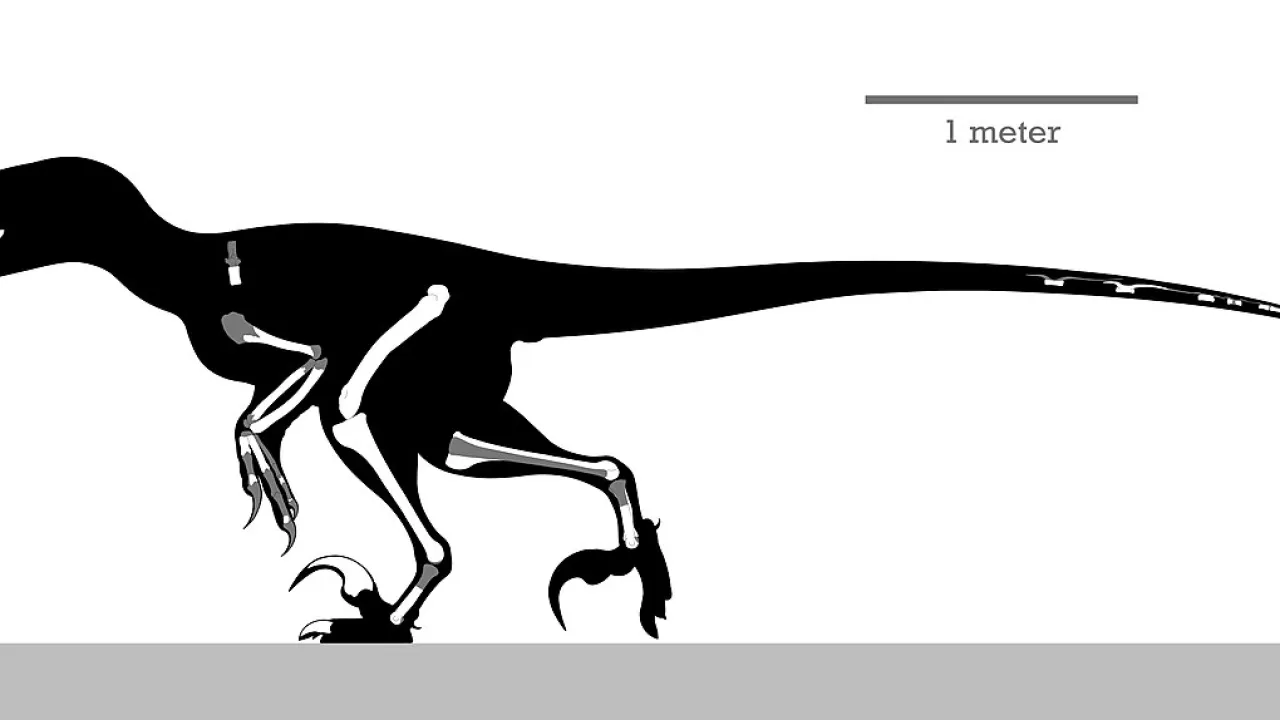
1. About how tall did Dakotaraptor stand at the head?
2. Where were Dakotaraptor's fossils discovered?
🤯 Mind-Blowing Fact • Grade 2
Dakotaraptor is the largest dinosaur ever discovered with direct skeletal quill knobs proving it had full wing feathers!
✨ Word Sparks (Grade 2 Glossary)
Tap 🔊 to hear
Quill Knob
Bone bump where a strong feather attaches
Forearm
Lower part of the arm near wrist
Sprinter
Runner built for bursts of high speed
🪝
How do we know for sure that an eighteen-foot, 700-pound dinosaur wore real bird-like wing feathers?
1
Sharing Land with Giants
Picture lush green swamps in South Dakota sixty-six million years ago. Giant Triceratops munched ferns while heavy Tyrannosaurus rex stomped nearby. Right between them sprinted Dakotaraptor, a sleek feathered hunter stretching eighteen feet from nose to tail!
2
Bumps That Prove Feathers
Paleontologists found a trail of small bumps along Dakotaraptor's bone. Modern eagles and turkeys have these exact bumps, called , where strong wing feathers attach! Even though Dakotaraptor weighed around seven hundred pounds, it proudly wore full feathered wings.
3
Built for Speed
Long, slim leg bones made Dakotaraptor a champion . It chased fast plant-eating dinosaurs that lumbering T. rex could not easily catch.
1. What clue on Dakotaraptor's arm bone proved it had wing feathers?
2. Which famous dinosaur lived in the exact same Hell Creek habitat as Dakotaraptor?
🤯 Mind-Blowing Fact • Grade 3
Paleontologists uncovered two slightly different body builds of Dakotaraptor—one sturdier and one slimmer—which may represent males and females or growth stages!
✨ Word Sparks (Grade 3 Glossary)
Tap 🔊 to hear
Ecosystem
Community of living things and their habitat
Ulna
One of two bones inside the forearm
Ornithopod
Two-legged plant-eating dinosaur with beak
🪝
Why did a dinosaur heavier than a grizzly bear still grow forty-inch winged arms if it never flew?
1
The Missing Middle Predator
Travel back sixty-six million years to the Hell Creek Formation of North America. For years, scientists wondered why this rich had giant Tyrannosaurus rex and tiny cat-sized raptors, yet seemed to lack mid-sized hunters. In 2015, the announcement of Dakotaraptor steini helped solve that puzzle!
2
Wings Without Flight
At eighteen feet long and roughly seven hundred pounds, Dakotaraptor was far too heavy to leave the ground. Still, distinct quill knobs spaced along its fifteen-inch bone show it carried long, stiff wing feathers. Scientists think it flashed these dramatic plumes for communication, shielded nests of eggs, and flapped them for grip and balance.
3
Built for High-Speed Chases
Compared with stockier giant raptors like Utahraptor, Dakotaraptor had remarkably slender, long shin bones. Those athletic legs allowed rapid strides across open floodplains when pursuing speedy and ostrich-like dinosaurs.
4
Fierce Talons
Once close to its target, Dakotaraptor used grasping three-fingered hands and a curved 9.5-inch second-toe sickle claw to hold fast-moving prey steady.
1. How did Dakotaraptor's legs compare to those of bulky Utahraptor?
2. Which was NOT a way flightless Dakotaraptor could use its feathered wings?
🤯 Mind-Blowing Fact • Grade 4
Scientists discovered that one bone originally identified as Dakotaraptor's wishbone actually belonged to an ancient freshwater softshell turtle buried in the exact same quarry!
✨ Word Sparks (Grade 4 Glossary)
Tap 🔊 to hear
Cursorial
Adapted with long legs for fast running
Bonebed
Rock layer packed with many fossil bones
Peer Review
Scientists checking each other's research carefully
🪝
What happens when paleontologists discover accidentally mixed turtle shells inside a dinosaur quarry—and how does science test every bone?
1
Filling an Ecological Gap in Hell Creek
Sixty-six million years ago, just before the end of the Cretaceous Period, lush cypress swamps and winding rivers blanketed South Dakota. Adult Tyrannosaurus rex dominated massive prey, while tiny dromaeosaurids like Acheroraptor hunted lizards and mammals. Swirling into the middle predator tier was Dakotaraptor steini, a 5.5-meter (18-foot), 300-to-350-kilogram pursuit hunter agile enough to chase swift parksosaurs and ornithomimids.
2
Quill Knobs and Ancestral Flight
Described in 2015 by Robert DePalma and colleagues from in Harding County, South Dakota, Dakotaraptor preserved an ulna lined with raised papillae—quill knobs about ten millimeters wide. In living birds, quill knobs form where ligaments anchor secondary flight feathers against aerodynamic stress. Because a 350-kilogram raptor could never fly, these structures suggest Dakotaraptor evolved from much smaller flying or gliding ancestors.
3
Athletic Proportions and Grappling Claws
Unlike the heavily built Early Cretaceous giant Utahraptor, Dakotaraptor possessed elongated tibiae relative to its femurs—a hallmark of fast runners. Its compressed, strongly recurved 24-centimeter (9.5-inch) sickle claws worked alongside long grasping hands to pin fast prey.
4
How Paleontology Self-Corrects
Multi-species act like prehistoric jigsaw puzzles! Soon after Dakotaraptor's announcement, sharp-eyed researchers realized the piece originally thought to be its wishbone was actually bridge armor from a softshell turtle, Trionyx! That exciting correction demonstrates how scientific tests every fossil bone to build a clearer truth.
1. Why is the presence of quill knobs on a 350-kilogram flightless dinosaur scientifically exciting?
2. What turned out to be the true identity of the fossil piece first thought to be Dakotaraptor's wishbone?
🤯 Mind-Blowing Fact • Grade 5
In paleontology, a fossil specimen accidentally assembled from bones of more than one species buried together is called a 'chimera,' named after the mixed creature of Greek myth!
✨ Word Sparks (Grade 5 Glossary)
Tap 🔊 to hear
Mesopredator
Mid-sized hunter positioned below top predators
Chimera
Fossil mix containing bones from different species
Flightlessness
Losing flight after evolving from flying ancestors
🪝
How did Dakotaraptor share North America's final dinosaur ecosystem with juvenile Tyrannosaurus rex—and why do paleontologists still debate its fossil puzzle?
1
Apex Speedster of the Maastrichtian Floodplains
During the final million years of the Cretaceous Period, the Hell Creek Formation of South Dakota supported a humid coastal lowland laced with meandering channels and bald cypress forests. Reaching approximately 5.5 meters (18 feet) in length and weighing roughly 300 to 350 kilograms, Dakotaraptor steini stood among the largest dromaeosaurids in Earth's history—sharing its habitat with teenaged Tyrannosaurus rex, armored Ankylosaurus, and herds of Edmontosaurus.
2
Osteological Evidence of Wing Plumage
Excavated in 2005 and formally described in 2015 by paleontologist Robert DePalma, David Burnham, Larry Martin, Peter Larson, and Robert Bakker, the holotype preserved a remarkable forearm bone. Spaced along the posterior margin of the 36-centimeter ulna is a row of ulnar papillae (quill knobs) that would have supported secondary remiges over a meter in wingspan. Retaining robust feather ligaments in a massive, ground-bound predator supports hypotheses of secondary within paravian theropods.
3
Niche Partitioning with Juvenile Tyrannosaurs
In Hell Creek, lanky juvenile Tyrannosaurus rex occupied the fast role before growing into bone-crushing adults. To coexist, Dakotaraptor relied on specialized anatomy: whereas young tyrannosaurs delivered rapid, puncturing bites with tiny arms, Dakotaraptor combined high-speed cursorial legs with long, raptorial forelimbs and a recurved 24-centimeter pedal sickle claw to grapple agile prey in dense woodland cover.
4
Sorting Out a Chimera Mystery
Because river floods often jumble skeletons from many animals together into one sandstone lens, multi-taxon quarries require intense scrutiny. In 2016, paleontologist Victoria Arbour and colleagues showed that the supposed furcula (wishbone) belonged to a trionychid turtle, sparking ongoing scientific discussion about whether other isolated elements in the quarry might belong to Caenagnathidae oviraptorosaurs or tyrannosaurs alongside genuine giant dromaeosaurid claws and ulnae.
5
Science as an Ongoing Detective Story
Far from being a setback, testing whether a fossil assemblage contains mixed bones—known as a —shows paleontology at its sharpest. Every bone scan refines our picture of the feathered predators witnessing the twilight of the Mesozoic Era.