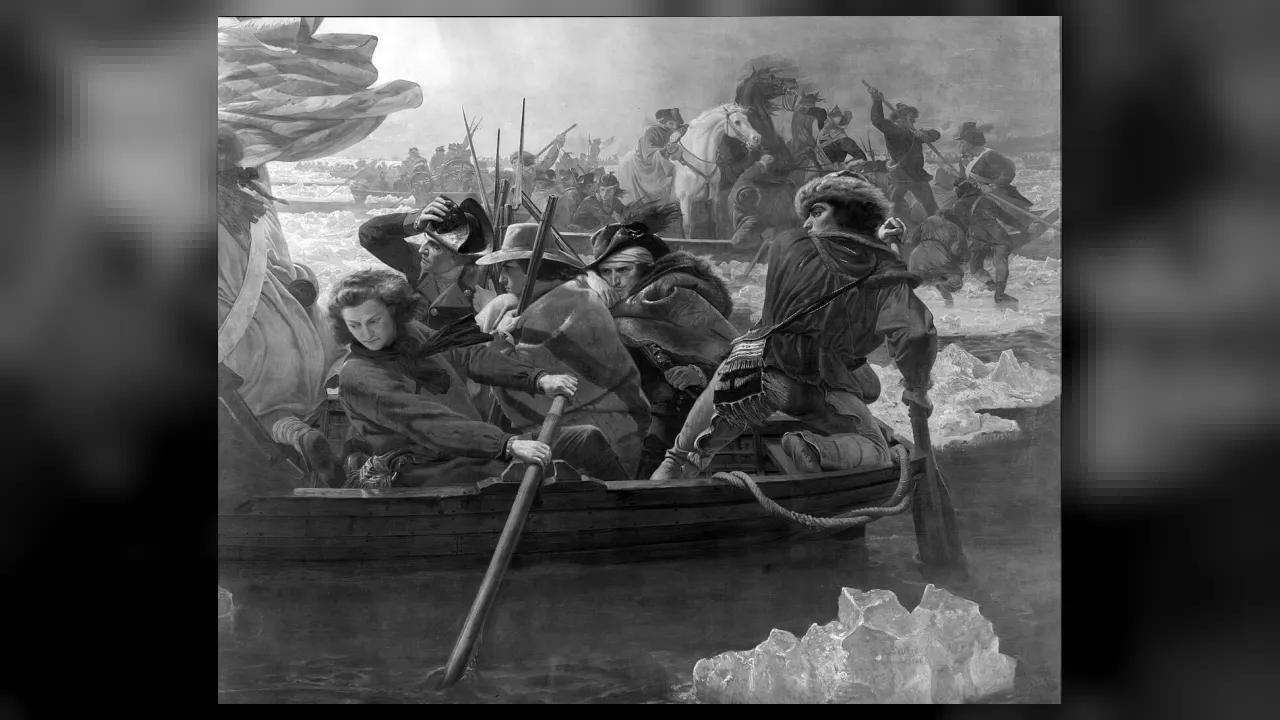
1. Which leader guided the American army across the icy Delaware River in 1776?
2. On what holiday night did the soldiers begin crossing the Delaware River?
🤯 Mind-Blowing Fact • Grade 2
General Washington chose the secret password 'Victory or Death' so his troops could recognize one another in the dark storm!
✨ Word Sparks (Grade 2 Glossary)
Tap 🔊 to hear
Durham boat
Long flat-bottomed wooden cargo boat for rivers
morale
How hopeful, confident, and brave a group feels
sleet
Icy mix of freezing rain and snow
🪝
How did tough fishermen from Massachusetts help save George Washington's army in a blizzard?
1
Sleet, Wind, and Floating Ice
Picture freezing stinging your cheeks on Christmas night, December 25, 1776. General George Washington stood on the snowy Pennsylvania riverbank watching blocks of white ice bump and scrape down the dark Delaware River.
2
Skilled Sailors Take the Oars
After months of losses, America's Continental Army badly needed a win before soldiers' enlistments ended on New Year's Day. Skilled fishermen from Marblehead, Massachusetts, steered long flat-bottomed through the swirling current.
3
Surprise Morning Victory at Trenton
All 2,400 soldiers crossed safely into New Jersey, marched nine snowy miles, and won the Battle of Trenton, lifting spirits across every colony!
1. Who steered the heavy wooden boats across the icy current for Washington's army?
2. Which New Jersey town did Washington's troops march nine miles to capture the next morning?
🤯 Mind-Blowing Fact • Grade 3
Two future U.S. presidents crossed the icy Delaware River together that night—General George Washington and eighteen-year-old Lieutenant James Monroe of Virginia!
✨ Word Sparks (Grade 3 Glossary)
Tap 🔊 to hear
enlistment
Agreed length of time serving in the army
nor'easter
Powerful East Coast storm with freezing northeast winds
garrison
Group of troops stationed to guard a town
🪝
Why was the American Revolution just days away from collapsing before Christmas night in 1776?
1
Times That Try Men's Souls
Shivering beside campfires in Pennsylvania in December 1776, General George Washington's Continental Army had shrunk after defeats around New York. Writer Thomas Paine captured the gloomy mood with famous words: 'These are the times that try men's souls.' Worse still, most soldiers' expired on December 31.
2
Durham Boats Against a Nor'easter
Washington planned a daring surprise crossing of the Delaware River on Christmas night, December 25, 1776. Just after sunset, a howling winter pelted McConkey's Ferry with snow and sleet while jagged ice floes jammed the three-hundred-yard-wide channel.
3
Glover's Marblehead Mariners
Colonel John Glover's regiment of diverse New England sailors—white, Black, and Indigenous mariners accustomed to stormy Atlantic seas—poled forty-to-sixty-foot iron-ore Durham boats back and forth until 3:00 a.m., ferrying 2,400 soldiers, horses, and eighteen artillery pieces without losing a single person.
4
Turning Point at Trenton
Marching nine miles south into Trenton at 8:00 a.m. on December 26, Washington's troops caught Colonel Johann Rall's Hessian completely off guard, inspiring thousands of Americans to re-enlist.
1. Which writer inspired Washington's troops in December 1776 with the words 'These are the times that try men's souls'?
2. Besides George Washington, which young Virginia officer who later became president crossed the Delaware that night?
🤯 Mind-Blowing Fact • Grade 4
Emanuel Leutze's famous 1851 painting Washington Crossing the Delaware at New York's Metropolitan Museum of Art is massive—over twenty-one feet wide and twelve feet tall!
✨ Word Sparks (Grade 4 Glossary)
Tap 🔊 to hear
auxiliary
Extra troops hired to assist another nation's army
artillery
Large heavy-wheeled cannons used in battle
sentries
Soldiers standing watch to warn of danger
🪝
Why did bad blizzard weather actually help George Washington pull off one of history's greatest surprise victories?
1
Retreat Across New Jersey
Five months after signing the Declaration of Independence in July 1776, American independence hung by a thread. Driven out of Long Island and Manhattan by British General William Howe, George Washington's exhausted Continental Army retreated across New Jersey into Pennsylvania with barely a fraction of its summer strength remaining and year-end enlistments days from expiring.
2
Three Columns, Only One Succeeds
Stationed across the Delaware River in Trenton, New Jersey, were roughly 1,400 German troops—known as Hessians—hired by Great Britain and commanded by Colonel Johann Rall. Washington devised a three-pronged night crossing for December 25, 1776. River ice grew so thick that two downstream Continental divisions could not get their boats across, yet Washington refused to abandon the main crossing nine miles north at McConkey's Ferry.
3
Iron-Ore Boats and Artillery Power
Colonel John Glover's Fourteenth Continental Regiment from Marblehead, Massachusetts, muscled wide-beamed Durham cargo boats and flat ferries carrying Colonel Henry Knox's vital eighteen cannons across the churning three-hundred-yard current. Though three hours behind schedule, Washington pressed nine miles south through driving hail so fierce it dampened gunpowder—prompting him to order bayonets and Knox's booming to lead the way.
4
Momentum Reborn in Ten Days
Because the howling blizzard convinced Hessian no army could march that morning, Washington's attack at 8:00 a.m. on December 26 overwhelmed Trenton in under an hour. Followed days later by another victory at Princeton, those 'Ten Crucial Days' rescued the Revolution.
1. How did the fierce winter storm unexpectedly help Washington's troops at Trenton?
2. Whose eighteen cannons played a decisive role after wet snow dampened many soldiers' muskets?
🤯 Mind-Blowing Fact • Grade 5
Before crossing back to Pennsylvania earlier in December 1776, Washington wisely ordered his troops to collect or hide every boat for seventy miles along the Delaware River so the British Army could not chase him across!
✨ Word Sparks (Grade 5 Glossary)
Tap 🔊 to hear
amphibious
Combining travel over water with action on land
thwarted
Blocked or prevented from completing a plan
stentorian
Extremely loud, clear, and booming in sound
🪝
How did ten winter days along the Delaware River transform a retreating rebel force into an enduring Continental Army?
1
Strategic Crisis of December 1776
By mid-December 1776, British Commander-in-Chief Sir William Howe believed the American rebellion was practically extinguished. Having captured New York City, Fort Washington, and Fort Lee, Crown forces pushed George Washington's dwindling Continental Army southwest across New Jersey until only the Delaware River separated them. Foresightedly ordering every watercraft along seventy miles of riverbank seized or hidden, Washington bought brief breathing room—yet most Continental enlistments expired at midnight on December 31.
2
Operation on Christmas Night
Encamped on the New Jersey side at Trenton stood three regiments of disciplined Hessian soldiers—German troops from Hesse-Cassel commanded by Colonel Johann Rall. Ordering Thomas Paine's newly printed essay The American Crisis read to shivering brigades on December 23, Washington staked everything on a nocturnal strike on December 25. While thick ice floes subordinate crossings by Generals James Ewing and John Cadwalader downstream, Washington's 2,400-man main force assembled at McConkey's Ferry as a violent nor'easter unleashed sleet and snow.
3
Logistics of Durham Boats and Marblehead Sailors
Success hinged on Colonel Henry Knox's voice directing loading ramps and Colonel John Glover's integrated Fourteenth Continental Regiment of Marblehead mariners—including free Black seamen and Massachusetts fishermen skilled at poling forty-to-sixty-foot flat-bottomed Durham iron boats through jagged ice. Completing the crossing at Johnson's Ferry by 3:00 a.m. on December 26—three hours behind schedule—Washington split his column under Generals Nathanael Greene and John Sullivan for a nine-mile march south.
4
Victory at Trenton and the Ten Crucial Days
Striking Trenton from north and west at 8:00 a.m., Knox positioned artillery atop King and Queen Streets, sweeping Hessian formations before they could rally. Within forty-five minutes, Continental troops captured roughly nine hundred prisoners and vital supplies while suffering minimal casualties, including young Virginia Lieutenant James Monroe, who survived a shoulder wound while charging a Hessian cannon.
5
Legacy in History and Art
Recrossing the Delaware days later to outmaneuver Lord Cornwallis at Assunpink Creek and triumph at Princeton on January 3, 1777, Washington shattered British assumptions of quick victory. Though Emanuel Leutze's 1851 painting took artistic liberties—showing daylight skies and a 1777 Stars and Stripes—it immortalized the resolve that preserved American independence.