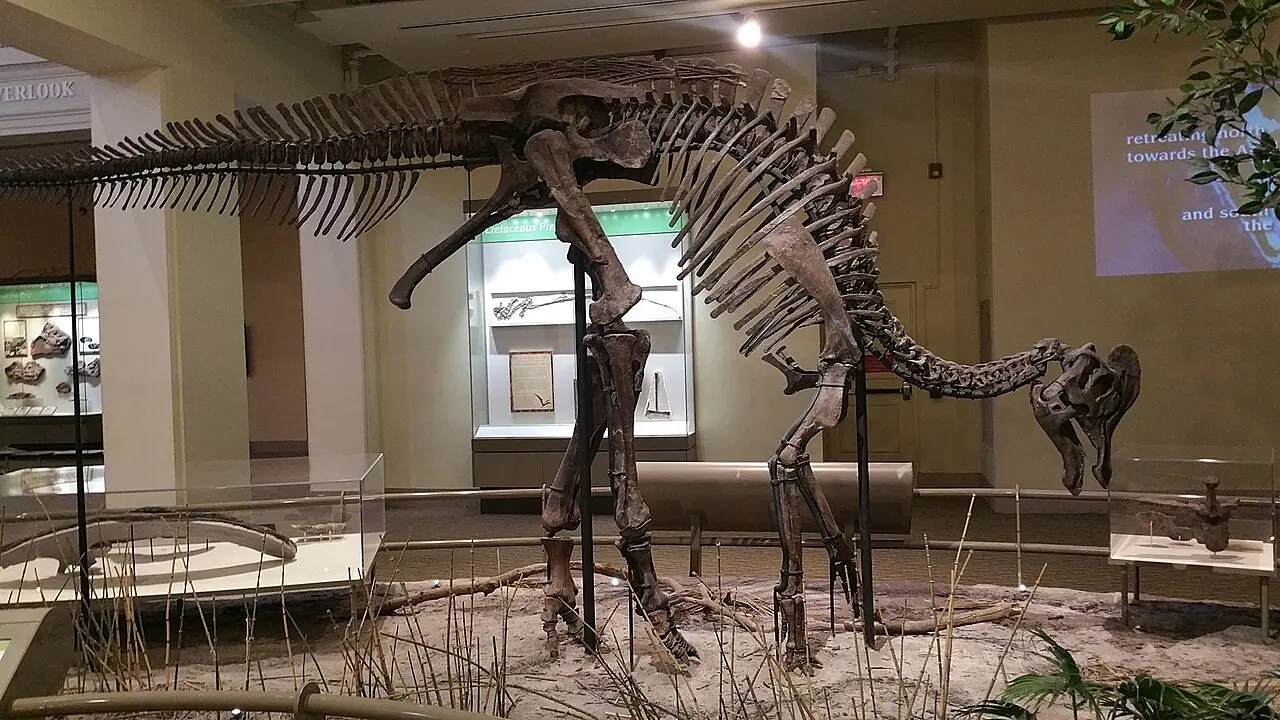
1. What happened inside the tall rounded crest on Corythosaurus's head?
2. What kind of mouth did Corythosaurus have at the front of its snout?
🤯 Mind-Blowing Fact • Grade 2
Two priceless Corythosaurus skeletons sank to the bottom of the Atlantic Ocean in 1916 during World War I—and still sit on the seafloor today!
✨ Word Sparks (Grade 2 Glossary)
Tap 🔊 to hear
Cassowary
Large flightless bird wearing a tall crest
Megaphone
Horn shape that makes voices carry farther
Hadrosaur
Plant-eating dinosaur with a wide duck bill
🪝
Why did scientists once think Corythosaurus wore a snorkel for swimming underwater?
1
Helmet Lizard of Canada
Bellowing softly through cypress trees in ancient Alberta 76 million years ago walks a 30-foot Corythosaurus! Weighing four tons, its name means 'helmet lizard' because its tall, plate-shaped crest looked like a Greek Corinthian helmet—and its species name matches the modern bird!
2
Not an Underwater Snorkel
Long ago, people guessed Corythosaurus used its crest as an air tank or snorkel underwater. When scientists looked closer, they found zero hole at the top—instead, looping nose tunnels turned its crest into a musical !
3
Pebbled Mummy Skin
The very first skeleton found in 1912 still had large patches of fossilized pebble-textured skin across its sides and tail!
1. Why couldn't Corythosaurus use its tall crest like a scuba snorkel?
2. Which modern crested bird inspired Corythosaurus's species name, casuarius?
🤯 Mind-Blowing Fact • Grade 3
Scientists used 3D-printed models of Corythosaurus nasal tubes to hear low, foghorn-like calls that could travel for miles through dense Cretaceous forests!
✨ Word Sparks (Grade 3 Glossary)
Tap 🔊 to hear
Frequency
How high or low a musical pitch sounds
Conifer
Cone-bearing evergreen tree like pine or redwood
Dental Battery
Hundreds of teeth packed into grinding blocks
🪝
What did CT scans of Corythosaurus's brain and inner ears reveal about its musical superpowers?
1
Barnum Brown's Dinosaur Mummy
In 1912, legendary fossil hunter Barnum Brown uncovered an extraordinary 30-foot skeleton along Alberta's Red Deer River. Not only was the skull crowned by a dinner-plate-shaped crest, most of its ribcage, belly, and tall swimming-style tail were still wrapped in polygonal skin impressions!
2
Tuned Ears and Booming Crests
Using hospital CT scanners in 2008, Lawrence Witmer and David Evans peered inside Corythosaurus skulls from youngsters to adults. Delicate inner-ear tubes proved Corythosaurus heard low-pitched booming sounds best—the exact deep frequencies echoed by its looping nasal crest!
3
Growing Into Its Voice
Babies hatched with flat heads and squeaky voices! Only as teenagers neared adulthood did the hollow crest puff tall, giving big adults deeper, louder calls and eye-catching profiles.
4
Chewing Conifers With 600 Teeth
Packed inside its cheeks sat dental batteries holding hundreds of diamond-shaped teeth—letting Corythosaurus grind tough needles, seeds, and woody twigs preserved right inside one fossil stomach!
1. How did Corythosaurus's inner ears match its hollow head crest?
2. When did a young Corythosaurus grow its full, tall helmet crest?
🤯 Mind-Blowing Fact • Grade 4
What early scientists mistook for swimming 'webbed hands' on Corythosaurus mummies turned out to be tough, bouncy hoof-mitten pads built for walking on land!
✨ Word Sparks (Grade 4 Glossary)
Tap 🔊 to hear
Lambeosaurine
Subgroup of duck-billed dinosaurs with hollow crests
Bioacoustics
Science of how animals make and hear sounds
Cochlear
Spiral inner-ear tube that senses sound pitches
🪝
How did skin mummies, fossilized meals, and sunken ships make Corythosaurus a legend of paleontology?
1
Woodland Musician of Dinosaur Park
Between 77 and 75.7 million years ago, four-ton herds of Corythosaurus casuarius browsed across the lush coastal forests of southern Alberta. Walking comfortably on all fours while grazing or striding swiftly on muscular hind legs, this nine-meter ('hollow-crested') hadrosaur cropped twigs and foliage with a keratin-sheathed duck bill before pulverizing tough fibers across grinding batteries of over 600 interlocking teeth.
2
Debunking Webbed Hands and Snorkels
When Barnum Brown discovered the mummified holotype in 1912, fleshy pads preserved around its front fingers looked like 'mittens,' inspiring decades of paintings showing Corythosaurus paddling lakes using its crest as a snorkel! Modern biomechanics overturned both myths: those pads were weight-bearing walking cushions like camel feet, ossified tail tendons stiffened its spine for land travel, and fossilized gut contents held terrestrial conifer needles, seeds, and twigs rather than water lilies.
3
Bioacoustics in 3D
CT scans by David Evans and Lawrence Witmer mapped twin S-looped nasal airways ascending into separate left and right pockets inside the tall cockscomb crest before plunging down to the windpipe. Paired with elongated ducts in the inner ear, these chambers amplified deep contact calls that bent around tree trunks without scattering!
4
Shipwrecked Treasures of the SS Mount Temple
In December 1916, Charles Sternberg shipped two magnificent skin-wrapped Corythosaurus specimens toward Britain aboard the merchant steamer SS Mount Temple, which was sunk in the North Atlantic—leaving 76-million-year-old fossils resting 4,000 meters beneath the sea!
1. Why are low-frequency booming calls especially useful inside thick forests?
2. What proved Corythosaurus foraged on land forests rather than eating soft underwater pond weeds?
🤯 Mind-Blowing Fact • Grade 5
By measuring dozens of skulls mathematically in 1975, Peter Dodson proved that a whole group of 'dwarf duckbills' called Procheneosaurus were actually teenage Corythosaurus and Lambeosaurus whose crests hadn't popped up yet!
✨ Word Sparks (Grade 5 Glossary)
Tap 🔊 to hear
Diverticula
Branching air pouches off the nasal passage
Facultative
Able to switch postures depending on activity
Lagena
Hearing tube inside reptile and bird ears
🪝
How did computed tomography, ontogenetic allometry, and gut-content taphonomy revolutionize our view of Corythosaurus?
1
Barnum Brown's 1912 Holotype Mummy
Excavated in 1912 by Barnum Brown along the Red Deer River in Alberta's lower Dinosaur Park Formation and named Corythosaurus casuarius in 1914, specimen AMNH 5240 remains one of vertebrate paleontology's crown jewels. Measuring nine meters (30 feet) long and weighing roughly four metric tons, the articulated skeleton preserved vast expanses of non-overlapping polygonal basement scales studded with conical limpet-like feature shields across the flanks, abdomen, and ossified-tendon-stiffened tail.
2
Unifying Seven 'Species' via Ontogeny
Because juvenile, subadult, and adult lambeosaurines differ radically in crest size and shape, early 20th-century researchers erected seven separate species across Corythosaurus and 'Procheneosaurus.' In 1975, Peter Dodson applied bivariate morphometrics across dozens of skulls, proving tiny round-headed 'cheneosaurs' were simply juveniles that underwent explosive positive allometry at sexual maturity—trimming valid species down to earlier Corythosaurus casuarius (~76.6–75.9 MYA) and slightly younger, steeper-crested C. intermedius (~75.8–75.7 MYA).
3
Endocranial CT and Coupled Bioacoustics
In 2008–2009, David Evans, Lawrence Witmer, and Ryan Ridgely performed high-resolution CT reconstructions of ontogenetic Corythosaurus skulls. Paired premaxillary-nasal looped cleanly through spacious lateral pockets inside the helmet before coalescing into a common median chamber above the braincase. Simultaneously, elongated (cochlear) ducts inside the inner ear confirmed acute sensitivity to low-frequency vocalizations generated long before adult crests finished inflating, paired with large cerebral hemispheres supporting complex herd behavior!
4
Terrestrial Diet and Mitten-Pad Forefeet
Soft-tissue 'mittens' enveloping digits II–IV on forelimb mummies—long misinterpreted as aquatic paddles—were re-identified as weight-bearing ungual pads for quadrupedalism, corroborated by abdominal cololites packed with diced conifer needles, deciduous foliage, seeds, and woody angiosperm twigs pulverized by 600-tooth dental batteries.
5
Resting on the Atlantic Abyssal Plain
Two additional skin-bearing Corythosaurus skeletons collected by Levi and Charles Sternberg still rest 4,375 meters underwater in the North Atlantic after German raider SMS Möwe sank the cargo ship SS Mount Temple in December 1916.