1. What everyday job does copper metal do inside almost every house and school?
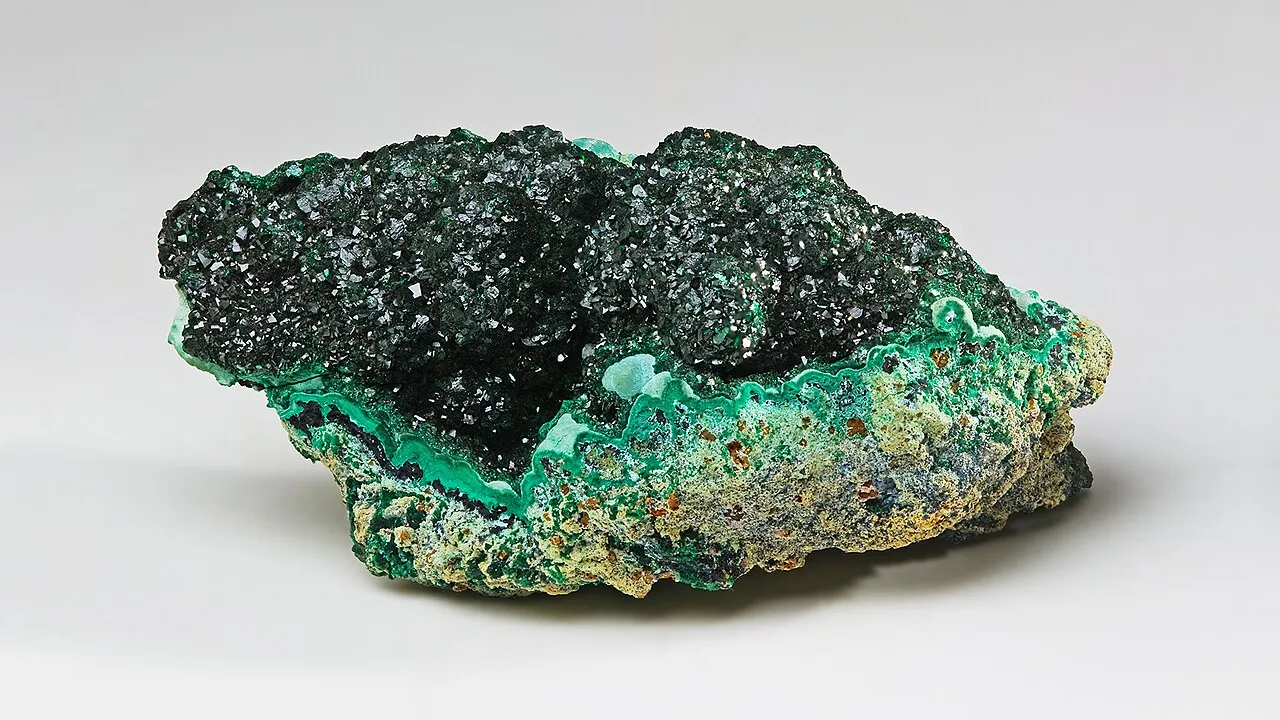
2. Why do miners nickname the copper mineral bornite 'peacock ore'?
🤯 Mind-Blowing Fact • Grade 2
Around Lake Superior in Michigan, Indigenous miners hammered pure native copper out of ancient lava rocks more than 7,000 years ago!
✨ Word Sparks (Grade 2 Glossary)
Tap 🔊 to hear
bronze
Strong metal mix of copper and tin
alloy
Two or more metals melted together
furnace
An enclosed super-hot chamber for melting metal
🪝
How did humans use copper rocks to step out of the Stone Age?
1
Humanity's First Metal
Nearly ten thousand years ago, Stone Age toolmakers found heavy reddish lumps of pure native copper along riverbanks and in Michigan's Upper Peninsula. Unlike brittle flint rocks that chipped, copper could be hammered into tough knives, hooks, and bowls!
2
Creating Bronze!
Later, ancient metalworkers melted colorful copper ores in hot and mixed copper with a little tin. Presto—they invented , a super-hard golden that gave its name to the entire Bronze Age!
3
Two Reddish Metals Alone
Almost every metal on Earth is silvery gray or white. Only two pure metals show rich warm color: yellow gold and reddish-orange copper!
1. What famous strong metal did ancient people invent by mixing melted copper with tin?
2. Near which Great Lake did Indigenous people mine pure native copper over 7,000 years ago?
🤯 Mind-Blowing Fact • Grade 3
Copper can be recycled endlessly without losing quality—experts estimate that much of the copper mined in ancient Roman times is still melted into wires and pipes used today!
✨ Word Sparks (Grade 3 Glossary)
Tap 🔊 to hear
chalcopyrite
Brassy copper-iron-sulfur mineral, Earth's main copper ore
iridescent
Shining with shifting rainbow-like metallic colors
generator
Machine spinning magnets and copper to make electricity
🪝
Which brassy copper mineral supplies more of the world's copper than all others combined?
1
Meet Chalcopyrite, King of Copper Ore
Spot a brassy-yellow chunk of rock glittering beside fool's gold and look closer! (CuFeS2)—made of copper, iron, and sulfur—is Earth's number-one copper ore. Unlike harder pyrite cubes (hardness 6.5), chalcopyrite is much softer (hardness 3.5 to 4), so a steel pocketknife scratches it easily!
2
A Family of Colorful Ores
Copper paints rocks in wild colors! Deep underground live brassy and purple bornite ('peacock ore'). Near the surface where rain and air reach the vein, copper ores weather into ruby-red cuprite, electric-blue azurite, and swirled-green malachite!
3
Inside Wind Turbines and Electric Cars
A typical gas car holds about 50 pounds of copper wire, while a battery-electric car uses nearly 180 pounds—and one giant offshore wind turbine packs tons of coiled copper inside its !
4
Infinitely Recyclable
Copper can be melted down and reused over and over forever without losing a single bit of its electrical superpower!
1. How can a geologist quickly tell brassy chalcopyrite copper ore apart from pyrite (fool's gold)?
2. Why do wind turbines and electric cars need large amounts of copper?
🤯 Mind-Blowing Fact • Grade 4
Octopuses and horseshoe crabs have bright blue blood instead of red blood because they carry oxygen using copper atoms instead of iron atoms!
✨ Word Sparks (Grade 4 Glossary)
Tap 🔊 to hear
porphyry deposit
Giant fractured magma root speckled with copper
brass
Golden musical alloy of copper and zinc
Cyprus
Mediterranean island that gave copper its name
🪝
Why are the biggest copper mines on Earth lined up along the Pacific Ocean's 'Ring of Fire'?
1
Subduction Volcanoes Brew Porphyry Copper
Plot the world's giant copper mines—in Chile's Atacama Desert, Peru, Arizona, and Utah—on a tectonic map and a dramatic pattern jumps out! When dense oceanic crust dives beneath a continent along a subduction zone, seawater and sulfur rise into overlying magma chambers three miles beneath towering volcanoes. Cracking rock fills with spiderwebs of quartz, chalcopyrite, and bornite called 'porphyry copper deposits,' supplying over sixty percent of humanity's copper!
2
Why Coins Use Cupronickel and Brass
From ancient Mediterranean island —whose Latin name 'aes Cyprium' gave us the word 'copper'—to modern U.S. Mint coins, copper alloys are everywhere! Mix copper with zinc to get golden musical-instrument ; mix copper with nickel to get corrosion-resistant 'silver-colored' U.S. nickels, dimes, and quarters!
3
Blue Ridge Native Copper in Virginia
Along Virginia's Blue Ridge Mountains inside Shenandoah National Park's Catoctin metabasalt lavas, ancient gas pockets preserved nuggets of native copper coated in green malachite and red cuprite.
4
Essential Trace Element for Life
Trace copper isn't just for machines—humans need tiny amounts of dietary copper for healthy blood vessels, while horseshoe crabs and octopuses use copper-rich 'hemocyanin' that turns their blood bright blue! In school mineral kits, students distinguish brassy chalcopyrite copper ore by its dark greenish-black streak, softness against steel, and colorful rainbow tarnish.
1. Which plate-tectonic setting creates giant 'porphyry copper' deposits like those in Chile and Arizona?
2. Where did the English word 'copper' and chemical symbol 'Cu' originate?
🤯 Mind-Blowing Fact • Grade 5
During the final electrorefining step that purifies copper to 99.99 percent for electrical wires, trace gold, silver, and platinum hidden inside the copper ore settle neatly to the bottom of the tank!
✨ Word Sparks (Grade 5 Glossary)
Tap 🔊 to hear
chalcocite
Rich copper-sulfide mineral containing nearly eighty percent copper
froth flotation
Separating crushed sulfide ore using rising air bubbles
electrorefining
Purifying metal to 99.99 percent using electric current
🪝
How do engineers refine 0.5-percent copper rock into 99.99-percent pure wire required for high-speed electronics?
1
Porphyry Stockworks and Supergene Enrichment Blankets
At Chuquicamata and Escondida in Chile or Bingham Canyon in Utah, average porphyry ore contains less than one percent copper! Nature often gives miners a geochemical boost called a 'supergene enrichment blanket': when oxygenated rainwater oxidizes near-surface pyrite and chalcopyrite (CuFeS2, 34.6% Cu), dissolved Cu2+ ions trickle downward below the water table. There, in oxygen-free rock, copper ions replace iron inside deeper sulfides to precipitate sooty gray (Cu2S—nearly 80% pure copper by weight!).
2
Froth Flotation, Smelting, and Electrorefining
How do metallurgists extract copper from crushed rock? First, '' stirs finely ground ore in water with pine-oil reagents so hydrophobic chalcopyrite and bornite (Cu5FeS4) cling to rising air bubbles while waste silicate sand sinks! Flash smelting produces 98.5-percent 'blister copper,' and finally electrolytic refining suspends cast anodes in copper-sulfate baths so electric current plates 99.99-percent 'cathode copper' onto pure starter sheets—while precious gold and silver drop below as valuable anode slime!
3
Band-Structure Physics of Reddish Luster
Among pure elemental metals, only copper (atomic number 29) and gold display strong non-silver colors—alongside pale-gold cesium. Copper's filled 3d electron subshell sits just 2.1 electron-volts below its Fermi conduction level, absorbing blue and green photons above that energy threshold while reflecting warm reddish-orange wavelengths!
4
Keweenaw Flood Basalt Native Copper
Around 1.1 billion years ago in North America's Midcontinent Rift, hydrothermal brines flushed upward through permeable amygdaloidal basalt tops in Michigan, precipitating single masses of pure native copper weighing up to 500 tons!
5
Contact-Kill Antimicrobial Surfaces
Registered by environmental health agencies as naturally antimicrobial, bare copper-alloy hospital doorknobs and bedrails release Cu+ and Cu2+ ions that rupture bacterial membranes on contact within two hours. Recycling retired copper wiring requires roughly 85 percent less energy than smelting primary sulfide ore, making urban copper recovery vital to clean-energy grids worldwide.