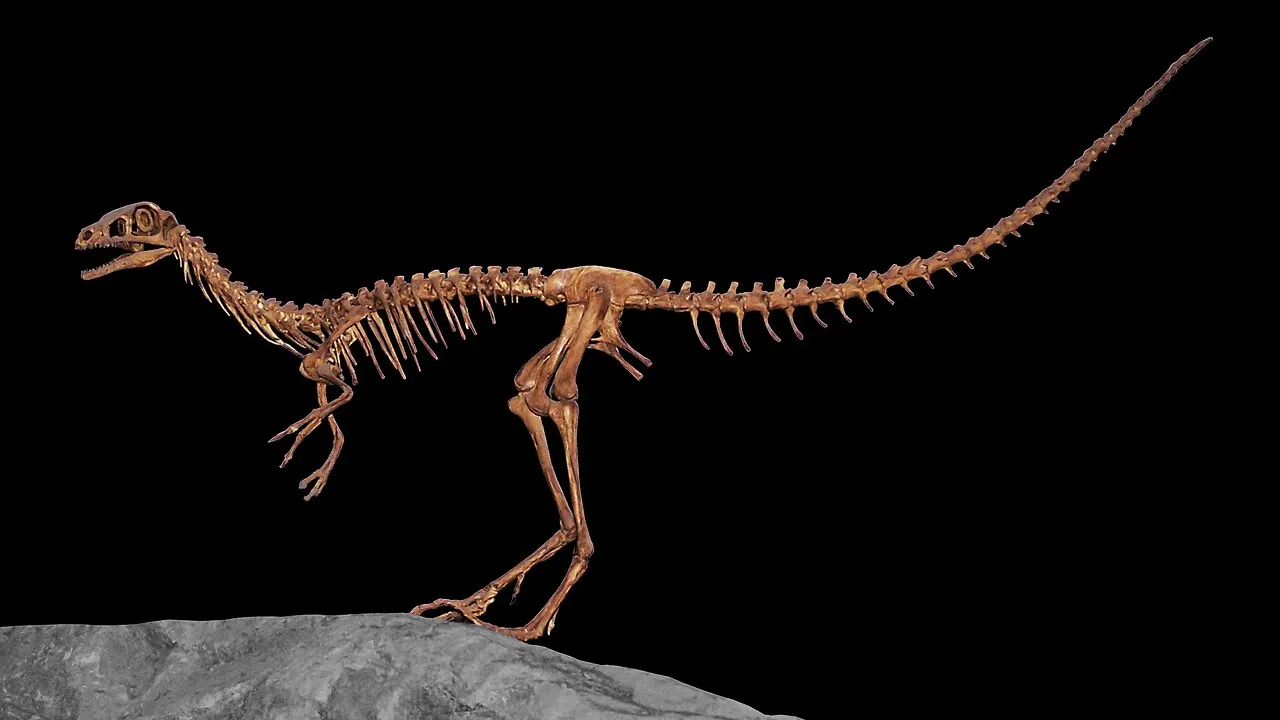
⚡ Survival SuperpowerSix-pound island sprinter preserved in lagoon stone with a whole lizard inside its belly
🤯 Mind-Blowing Fact • Grade 1
Scientists can still see the tiny skeleton of a whole lizard preserved right inside the belly of the German Compsognathus fossil!
✨ Word Sparks (Grade 1 Glossary)
Tap 🔊 to hear
Lagoon
Calm shallow pool of warm ocean water
Ribcage
Curved basket of chest bones protecting inside organs
Dart
Run suddenly and quickly from spot to spot
🪝
Did you know some real dinosaurs weighed no more than a house cat?
1
Tiny Feet on Sunny Beaches!
Pitter, patter! Across a warm white sandy beach a tiny, speedy hunter! Not every dinosaur grew huge—this little runner weighed less than a house cat! Say hello to Compsognathus.
2
Chasing Fast Lizards
Long back legs and a whip-thin balancing tail helped it zig and zag! Sharp little teeth snapped up fast lizards and crunchy bugs.
3
Fossil Tummy Surprise
Inside its fossil sat the tiny bones of its very last lizard lunch!
2. What amazing clue was preserved right inside its fossilized stomach?
🤯 Mind-Blowing Fact • Grade 2
For more than a hundred years after 1861, Compsognathus held the world record as the smallest known non-avian dinosaur on Earth!
✨ Word Sparks (Grade 2 Glossary)
Tap 🔊 to hear
Elegant
Slender, graceful, and finely shaped in build
Limestone
Smooth pale rock formed on calm sea bottoms
Tropical
Warm and sunny all year near shallow seas
🪝
Why did someone once mistake Compsognathus's last lunch for a baby dinosaur?
1
Life on Tropical European Islands
Imagine Europe one hundred fifty million years ago as a chain of sunny islands surrounded by sparkling blue lagoons! Darting through scrubby bushes in Germany and France lived Compsognathus, whose name means jaw.
2
Solving the Belly Mystery
When doctor Joseph Oberndorfer showed off the delicate German skeleton in 1859, tiny bones sat curled inside its stomach! One scientist guessed Compsognathus gave birth to live babies instead of laying eggs. Decades later, paleontologist Franz Nopcsa zoomed in closely and proved those tiny bones belonged to a fast-running lizard swallowed nearly whole!
3
Neighbors With the First Bird
Flying between the exact same lagoon islands lived Archaeopteryx, the famous early feathered bird!
1. What famous early feathered bird shared the exact same German islands with Compsognathus?
2. Why were the tiny bones inside the German Compsognathus fossil so important?
🤯 Mind-Blowing Fact • Grade 3
One fossil skeleton of Archaeopteryx was actually mislabeled in a museum drawer as a Compsognathus for years until someone noticed faint feather marks in the stone!
Family of small, swift coelurosaurian meat-eating dinosaurs
Juvenile
Young animal that has not finished growing
🪝
How did tiny Compsognathus give Thomas Henry Huxley the very first clue that birds evolved from dinosaurs?
1
Twin Skeletons From Lagoon Mud
In the 1860s, quarry workers slicing smooth limestone slabs in Bavaria, Germany, uncovered two astonishing fossils from the exact same 150-million-year-old lagoons: feathered Archaeopteryx and sleek, hollow-boned Compsognathus longipes!
2
Huxley's Brilliant Connection
British biologist Thomas Henry Huxley studied both skeletons side by side and gasped! Take away the wing feathers on Archaeopteryx, and its ankles, three-toed feet, S-curved neck, and hollow bones looked almost identical to Compsognathus! In 1868, Huxley boldly proposed for the first time in history that modern birds evolved from small dinosaurs.
3
Bigger French Adult Found in 1971
For a century, books called Compsognathus chicken-sized based on the two-foot German —until a four-foot adult skeleton turned up in southern France in 1971!
4
Fuzzy Coat From Cousin Sinosauropteryx
Close cousin Sinosauropteryx found in China preserved reddish-orange fuzzy protofeathers with a striped raccoon-like tail!
1. Why did a museum accidentally label an Archaeopteryx skeleton as Compsognathus?
2. Why did scientists double their size estimate for adult Compsognathus in the 1970s?
🤯 Mind-Blowing Fact • Grade 4
In 2017, scientists realized the lizard preserved inside the German Compsognathus stomach was a brand-new species to science and named it Schoenesmahl—German for 'beautiful meal'!
✨ Word Sparks (Grade 4 Glossary)
Tap 🔊 to hear
Musculoskeletal
Combined system of bones, joints, and muscles
Longipes
Latin species name meaning having long feet
Sediment
Fine mud or sand settling underwater into layers
🪝
Did Compsognathus have swimming flippers on its hands, or was that a 1970s fossil illusion?
1
Solving the Flipper Mistake
When paleontologists first examined the four-foot French skeleton from Canjuers in 1972, ripples in the surrounding limestone beside its forearms fooled observers into claiming Compsognathus had webbed flippers for swimming across lagoons! Careful re-examination by John Ostrom in 1978 proved those marks were simply natural ripples—confirming Compsognathus was a nimble land runner with grasping hands.
2
Counting Fingers: Two or Three?
For generations, museum charts stated Compsognathus had only two functional fingers like Tyrannosaurus Rex because tiny finger bones drifted slightly in lagoon mud after burial. Closer comparisons with articulated compsognathids revealed three clawed digits on each hand: two large grasping fingers plus a smaller third outer finger!
3
Forty-Miles-Per-Hour Computer Sprint
In 2007, biomechanist Bill Sellers built computer models testing top speeds across theropods. Weighing just three kilograms with long shins and ankles (`` means 'long-footed'), Compsognathus clocked nearly forty miles per hour—faster than an ostrich!
4
A Brand-New Lizard Named From Its Stomach!
In 2017, paleontologist Jack Conrad re-examined the tiny lizard skeleton preserved inside the German Compsognathus belly and discovered it belonged to a previously unknown species—naming it Schoenesmahl dyspepsia, meaning 'beautiful meal hard to digest' because its long tail had folded neatly inside the dinosaur's stomach!
1. What caused a scientist in 1972 to mistakenly suggest the French Compsognathus had swimming flippers?
2. What witty scientific name did researchers give the lizard inside the German Compsognathus stomach in 2017?
🤯 Mind-Blowing Fact • Grade 5
Compsognathus's Chinese cousin Sinosauropteryx made history twice: in 1996 as the first non-bird dinosaur found with fossilized fuzzy feathers, and in 2010 as the first dinosaur ever to have its real ginger-striped colors decoded!
✨ Word Sparks (Grade 5 Glossary)
Tap 🔊 to hear
Lagerstätte
Rare fossil deposit preserving extraordinary soft or tiny details
Hypersaline
Extra-salty lagoon water preventing decay and scavengers
Melanosomes
Microscopic pigment structures revealing real fossil feather colors
🪝
How did hypersaline Tethyan lagoons preserve Compsognathus down to its stomach contents and transform evolutionary biology?
1
Konservat-Lagerstätten of the Jurassic Archipelago
One hundred fifty million years ago during the Tithonian stage of the Late Jurassic, shallow subtropical seas covered much of Europe, dotting Bavaria and southeastern France with arid coral-ringed islands. Storm surges occasionally washed terrestrial island animals into stagnant, , oxygen-free lagoon basins—creating Konservat-Lagerstätten ('conservation deposits') at Solnhofen and Canjuers where lack of scavengers preserved delicate skeletons intact. Described by Johann Andreas Wagner in 1861 (`Compsognathus longipes`), only two indisputable skeletons exist: the 89-centimeter German juvenile and the 125-centimeter, three-kilogram French adult.
2
Catalyst for Darwinian Evolutionary Debates
Published just two years after Charles Darwin's On the Origin of Species, `Compsognathus` and `Archaeopteryx` handed Thomas Henry Huxley empirical transitional anatomy. In his landmark 1868 lecture On the Animals Which Are Most Nearly Intermediate Between Birds and Reptiles, Huxley cited `Compsognathus`'s mesotarsal ankle hinge, tridactyl pes, and avian neck curvature to establish dinosaur-bird ancestry.
3
Multibody Locomotor Simulation
Evolutionary robotics models by William Sellers and Phillip Manning applied genetic algorithms to reconstruct hindlimb muscle activations for `Compsognathus`, computing a peak running velocity of 17.8 meters per second (nearly 40 mph)—necessary to outmaneuver swift sphenodontians and scleroglossan lizards like `Schoenesmahl`.
4
Integument of Compsognathidae
While neither European limestone slab preserved plumage imprints, Early Cretaceous Chinese compsognathids (`Sinosauropteryx prima`, 1996—the first non-avian dinosaur ever discovered with fossilized protofeathers—and `Juravenator` from Germany showing both scales and filaments) indicate basal coelurosaurs combined scaly tails or legs with insulating filamentous down.
5
First Color Reconstruction in Paleontology
In 2010, scanning electron microscopy of in `Sinosauropteryx` unlocked chestnut-ginger coloration, elevating humble compsognathids into icons of modern molecular paleobiology.
1. Why did the Solnhofen and Canjuers lagoons preserve delicate skeletons like Compsognathus and Archaeopteryx without scavengers scattering the bones?
2. Why were Compsognathus and Archaeopteryx so pivotal in the 1860s right after Charles Darwin published On the Origin of Species?