🇺🇸 U.S. HISTORY
🏛️ 2nd U.S. State • Keystone State Commonwealth
VA History & Social Science SOL K.1, 1.2, 2.4, VS.1–VS.10, USI & USII
Commonwealth of Pennsylvania
Liberty Bell Echoes, Independence Hall, and Keystone Bridges
Grade 2 • Developing • 98 words
⏳ Era / StatehoodDecember 12, 1787 (2nd U.S. State)
🗺️ Region / CapitalMid-Atlantic / Northeast Region • Capital: Harrisburg
📜 Key MilestoneDeclaration of Independence, U.S. Constitution & Gettysburg
⚡ Historical SparkBirthplace of both the Declaration of Independence (1776) and the U.S. Constitution (1787) in Philadelphia
🤯 Mind-Blowing Fact • Grade 1
Pittsburgh, Pennsylvania has 446 bridges—more bridges than Venice, Italy or almost any other city on Earth!
✨ Word Sparks (Grade 1 Glossary)
Tap 🔊 to hear
liberty
Freedom to live and choose fairly
keystone
Center wedge stone locking an arch together
bronze
Strong reddish-brown metal used for bells
🪝
Where can you see a famous bronze bell with a giant crack up its side?
1
Ring the Liberty Bell!
Clang, ring! Step inside historic Philadelphia in Pennsylvania to spot the famous cracked Bell! Leaders signed America's freedom papers right next door.
2
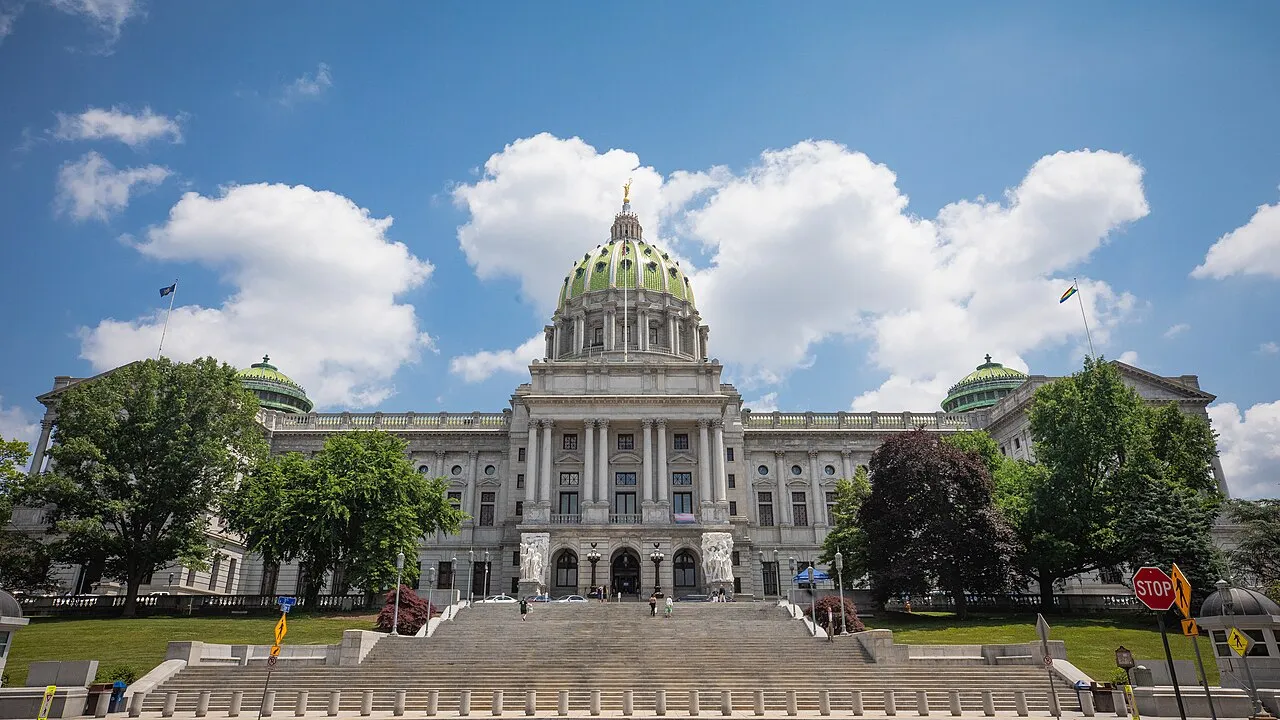
Penn's Woods and Harrisburg
Tall oak and pine trees shade green mountains! Pennsylvania means 'Penn's Woods.' Along the wide Susquehanna River sits Harrisburg, the state capital.
3
Bridges and Sweet Chocolate
Yellow steel bridges cross three rivers in Pittsburgh! In Hershey, sweet cocoa aromas drift from America's famous chocolate town.
1. In which Pennsylvania city can visitors see Independence Hall and the Liberty Bell?
2. Which city is the state capital of the Commonwealth of Pennsylvania?
🤯 Mind-Blowing Fact • Grade 2
America's first public zoo, first lending library, and first hospital were all started in Philadelphia—many with help from Benjamin Franklin!
✨ Word Sparks (Grade 2 Glossary)
Tap 🔊 to hear
declaration
Bold public announcement shared with everyone
founder
Person who helps start a new community
quaker
Member of a peaceful religious group
🪝
Why is Pennsylvania called 'The Keystone State' of the original thirteen colonies?
1
Locking the Arch Together
Imagine building a stone arch—the middle stone at the very top holds every other stone in place! Sitting right in the middle of the thirteen colonies, the Commonwealth of Pennsylvania earned that proud nickname, the Keystone State.
2
William Penn and Two Founding Papers
Founded in 1681 by peacemaker William Penn as 'Penn's Woods,' Philadelphia welcomed neighbors of many faiths. Inside red-brick Independence Hall, signed both the of Independence in 1776 and the U.S. Constitution in 1787! Pennsylvania ratified second on December 12, 1787.
3
Rivers, Steel, and Harrisburg
Lawmakers meet in Harrisburg along the Susquehanna River, while western rivers join in Pittsburgh to start the mighty Ohio River!
2. Which two foundational American documents were signed inside Philadelphia's Independence Hall?
🤯 Mind-Blowing Fact • Grade 3
Every February 2 in Punxsutawney, Pennsylvania, crowds gather at dawn to see whether famous groundhog Punxsutawney Phil spots his shadow!
✨ Word Sparks (Grade 3 Glossary)
Tap 🔊 to hear
address
Important formal speech delivered to a crowd
treaty
Peaceful written agreement between two nations
forge
Furnace workshop heating iron into strong steel
🪝
How did snowy Valley Forge, Gettysburg's rolling fields, and Pittsburgh's three rivers shape America?
1
Woods, Ridges, and Three Port Corners
Cross the Commonwealth of Pennsylvania and discover how water connects a forested mountain state to the world! Ships reach the Atlantic down the Delaware River from Philadelphia, freighters sail Lake Erie at Erie in the northwest, and the Allegheny and Monongahela Rivers meet at Pittsburgh to form the Ohio River!
2
Lenape Treaties and Penn's Holy Experiment
Lenni-Lenape, Susquehannock, Shawnee, and Haudenosaunee peoples lived across these valleys for centuries. Arriving in 1682, William Penn promised fair treaties with Lenape leaders and religious freedom for settlers in Philadelphia, whose Greek name means 'City of Brotherly Love.'
3
Birthplace of Independence and Valley Forge
After signing the Declaration of Independence in 1776, George Washington's troops endured the freezing winter of 1777–1778 at Valley , emerging stronger than ever! Following the 1787 Constitutional Convention, Pennsylvania became the second state on December 12, 1787, later naming Harrisburg its capital.
4
Gettysburg and Steel
In July 1863, Union troops won a pivotal Civil War battle at Gettysburg, where President Abraham Lincoln delivered his unforgettable Gettysburg .
1. Where did General George Washington's Continental Army camp and train through the harsh winter of 1777–1778?
2. Which two rivers join together at Pittsburgh to form the Ohio River?
🤯 Mind-Blowing Fact • Grade 4
In 1953–1955 at the University of Pittsburgh, Dr. Jonas Salk and his research team developed the first safe, effective polio vaccine—and generously refused to patent it so children everywhere could be protected!
✨ Word Sparks (Grade 4 Glossary)
Tap 🔊 to hear
anthracite
Hard, clean-burning coal mined in eastern Pennsylvania
vaccine
Medicine teaching your body to block disease
preside
Lead and guide an official meeting fairly
🪝
Why did Virginia statesmen travel to Philadelphia in 1776 and 1787—and how did Pennsylvania coal, oil, and steel power modern America?
1
Appalachian Ridges Linking East and Midwest
Spanning 46,054 square miles, the Commonwealth of Pennsylvania bridges the Mid-Atlantic coast and the Great Lakes Basin. Long, curving Appalachian Mountain ridges angle diagonally from southwest to northeast—peaking at Mount Davis (3,213 feet)—flanked by fertile limestone Lancaster County farmland in the southeast, deep Pocono and Allegheny forests, a Lake Erie shoreline at Presque Isle, and the Ohio River headwaters in the west.
2
Philadelphia's Twin Founding Summers
Chartered to William Penn in 1681 as a haven of religious conscience and civic assembly, Philadelphia grew into colonial America's largest city, energized by citizen-scientist Benjamin Franklin. In 1776, Virginia's Thomas Jefferson drafted the Declaration of Independence inside a Philadelphia brick lodging house before Congress adopted it at Independence Hall on July 4. Eleven years later, George Washington presided and James Madison took notes in that same hall to frame the U.S. Constitution! Pennsylvania ratified second on December 12, 1787, and Philadelphia served as national capital from 1790 to 1800.
3
Gettysburg's Turning Point
From July 1 to 3, 1863, Union forces under Pennsylvania-raised General George Meade turned back Robert E. Lee's northernmost advance at Gettysburg. That November, dedicating the Soldiers' National Cemetery, President Abraham Lincoln spoke just 272 words in the Gettysburg Address, rededicating the nation to 'a new birth of freedom.'
4
Titusville Oil, Pittsburgh Steel, and Modern Labs
In 1859 at Titusville, Edwin Drake drilled the world's first commercial oil well, while coal and Andrew Carnegie's Pittsburgh mills forged steel for bridges, rails, and skyscrapers—now matched by robotics and medical breakthroughs like Jonas Salk's polio in Pittsburgh!
1. Why did President Abraham Lincoln travel to Gettysburg, Pennsylvania in November 1863?
2. What energy milestone happened at Titusville, Pennsylvania in 1859?
🤯 Mind-Blowing Fact • Grade 5
Unveiled at the University of Pennsylvania in Philadelphia in February 1946, ENIAC—the world's first general-purpose electronic digital computer—weighed thirty tons and filled an entire fifty-foot room!
✨ Word Sparks (Grade 5 Glossary)
Tap 🔊 to hear
proprietor
Founder granted royal authority to govern land
enlightenment
Historical era prizing science, reason, and liberty
bituminous
Soft coal used to forge industrial steel
🪝
Why did one forested commonwealth at the arch of the thirteen colonies become the birthplace of American constitutionalism, the turning point of the Civil War, and the forge of modern industry?
1
Three Watersheds Across the Appalachian Arch
Positioned like the central wedge stone locking the Atlantic seaboard to the continental interior, the Commonwealth of Pennsylvania spans 46,054 square miles drained by three major river systems: the tidal Delaware in the east, the island-studded Susquehanna past capital city Harrisburg into the Chesapeake Bay, and the Allegheny-Monongahela confluence forming the Ohio River at Pittsburgh, plus forty-plus miles of Great Lakes port frontage at Erie. Across its folded Ridge-and-Valley Appalachians and dissected Allegheny Plateau—peaking at 3,213-foot Mount Davis—nature concentrated extraordinary anthracite and coal seams, limestone valleys, iron ore, hardwood timber, and petroleum.
2
Lenape Diplomacy, Penn's Frame of Government, and Franklin's Civic Sphere
Across ancestral homelands of the Lenni-Lenape, Susquehannock, Shawnee, and Haudenosaunee nations, Quaker William Penn established his 1681–1682 'Holy Experiment,' negotiating respectful land treaties at Shackamaxon and guaranteeing liberty of conscience, trial by jury, and representative assembly in his 'Frame of Government'—principles later echoed in constitutional design, while Germantown Quakers penned the earliest 1688 colonial protest against slavery. Eighteenth-century Philadelphia blossomed under printer-scientist Benjamin Franklin into the metropolis of British America.
3
Independence Hall, Valley Forge, and Second-State Ratification
Inside the Pennsylvania State House—now Independence Hall—the Second Continental Congress adopted the Declaration of Independence on July 4, 1776; following winter resilience and Baron von Steuben's training at Valley Forge (1777–1778), thirty-nine delegates returned to that same chamber on September 17, 1787, to sign the U.S. Constitution, opening with Pennsylvanian Gouverneur Morris's resonant words, 'We the People of the United States.' Pennsylvania ratified as the second state on December 12, 1787, hosted the federal government in Philadelphia from 1790 to 1800, and earlier enacted the Gradual Abolition Act of 1780—the first legislative abolition law in the Western Hemisphere.
4
Gettysburg's Crucible and the Industrial Heartland
Home to fifteenth U.S. President James Buchanan of Lancaster, Pennsylvania became the Civil War's strategic hinge on July 1–3, 1863, when General George Gordon Meade's Army of the Potomac repulsed Lee's invasion at Gettysburg, immortalized on November 19, 1863, by Abraham Lincoln's Gettysburg Address. Simultaneously, Edwin Drake's 1859 Titusville oil well, northeastern anthracite mines, the Pennsylvania Railroad, and Andrew Carnegie's Bessemer steelworks around Pittsburgh forged the structural backbone of modern cities.
5
ENIAC Computing, Polio Eradication, and Robotics
In 1946 at the University of Pennsylvania in Philadelphia, engineers J. Presper Eckert and John Mauchly unveiled ENIAC—the first programmable general-purpose electronic digital computer—soon followed by Dr. Jonas Salk's 1955 polio vaccine in Pittsburgh, anchoring today's leadership in robotics, artificial intelligence, medicine, and agriculture.