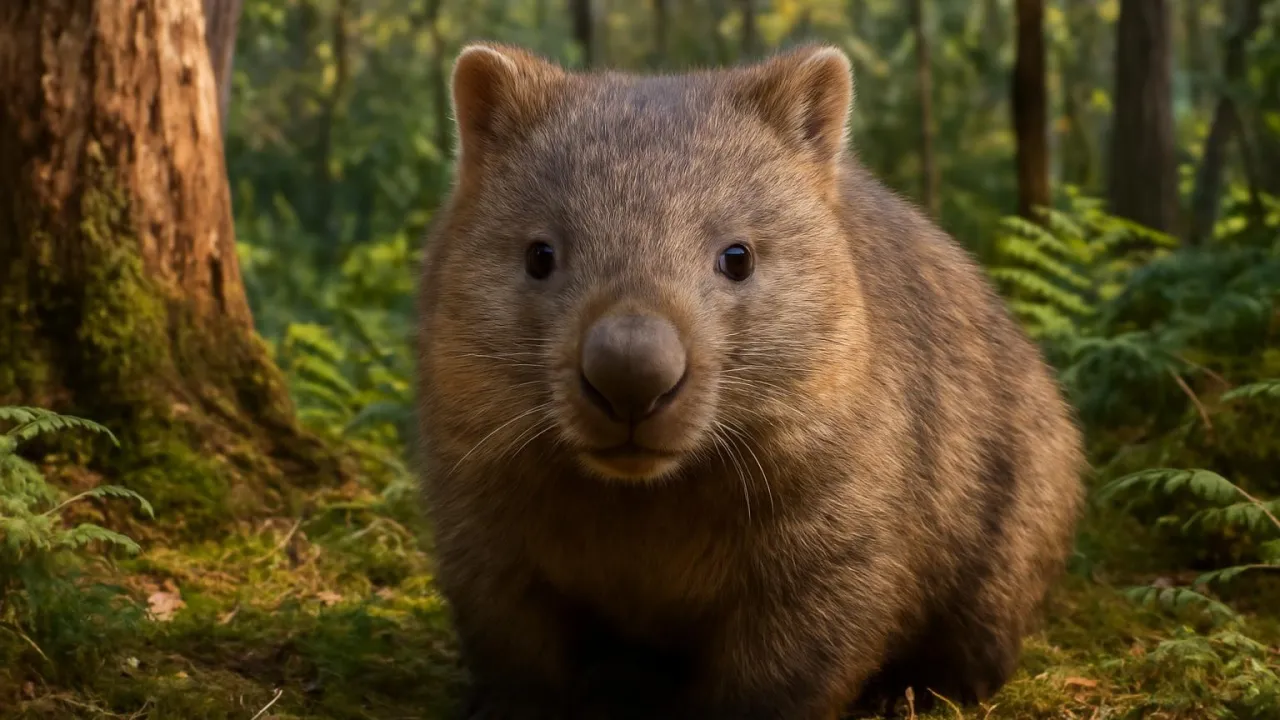
Wombats produce cube-shaped poop to mark their territory without it rolling away.
✨ Word Sparks (Grade 2 Glossary)
Tap 🔊 to hear
herbivore
An animal that eats plants only
predator
An animal that hunts other animals
claws
Sharp nails on animal feet
🪝
Have you ever wondered how wombats make their homes underground?
1
Wombat Appearance and Size
Common wombats have thick brown fur and a large round nose. They have short legs and strong . Their bodies grow about three feet long and help them dig.
2
Where Wombats Live and Dig
Wombats live in forests and woodlands in southeastern Australia. They dig large tunnels underground to live in. These tunnels keep them safe from and weather.
3
What Wombats Eat Every Day
Wombats are that eat grasses, roots, and bark. They chew slowly to digest tough plants. Their teeth keep growing to help with chewing and eating.
Wombats’ cube-shaped poop helps them mark territory without losing their scent.
✨ Word Sparks (Grade 3 Glossary)
Tap 🔊 to hear
adaptation
A body change that helps survival
nocturnal
Active during the night
territory
An animal’s home area
🪝
Did you know wombats have special teeth that keep growing all their lives?
1
Wombat Body and Adaptations
Common wombats have thick fur that helps protect them from cold weather. Their strong claws allow them to dig deep burrows underground. Their large noses help them smell food and danger nearby. These help wombats survive in their forest homes.
2
Wombat Habitat and Behavior
Wombats live mainly in southeastern Australia’s forests and woodlands. They build extensive tunnel systems for shelter and safety. These tunnels also help wombats hide from predators like dingoes. Wombats are mostly , meaning they are active at night.
3
Wombat Diet and Digestion
Wombats are herbivores that feed on grasses, roots, and bark. Their strong teeth continuously grow to replace worn parts from chewing tough plants. Wombats digest slowly to extract nutrients from fibrous food. This slow digestion helps them survive in areas with little food.
4
Wombat’s Unique Poop Shape
Wombats produce cube-shaped poop, which is rare in the animal kingdom. This shape prevents the poop from rolling away on slopes. Wombats use their poop to mark and communicate with other wombats. Scientists study this unique trait to understand wombat biology.
Wombats’ digging not only shelters them but also improves soil health for many plants.
✨ Word Sparks (Grade 4 Glossary)
Tap 🔊 to hear
symbiosis
When animals help each other live
aerate
To mix air into soil
conservation
Protecting nature and animals
🪝
How does the common wombat’s digging skill affect its role in the forest ecosystem?
1
Physical Traits and Survival
The common wombat has a sturdy body with thick fur that protects it from cold temperatures and rough terrain. Its powerful claws enable it to dig extensive burrows, which provide shelter and protection from predators. These burrows also regulate temperature, keeping wombats cool in summer and warm in winter. Such adaptations are vital for survival in southeastern Australia’s forests.
2
Ecosystem Role and Food Web
Wombats play an important role in their ecosystem by aerating soil through their digging, which helps plant growth. As herbivores, they feed mainly on grasses and roots, influencing vegetation patterns. Their burrows create habitats for other small animals, showing a symbiotic relationship. Predators like dingoes rely on wombats as a food source, linking wombats to the local food web.
3
Geographic Distribution and Habitat
Common wombats are found in southeastern Australia, including Tasmania and parts of Victoria and New South Wales. They prefer forested and woodland areas with soft soil suitable for digging. Human activities such as land clearing have reduced wombat habitats, but efforts aim to protect these areas. Wombats adapt to various environments but rely on safe burrowing grounds.
4
Cause and Effect of Digging Behavior
Wombats dig tunnels to escape predators and harsh weather, which increases their chances of survival. Their digging also changes soil structure, improving water absorption and nutrient cycling in the ecosystem. However, excessive digging near farmland can cause conflicts with humans. Understanding these cause-and-effect relationships helps balance wombat with human interests.
A wombat can dig tunnels nearly 30 feet long using its powerful claws and muscles.
✨ Word Sparks (Grade 5 Glossary)
Tap 🔊 to hear
marsupial
Animal with a pouch for babies
taxonomy
Science of naming and grouping animals
metabolism
How bodies use energy to live
🪝
What unique biological features make the common wombat a fascinating marsupial digger?
1
Taxonomy and Scientific Classification
The common wombat, scientifically named Vombatus ursinus, belongs to the family Vombatidae within the order Diprotodontia. This is closely related to koalas and other wombat species. Its classification highlights evolutionary adaptations for burrowing and herbivory. Understanding its helps scientists study its ecological niche and evolutionary history.
2
Physiological Mechanics of Digging
Common wombats possess exceptionally strong forelimbs with curved claws that enable efficient soil excavation. Their muscular build provides leverage needed to dig large, complex burrow systems. The wombat’s backward-facing pouch prevents dirt from entering while digging. This anatomical adaptation is crucial for its subterranean lifestyle and protection of offspring.
3
Conservation Status and Human Impact
Although classified as Least Concern by conservation organizations, common wombats face habitat fragmentation due to urban development and agriculture. Road accidents and disease also threaten populations. Conservation programs focus on habitat preservation and public education to reduce human-wombat conflicts. These efforts aim to maintain stable wombat populations across their natural range.
4
Ecological Role and Quantitative Comparisons
Wombats contribute significantly to soil health by aerating up to 20 tons of soil annually through digging activities. Their burrows provide shelter for various species, enhancing biodiversity. Adult common wombats typically weigh between 44 and 77 pounds (20 to 35 kilograms) and can dig tunnels up to 30 feet (9 meters) long. These impressive figures underscore their ecological importance.
5
Unique Biological Traits and Behavior
The wombat’s cube-shaped feces are a unique biological trait that aids in territorial marking and communication. Their slow allows survival on low-nutrient diets, and they can run up to 25 miles per hour (40 kilometers per hour) in short bursts to escape predators. These combined features illustrate the wombat’s remarkable adaptations to its environment.