🦴 PREHISTORIC
🦴 Mammuthus columbi • Elephantidae
VA Science SOL 2.5, 3.4, 3.5, 5.8 (Fossils, Adaptations & Earth History)
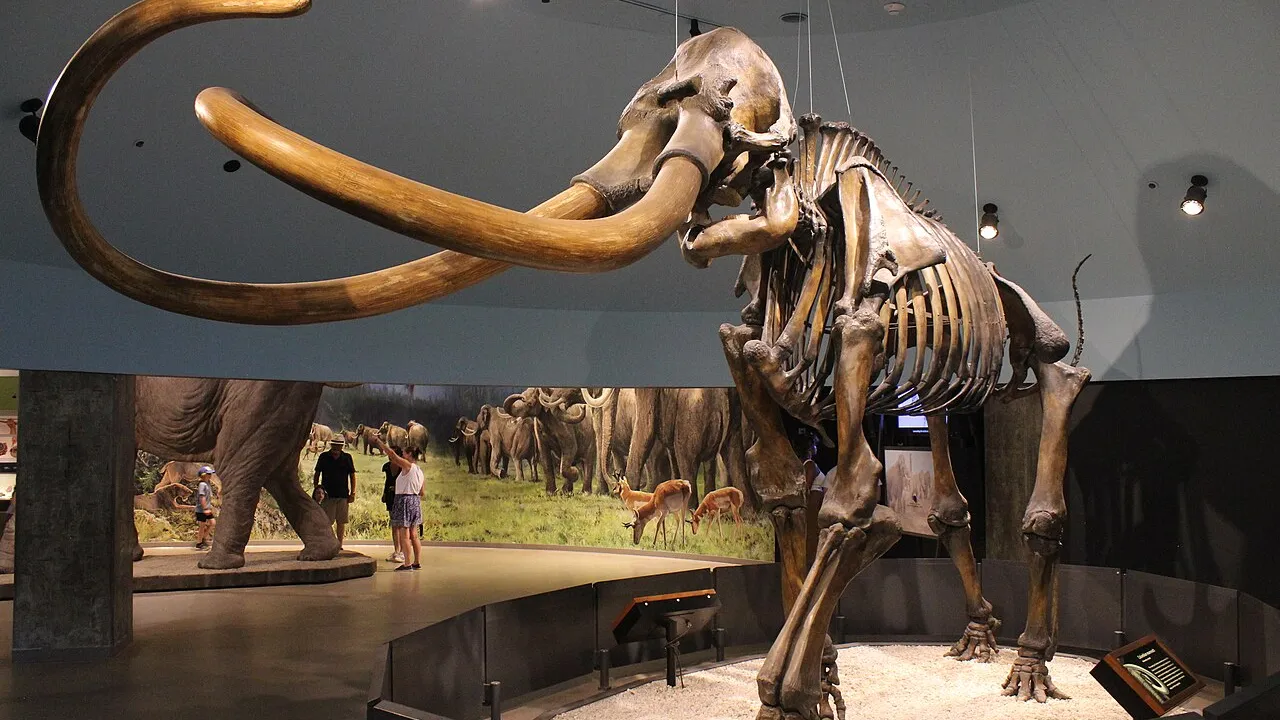
Columbian Mammoth
Towering Spiral-Tusked Giant of Sunny Prairies
Grade 1 • Early Reader • 77 words
🌋 Geologic Period & RegionPleistocene Epoch (1.5 MYA–11,000 YA) • Grasslands & Savannas of USA, Mexico & Central America
📏 Size & Weight13 ft (4 m) shoulder height • 9–11 tons (8,200–10,000 kg)
🦴 Diet & FossilsTemperate Grassland Grazer • La Brea Tar Pits, Waco & Hot Springs Mammoth Site
⚡ Survival SuperpowerTowered taller and heavier than Woolly Mammoths with sixteen-foot spiraling tusks
🤯 Mind-Blowing Fact • Grade 1
Two giant Columbian Mammoth tusks laid end to end stretched longer than a bowling alley lane is wide—over thirty feet together!
✨ Word Sparks (Grade 1 Glossary)
Tap 🔊 to hear
Prairie
Wide open land covered in tall grass
Spiral
A smooth curving twist shape
Tower
To stand much taller than things nearby
🪝
Did you know a sunny-weather mammoth grew way bigger than the Woolly Mammoth?
1
Stomp Across Warm Grass
Thump, boom, thump! The sunny shakes as a giant walks by. Look up at the Columbian Mammoth! It lived in warm grassy lands from California to Florida and Mexico.
2
No Heavy Winter Coat Needed
Because its home was mild and sunny, it did not wear long shaggy wool! Its wrinkled skin had light short hair like elephants today.
3
Record-Breaking Curly Tusks
It towered thirteen feet tall—much bigger than a Woolly Mammoth! Its curved tusks grew sixteen feet long and crossed at the tips.
1. Why didn't the Columbian Mammoth wear a thick, shaggy coat like the Woolly Mammoth?
2. Which mammoth grew taller and heavier?
🤯 Mind-Blowing Fact • Grade 2
Big wild fruits like avocados, Osage oranges, and honey locust pods originally evolved so giant mammoths and ground sloths would swallow and spread their seeds!
✨ Word Sparks (Grade 2 Glossary)
Tap 🔊 to hear
Savanna
Warm grassland dotted with scattered trees
Sinkhole
Deep natural pit formed when underground rock collapses
Sedge
Grass-like wetland plant loved by grazing mammoths
🪝
Why are giant round fruits like Osage oranges still growing in North America waiting for a mammoth snack?
1
True Giant of the Americas
Imagine standing on a warm Texas or California 20,000 years ago! Striding past giant ground sloths and camels is a ten-ton Columbian Mammoth. Standing thirteen feet at the shoulder, a grown-up human would barely reach the top of its front leg!
2
Four Hundred Pounds of Salad
Four huge flat molars with washboard ridges ground up four hundred pounds of prairie grass, , and cactus pads every single day! It also gulped whole prickly locust pods and softball-sized Osage oranges, planting their seeds miles away in its droppings.
3
Trapped in Tar and Sinkholes
Dozens of skeletons preserved at California's La Brea Tar Pits and South Dakota's Mammoth Site teach scientists how herds lived together!
1. How did Columbian Mammoths help wild fruit trees like Osage oranges spread across ancient North America?
2. About how many pounds of plants did an adult Columbian Mammoth eat each day?
🤯 Mind-Blowing Fact • Grade 3
In 2021, million-year-old DNA revealed a blockbuster surprise: the Columbian Mammoth originally formed when ancient steppe mammoths and early woolly mammoths met and hybridized in North America!
✨ Word Sparks (Grade 3 Glossary)
Tap 🔊 to hear
Matriarch
Wise older mother who leads an elephant herd
Hybrid
Offspring born from two closely related species
Shale
Layered mud rock that turns slippery when wet
🪝
What happened when sixty teenage male Columbian Mammoths slipped into an ancient warm-water pond in South Dakota?
1
Mystery of the Hot Springs Sinkhole
Twenty-six thousand years ago in the Black Hills of South Dakota, a steep-walled sinkhole filled with warm spring water steamed invitingly during chilly winters. Tempted by green pondside grass, bold Columbian Mammoths reached down for a snack—and slipped down slick walls they could not climb! Over centuries, more than sixty mammoths were preserved there.
2
Why Mostly Young Bulls?
When paleontologist Larry Agenbroad studied the Mammoth Site skeletons, he discovered almost every single mammoth in the trap was a young adult male! Just like modern elephants, cautious mother steered family herds away from danger, while adventurous bachelor bulls explored alone and took risky shortcuts.
3
Family Protection in Waco, Texas
Meanwhile, at Waco Mammoth National Monument in Texas, fossil hunters uncovered an entire nursery herd of females and calves huddled together during an ancient flash flood—showing strong family bonds.
4
Longest Tusks on Earth
Older bulls grew magnificent corkscrew tusks up to 4.9 meters (16 feet) long—used for shoving matches, stripping bark, and sweeping aside brush.
1. Why were almost all sixty mammoths trapped at the Hot Springs Mammoth Site in South Dakota young males?
2. What amazing origin story did million-year-old mammoth DNA uncover in 2021?
🤯 Mind-Blowing Fact • Grade 4
Two massive bull Columbian Mammoths unearthed in Trailside Museum, Nebraska, got their curved sixteen-foot tusks locked tightly together in a shoving match and fossilized nose-to-nose!
✨ Word Sparks (Grade 4 Glossary)
Tap 🔊 to hear
Speciation
Evolutionary process that forms a brand-new species
Bolus
Rounded mass of chewed or digested plant material
C4 grasses
Warm-season prairie grasses thriving in bright sunshine
🪝
How did million-year-old DNA locked inside Siberian teeth rewrite the family tree of America's ten-ton mammoth?
1
Sovereign of Temperate North America
Stand along the grassy coastal plains of Pleistocene California or central Mexico 30,000 years ago, far south of the Laurentide Ice Sheet. Dominating open parklands from southern Canada all the way to Costa Rica is Mammuthus columbi, standing four meters (13 feet) at the shoulder and weighing eight to ten metric tons—nearly double the mass of its northern relative, the Woolly Mammoth.
2
Million-Year-Old Hybrid Speciation
For decades, paleontologists assumed Mammuthus columbi descended solely from Eurasian steppe mammoths (Mammuthus trogontherii) that crossed Beringia 1.5 million years ago. Then in 2021, Love Dalén and colleagues extracted the oldest ancient DNA ever sequenced—over one million years old—from Siberian mammoth molars. Comparing genomes stunned geneticists: Columbian Mammoths carried a roughly 50/50 genetic mix of a novel Siberian 'Krestovka' steppe-mammoth lineage and early Woolly Mammoths—a textbook case of hybrid !
3
Dental Ridges Tuned to Coarse Forage
Compared with Woolly Mammoth molars packed with up to twenty-six thin enamel plates for tough Arctic sedges, Columbian Mammoth third molars featured fourteen to twenty slightly wider-spaced enamel lamellae suited to lush C4 prairie grasses, rushes, yucca leaves, and megafaunal fruits documented in preserved Utah dung .
4
Clash of Titans Locked in Stone
In Crawford, Nebraska, paleontologists excavated two bull Columbian Mammoths that died with their four-meter tusks hopelessly interlocked during a dominance sparring match—preserving a split-second behavioral drama from the Pleistocene!
1. How did the spacing of enamel plates on Columbian Mammoth molars differ from Woolly Mammoth molars?
2. What rare fossil discovery in Crawford, Nebraska, proved bull Columbian Mammoths sparred with their giant curved tusks?
🤯 Mind-Blowing Fact • Grade 5
Dry mammoth droppings stacked several feet deep inside Utah's dry Bechan Cave stayed intact for over 13,000 years—letting botanists identify every grass species and wild fruit seed those mammoths ate!
✨ Word Sparks (Grade 5 Glossary)
Tap 🔊 to hear
Introgression
Gene flow between species through repeated crossbreeding
Phytolith
Microscopic silica crystal formed inside grass cells
Taphonomy
Study of how organisms decay and become fossils
🪝
What do deep-time paleogenomics, Bechan Cave dung boluses, and Clovis-age sites reveal about North America's largest proboscidean?
1
Taxonomy from Georgia Canals to Costa Rica
First described by Scottish paleontologist Hugh Falconer in 1857 from ridged molar plates unearthed while digging the Brunswick Altamaha Canal in Georgia (referencing Christopher Columbus in its epithet), Mammuthus columbi—now encompassing synonymized forms such as 'Mammuthus imperator' and 'Mammuthus jeffersonii'—ranged across temperate and subtropical North America from southern Canada to Nicaragua and Costa Rica. Reaching 4.0 to 4.2 meters at the shoulder, 8 to 10.5 metric tons in mass, and sporting spiraled premaxillary tusks up to 4.9 meters long, it dwarfed northern Mammuthus primigenius.
2
Million-Year Paleogenomics and Hybrid Origin
In 2021, van der Valk, Love Dalén, and colleagues sequenced 1.1-to-1.65-million-year-old nuclear DNA from Early Pleistocene Siberian permafrost molars—shattering the deep-time ceiling of paleogenetics. Having diverged earlier from Eurasian steppe mammoths, an unrecognized 'Krestovka' lineage colonized North America ~1.5 MYA and subsequently hybridized extensively (~420,000 YA) with incoming Mammuthus primigenius populations. Later bidirectional across mid-latitude contact zones produced intermediate 'Jeffersonian' phenotypes along fluctuating glacial margins.
3
Paleobotanical Forensics and Seed Dispersal
Desiccated dung boluses preserved inside Utah's Bechan Cave alongside residue trapped in dental calculus show a diet of ~70–90% graminoids (C3 and C4 grasses, sedges) supplemented by saltbush, prickly pear cactus, birch, and indehiscent megafaunal fruits such as Maclura pomifera (Osage orange) and Gymnocladus dioicus (Kentucky coffeetree), ground between hypsodont M3 molars bearing 14 to 20 lamellar plates.
4
Behavioral Taphonomy Across Landmark Bonebeds
Contrasting demographic profiles illuminate proboscidean social structure directly mirrors extant Loxodonta and Elephas: South Dakota's 26,000-year-old Hot Springs karst sinkhole selectively entrapped solitary, risk-prone adolescent and prime-age bulls (over 60 individuals), whereas Texas's 65,000-year-old Waco Mammoth National Monument preserved a catastrophic flood burial of an entire matriarchal nursery herd alongside a later bull.
5
Terminal Pleistocene Extinction
Between 13,000 and 11,000 years ago—documented at Clovis archaeological butcheries like Arizona's Lehner and Naco sites alongside abrupt Younger Dryas habitat shifts—Mammuthus columbi vanished across the Americas, stranding ecological cascades across temperate grasslands.
1. How did contrasting age-and-sex profiles at Waco, Texas, versus Hot Springs, South Dakota, prove Columbian Mammoths shared modern elephant social structures?
2. What made the 2021 sequencing of the Siberian 'Krestovka' mammoth tooth a landmark breakthrough for Columbian Mammoth research?