⚡ Survival SuperpowerFeather-light hollow bones, a bird-like wishbone, and stork-slim snapping jaws
🤯 Mind-Blowing Fact • Grade 1
In 1998, astronauts carried a real Coelophysis skull into orbit aboard the Space Shuttle Endeavour!
✨ Word Sparks (Grade 1 Glossary)
Tap 🔊 to hear
wishbone
a forked chest bone shared with birds
slim
very thin, sleek, and lightweight
flock
a group of swift animals moving together
🪝
How could a ten-foot dinosaur weigh no more than a medium dog?
1
Light as a Breeze
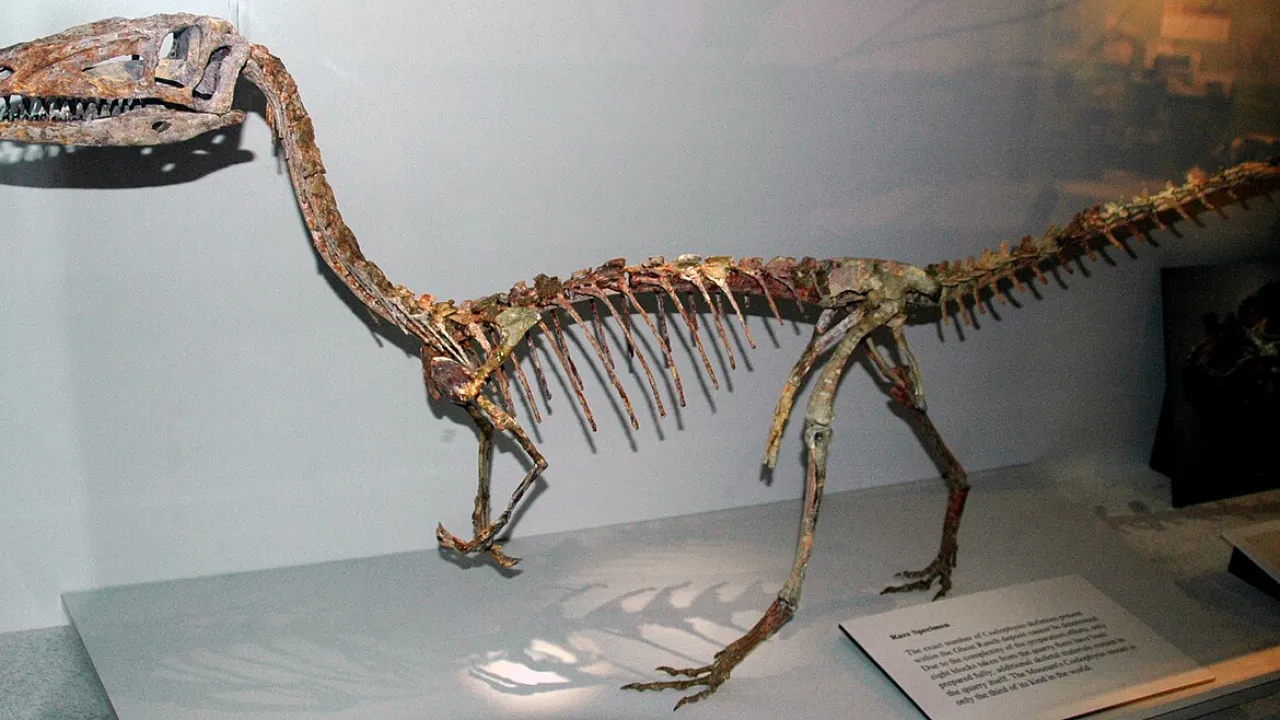
Zip, dart, snap! Across a dry riverbank dashes a super- hunter. Coelophysis stretched nearly ten feet long, yet its hollow bones kept it light as a dog!
2
Long Snapping Snout
Its S-curved neck whipped forward fast! Narrow jaws and sharp little teeth snatched fish, bugs, and small lizards.
3
Ghost Ranch Crowd
Hundreds of Coelophysis skeletons were found buried together in red rocks in New Mexico!
1. Why was ten-foot Coelophysis so light on its feet?
2. Where were hundreds of Coelophysis skeletons discovered together?
🤯 Mind-Blowing Fact • Grade 2
Coelophysis is the official state fossil of New Mexico thanks to the hundreds of complete skeletons unearthed at Ghost Ranch!
✨ Word Sparks (Grade 2 Glossary)
Tap 🔊 to hear
flash flood
a sudden rush of rising river water
ribcage
curved chest bones protecting heart and lungs
detective
someone who solves mysteries using careful clues
🪝
How did scientists clear Coelophysis of a sixty-year-old mystery about eating its own babies?
1
Mystery at Ghost Ranch
Dig into colorful red cliffs at Ghost Ranch, New Mexico! In 1947, paleontologists uncovered a breathtaking bonebed packed with hundreds of slender Coelophysis skeletons from tiny youngsters to ten-foot adults, likely swept together after a drought and .
2
Case of the Belly Bones
Inside the of one adult sat tiny reptile bones! For nearly sixty years, books claimed Coelophysis ate its own young. Then in 2006, scientists looked closer under microscopes and proved those belly bones actually belonged to a tiny crocodile relative!
3
Early Bird Clues
Long before birds flew, Coelophysis already had hollow bones, three walking toes, and a forked wishbone in its chest!
1. What were the tiny bones inside the Coelophysis ribcage really from?
2. Which chest bone did Coelophysis share with modern birds?
🤯 Mind-Blowing Fact • Grade 3
Eye-ring measurements show Coelophysis hunted in bright daylight with forward-angled vision similar to modern birds of prey!
✨ Word Sparks (Grade 3 Glossary)
Tap 🔊 to hear
silt
fine mud carried by moving river water
precision
exact, careful accuracy in every quick move
lungfish
an ancient fish able to breathe air
🪝
Why did Late Triassic droughts gather hundreds of agile hunters at one shrinking watering hole?
1
Gathering at the Waterhole
Picture blazing afternoon heat across southwestern North America 205 million years ago. Seasonal monsoon rains have stopped, and streams are drying into muddy pools teeming with trapped and crayfish. Drawn by easy meals and scarce water, scores of nimble Coelophysis gather along the banks—right before a sudden flash flood buries the entire group in fine .
2
Built Like a Racing Greyhound
Named by Edward Drinker Cope in 1889, Coelophysis bauri was built for speed and . Half of its ten-foot length came from its slender neck and whip-stiffened tail, keeping its total weight around forty-five pounds.
3
Stork-Style Hunting
Long, narrow jaws lined with small backward-curved teeth worked much like a modern heron's bill, snapping swiftly at fish, insects, lizards, and small crocodile cousins.
4
Sharp Daytime Vision
Bony eye rings studied by paleontologists show Coelophysis was a sharp-eyed daytime hunter with depth perception similar to modern hawks!
1. How did the narrow jaws of Coelophysis catch food?
2. What did bony eye rings tell scientists about when Coelophysis hunted?
🤯 Mind-Blowing Fact • Grade 4
Coelophysis had four fingers on each hand, though the fourth outer finger was shrunk to a tiny bone splint hidden beneath the skin!
✨ Word Sparks (Grade 4 Glossary)
Tap 🔊 to hear
furcula
the scientific name for a forked wishbone
exonerate
to prove someone innocent of old blame
opportunism
smartly taking advantage of whatever food appears
🪝
How did one quarry in New Mexico turn Coelophysis into the best-known Triassic dinosaur on Earth?
1
Edwin Colbert's 1947 Jackpot
Triassic dinosaur fossils are usually frustratingly rare, scattered as lonely teeth or broken limb bones. That changed forever in the summer of 1947 when paleontologist Edwin Colbert led an American Museum of Natural History team into Ghost Ranch, New Mexico. Inside colorful mudstones of the Chinle Formation lay an unprecedented tangle of more than a thousand Coelophysis skeletons preserved in stunning three-dimensional detail!
2
Hollow-Bone Engineering
True to its Greek name meaning hollow form, Coelophysis pioneered lightweight skeletal engineering within Neotheropoda. Air sacs connected to its lungs invaded its vertebrae and thin-walled limb bones, slashing body weight to roughly twenty kilograms despite a three-meter body length. Interlocking tail zygapophyses stiffened its tail for high-speed turns, while a fused wishbone () braced its shoulders as its four-fingered hands snatched prey.
3
Exonerating a Famous Dinosaur
When tiny bones appeared inside adult Ghost Ranch ribcages, textbooks portrayed Coelophysis as a cannibal for decades. In 2006, paleontologist Sterling Nesbitt and colleagues re-examined the museum blocks and demonstrated that the swallowed bones actually belonged to Hesperosuchus, a swift terrestrial crocodylomorph!
4
Surviving Harsh Pangaean Swings
Rapid growth and agile helped coelophysids outlast giant Triassic pseudosuchians and flourish straight across the boundary into the Early Jurassic.
1. How did hollow air-filled vertebrae help Coelophysis?
2. How many fingers were present in the hand skeleton of Coelophysis?
🤯 Mind-Blowing Fact • Grade 5
Finding a wishbone in 205-million-year-old Coelophysis proved that wishbones first evolved as shock-absorbers for grasping prey with clawed hands—millions of years before any bird ever flew!
✨ Word Sparks (Grade 5 Glossary)
Tap 🔊 to hear
taphonomy
study of how organisms decay and fossilize
pneumaticity
presence of air-filled spaces inside bones
diurnal
active primarily during bright daytime hours
🪝
Why is New Mexico's Ghost Ranch Coelophysis bonebed considered a masterclass in taphonomy, biomechanics, and scientific self-correction?
1
From Fragmentary Scraps to Ghost Ranch Taphonomy
First named by fossil hunter Edward Drinker Cope in 1889 from fragmentary New Mexico vertebrae, Coelophysis bauri vaulted to global fame in 1947 when Edwin H. Colbert's crew uncovered the Whitaker Quarry at Ghost Ranch within Norian-to-Rhaetian siltstones of the Chinle Formation. Taphonomic analysis indicates seasonal Pangaean megamonsoon droughts concentrated hundreds of individuals near dwindling waterways before low-energy sheet floods rapidly entombed the assemblage without scattering delicate skulls.
2
Neotheropod Pneumaticity and Avian Precursors
Measuring up to three meters long yet weighing scarcely fifteen to twenty-five kilograms, Coelophysis exemplifies early neotheropod cursoriality. Extensive postcranial skeletal hollowed its cervical vertebrae and long bones, signaling avian-style pulmonary air sacs more than fifty million years before Archaeopteryx. Equally notable is an ossified furcula—demonstrating that wishbones originally evolved as biomechanical shoulder springs during predatory grasping rather than for powered flight.
3
Cranial Mechanics and Diurnal Vision
Finite-element stress modeling confirms its narrow, fenestrated skull had a relatively modest bite force suited for rapid, heron-like strikes on lungfish, sphenodontians, and small archosaurs rather than bone-crushing grapples. Reconstructed scleral rings and bony labyrinths reveal acute, forward-overlapping vision and agile head stabilization.
4
Overturning the Cannibalism Myth
Science thrives by retesting classic claims. In 2006, Nesbitt, Turner, Erickson, and Norell histologically and anatomically audited famous Ghost Ranch stomach contents, proving the ingested bones belonged to sphenosuchian crocodylomorphs such as Hesperosuchus rather than juvenile Coelophysis.
5
Growth Plasticity and Triassic Resilience
Bone-histology curves document highly variable first-year growth rates among littermates—an adaptive developmental flexibility that helped coelophysids survive volatile Late Triassic climates. Unlike giant pseudosuchian competitors locked into slower ectothermic-style growth, Coelophysis combined brisk metabolic activity, social foraging near seasonal streams, and streamlined locomotion to carry the theropod lineage triumphantly into the Jurassic Period.