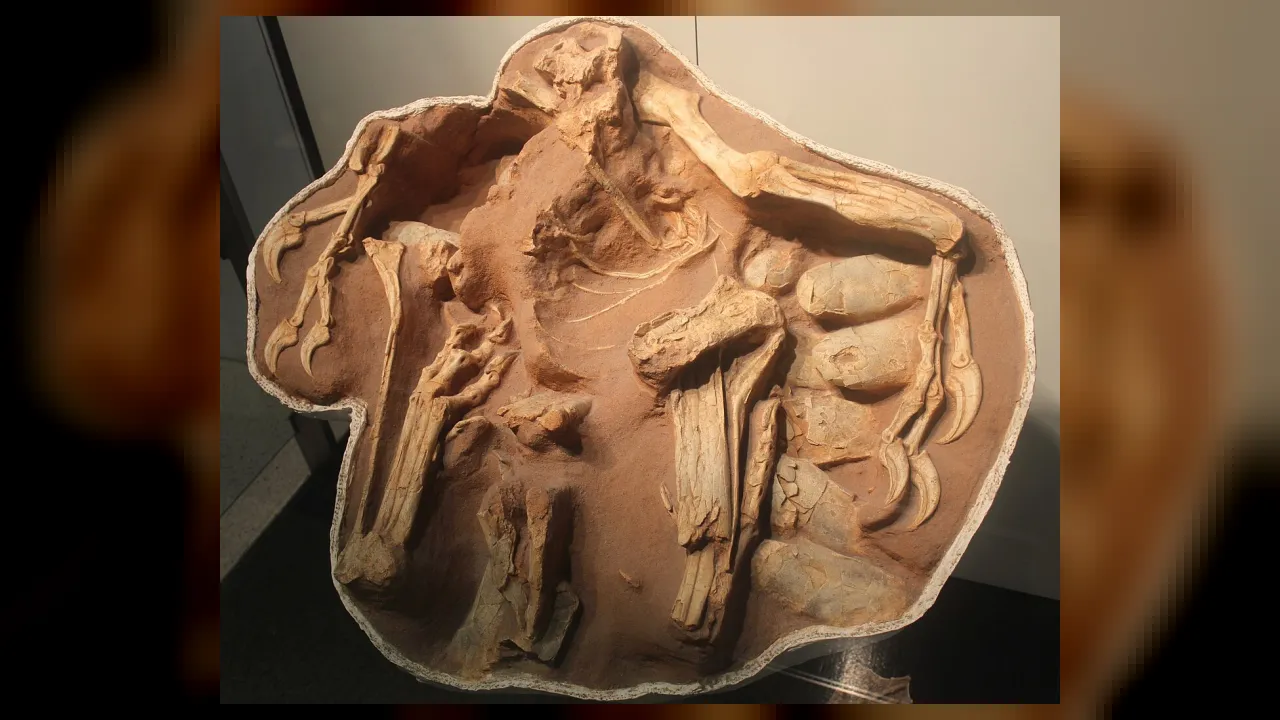
⚡ Survival SuperpowerCassowary-like head crest and bird-style feathered nest brooding
🤯 Mind-Blowing Fact • Grade 1
Scientists nicknamed the most famous nesting Citipati fossil 'Big Mama' because it stayed faithfully on its eggs through a giant sandslide!
✨ Word Sparks (Grade 1 Glossary)
Tap 🔊 to hear
emu
A tall, fast-running modern flightless bird
shield
To cover and protect something from harm
eggshell
Hard outer layer protecting a growing egg
🪝
Why did this emu-sized dinosaur hug a ring of blue-green eggs in a sandstorm?
1
Meet Big Mama!
Whoosh! Wind blows hot red sand across ancient Mongolia. Instead of running away, Citipati tucks its legs in and spreads its feathered arms wide over twenty eggs!
2
Tall Helmet Crest
Citipati stood as tall as a big . On top of its short, toothless beak rose a tall, flat-topped bony crest!
3
Pretty Colored Eggs
Scientists found blue-green color clues inside its —just like robin eggs today!
1. How was the famous 'Big Mama' Citipati fossil positioned when scientists found it?
2. What color were Citipati eggs in real life?
🤯 Mind-Blowing Fact • Grade 2
Citipati laid up to 22 loaf-shaped eggs arranged in neat stacked rings inside one sandy nest mound!
✨ Word Sparks (Grade 2 Glossary)
Tap 🔊 to hear
cassowary
Large flightless rainforest bird with a tall head crest
circular
Shaped in a round ring or circle
scorching
Extremely hot under bright desert sunshine
🪝
Have you ever seen a picture of 'Oviraptor' with a tall helmet crest? Surprise—you were actually looking at Citipati!
1
The Real Face Behind Famous Drawings
Imagine flipping open a dinosaur book and admiring a tall, flat-topped head crest above a parrot beak. For decades, artists labeled that dinosaur Oviraptor, whose first skull was crushed. In 2001, paleontologists realized those big, tall-crested skeletons from Mongolia actually belonged to a nine-foot cousin and named it Citipati!
2
Why Feathered Wings Evolved First
Citipati couldn't fly—at 175 pounds, it weighed as much as an adult human! Yet four separate Citipati skeletons were unearthed sitting directly atop nests with their arms folded outward like protective umbrellas.
3
Shading and Warming the Nest
Long wing feathers shaded its blue-green eggs from desert sun by day and trapped cozy warmth during chilly desert nights!
1. How did long arm feathers help flightless, human-sized Citipati?
2. Why did so many older dinosaur books draw Oviraptor looking like Citipati?
🤯 Mind-Blowing Fact • Grade 3
Just like modern emu and ostrich dads today, fossil bone chemistry hints that male Citipati parents did much of the heroic nest-sitting!
✨ Word Sparks (Grade 3 Glossary)
Tap 🔊 to hear
casque
A helmet-like bony crest atop a bird's or dinosaur's head
calcium
Mineral stored in bones to build hard eggshells
posture
The exact position in which a body sits or stands
🪝
What did four Citipati skeletons sitting on nests prove about where bird behavior came from?
1
Buried in an Ancient Dune Slide
Thunder rumbles over rain-soaked sand dunes at Ukhaa Tolgod in Late Cretaceous Mongolia 73 million years ago. Crouched motionless atop a neat spiral ring of twenty-two blue-green eggs sits Citipati osmolskae, a three-meter feathered dinosaur as big as an emu. Suddenly, a waterlogged sand dune slumps downward, preserving the faithful parent in stone for seventy-three million years.
2
Proof of Bird-Style Brooding
When paleontologists Mark Norell and James Clark uncovered specimen 'Big Mama' in 1993—and later three more brooding adults—every skeleton showed the exact same as modern nesting ostriches and chickens! Its hind feet tucked carefully into the egg-free center while its three-fingered arms curved around the outer rim.
3
Cassowary Crest and Tail Fan
Named in 2001 in honor of Polish paleontologist Halszka Osmólska, Citipati sported a tall, air-filled head crest resembling a modern cassowary's , plus fused tail-tip bones supporting a showy feather fan.
4
Did Dads Guard the Nest?
Bone checks of brooding Citipati lacked layers used by egg-laying mothers, suggesting devoted fathers took turns brooding just like modern emus and ostriches!
1. Why do scientists suspect male Citipati parents helped sit on nests?
2. Who does the species name 'osmolskae' in Citipati osmolskae honor?
🤯 Mind-Blowing Fact • Grade 4
The fossil embryo found in 1993 at Ukhaa Tolgod belonged to Citipati—and nestled inside that exact same Citipati nest sat two tiny skulls of baby Byronosaurus troodontids!
✨ Word Sparks (Grade 4 Glossary)
Tap 🔊 to hear
biliverdin
Natural pigment that colors robin, emu, and oviraptorid eggs blue-green
medullary bone
Temporary calcium-rich tissue inside female bird bones before laying eggs
paternal
Relating to care given by a father parent
🪝
How did chemical detectives discover that Citipati laid camouflaged blue-green eggs in open nests?
1
Treasure of Ukhaa Tolgod
Picture the sweeping red sandstone cliffs of Ukhaa Tolgod in Mongolia's Djadokhta Formation, one of the richest dinosaur fossil sites ever discovered. Roaming its seasonal desert oases 73 million years ago was Citipati osmolskae, one of the largest typical oviraptorids at nearly three meters long and eighty kilograms. Named by James Clark, Mark Norell, and Rinchen Barsbold in 2001 ('Citipati' from Sanskrit words for 'funeral-pyre lord'), this crested omnivore reshaped our understanding of avian behavioral origins.
2
Wing Evolution Driven by Parental Care
Across four extraordinary brooding specimens—including 'Big Mama' (IGM 100/979) and 'Romeo/Big Auntie'—adult skeletons sit symmetrically centered atop two-to-three-tiered rings of elongated eighteen-centimeter eggs. Had Citipati lacked broad, pennaceous wing feathers extending from its second fingers, bare arms could have sheltered neither inner nor outer egg rings. Thus, wide planar arm wings likely served crucial reproductive thermoregulation in flightless maniraptorans before or alongside flight!
3
Biliverdin Egg Pigments and Paternal Care
Mass-spectrometry studies led by Jasmina Wiemann identified two exact modern bird pigments—blue-green and reddish-brown protoporphyrin—preserved inside oviraptorid eggshells! Unlike buried white crocodile eggs, colored eggs camouflage exposed open nests.
4
Bone Histology Clues
Furthermore, histological thin sections published by David Varricchio in 2008 found zero reproductive inside brooding Citipati limbs, strongly pointing toward avian-style nest care.
1. Why did finding blue-green biliverdin pigment in oviraptorid eggs prove their nests stayed partially open rather than completely buried like crocodile nests?
2. What mysterious guests were discovered fossilized inside the 1993 Citipati embryo nest?
🤯 Mind-Blowing Fact • Grade 5
Isotope thermometers inside fossilized oviraptorid eggshells proved Citipati warmed its eggs to 35–40°C (95–104°F)—right in the exact warm-blooded brooding range of living birds!
✨ Word Sparks (Grade 5 Glossary)
Tap 🔊 to hear
ratite
Group of large flightless birds including ostriches, emus, and cassowaries
rectrices
Stiff, fan-forming feathers anchored near the tip of a tail
tetrapyrrole
Organic ring molecule forming natural blue-green and brown eggshell pigments
🪝
How do Citipati osmolskae fossils unite osteology, paleoproteomics, and reproductive biology to trace the dinosaurian roots of bird parenthood?
1
Untangling Mongolia's Tall-Crested Oviraptorid
Discovered during the historic 1993 American Museum of Natural History–Mongolian Academy expeditions to Ukhaa Tolgod in the Campanian Djadokhta Formation (~75–71 MYA), Citipati osmolskae was formally established in 2001 by James Clark, Mark Norell, and Rinchen Barsbold. Reaching 2.9 meters in length and weighing seventy-five to eighty-five kilograms, this emu-sized omnivore possessed a pneumatized, cassowary-like naso-premaxillary crest and shortened, muscular caudal series terminating in a fused, blade-like pygostyle that fanned for courtship display.
2
Taphonomy of Brooding Behavior
Four articulated Citipati skeletons—headed by IGM 100/979 ('Big Mama'), described in Nature in 1995—were entombed instantaneously by rain-mobilized alluvial sandflows while crouching directly over circular clutches of up to twenty-two paired Elongatoolithidae eggs. Each parent positioned its pes in the central open space, pressed its gastralia over the inner rim, and draped elongated, wing-feathered forelimbs across the perimeter—demonstrating that stereoscopic avian contact-brooding predated powered flight or evolved deep within Maniraptora.
3
Histological Support for Paternal Care
In 2008, David Varricchio and colleagues analyzed clutch-volume-to-adult-mass ratios and sectioned limb bones of brooding Citipati and Troodon. High clutch volumes paired with the complete absence of female-specific calcium-reservoir medullary bone mirrored modern palaeognath (ostriches, emus, rheas), indicating polygamous communal clutches tended primarily by males.
4
Raman and Mass-Spectrometry Egg Coloration
Biomolecular analyses led by Jasmina Wiemann (2017–2018) detected intact pigments—biliverdin and protoporphyrin IX—within oviraptorid eggshells, reconstructing dark blue-green camouflaged eggs suited to semi-open ground nests.
5
Thermoregulatory Incubation Dynamics
Oxygen-isotope thermometry of fossil embryos indicates oviraptorid eggs incubated between thirty-five and forty degrees Celsius, confirming endothermic body-heat transfer from feathered Citipati parents.