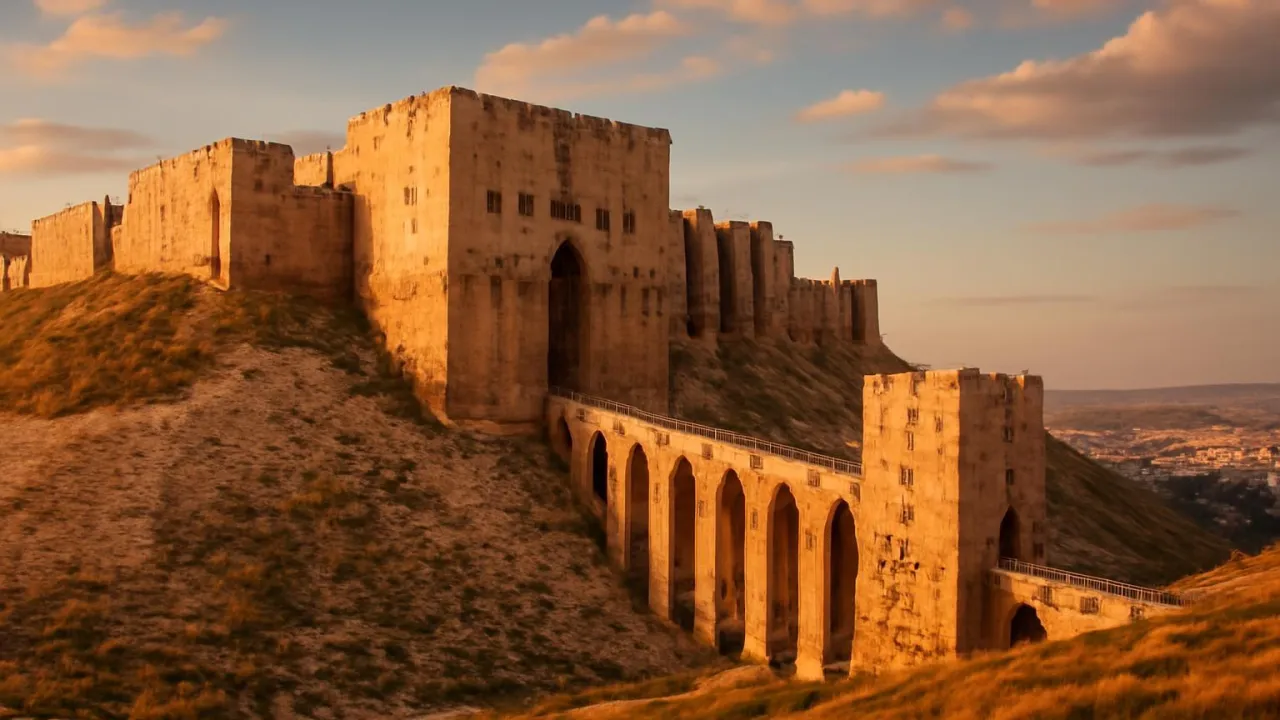
The Citadel’s hill was shaped by people thousands of years ago!
✨ Word Sparks (Grade 2 Glossary)
Tap 🔊 to hear
rampart
A strong wall for defense
tunnel
A long path under the ground
echo
A sound that bounces back
🪝
What would you see standing on the Citadel’s high walls?
1
A Mighty Hilltop Fortress
The Citadel sits on a steep hill, watching over Aleppo city. Its thick stone walls protected people long ago. From the top, you can see houses and busy streets. Visitors love to climb up and look around.
2
Exploring Ancient Rooms
Inside, you find old halls, dark , and tiny windows. Soldiers once guarded the gates and towers. The stones feel cool under your hands and feet. Some rooms when you talk or sing.
3
Stories in the Stones
The Citadel is full of exciting stories from the past. Kings, queens, and brave heroes lived here. Today, people visit to learn about history and imagine old battles. The Citadel keeps Aleppo’s stories safe.
The Citadel’s main gate has a sharp turn to slow down attackers!
✨ Word Sparks (Grade 3 Glossary)
Tap 🔊 to hear
ramparts
Tall, thick castle walls
cistern
A tank for storing water
erosion
Wearing away by wind or rain
🪝
What secrets might be hidden behind the Citadel’s ancient gates?
1
A Fortress Built for Protection
High on its mound, the Citadel of Aleppo towers over the city. Its thick limestone were designed to keep out invaders. Builders shaped the hill to make it extra steep and hard to climb. The fortress has protected people for thousands of years.
2
Inside the Mighty Walls
When you enter, you step onto cool stone floors and echoing halls. The Citadel holds a maze of tunnels, arched doorways, and secret stairways. Soldiers used these passages to move quickly and defend the fort. Some rooms have tiny windows for watching and shooting arrows.
3
Engineering Wonders of the Past
The Citadel’s walls are made of limestone blocks stacked in thick layers. Builders used arches and buttresses to hold up heavy roofs and towers. Rainwater was collected in deep underground for drinking during long sieges. Over centuries, earthquakes and have changed the walls’ shapes.
4
A Place Full of Stories
Many rulers, from ancient kings to medieval sultans, made the Citadel their home. Today, people visit to explore its history and imagine old battles. The Citadel is a monument to Aleppo’s strength and culture. Its stones still echo with stories from long ago.
The Citadel’s oldest parts date back over 4,000 years—older than the Roman Empire!
✨ Word Sparks (Grade 4 Glossary)
Tap 🔊 to hear
drawbridge
A bridge that can be lifted up
siege
A long attack on a castle
restoration
Fixing old buildings to save them
🪝
If you could time-travel, what would you witness inside the Citadel’s ancient halls?
1
A Fortress Through the Ages
The Citadel of Aleppo rises above the city on a massive, man-made mound, its origins stretching back over 4,000 years. Over centuries, rulers rebuilt and expanded its walls, turning it into one of the world’s oldest and largest castles. The thick limestone ramparts and towering gates were engineered to withstand attacks from every direction. Today, the Citadel stands as a symbol of Aleppo’s enduring strength and history.
2
Ingenious Medieval Engineering
Medieval builders used advanced techniques to make the Citadel nearly impossible to conquer. The main entrance zigzags sharply, forcing attackers to slow down and making defense easier. Deep moats, , and hidden arrow slits gave soldiers an advantage in battle. Rainwater was collected in underground cisterns, ensuring people inside could survive long without leaving.
3
A Center of Power and Culture
Throughout history, the Citadel was home to kings, sultans, and powerful armies. It was also a center for learning, with mosques, palaces, and even a small theater inside its walls. The fortress protected Aleppo’s people and treasures during wars and earthquakes. Today, visitors marvel at its ancient halls, tall towers, and the breathtaking view of the city below.
4
Legacy of Stone and Story
The Citadel’s stones have witnessed countless stories of bravery, invention, and daily life. Erosion and earthquakes have changed its shape, but careful keeps its history alive. As a UNESCO World Heritage Site, the Citadel reminds the world of Aleppo’s rich culture and the power of human engineering. Every visit helps keep its stories echoing for future generations.
1. How did the Citadel’s zigzag entrance help defenders?
2. Why is the Citadel a UNESCO World Heritage Site?
🤯 Mind-Blowing Fact • Grade 5
The Citadel’s walls contain stones reused from ancient Roman and Byzantine buildings, linking many eras together.
✨ Word Sparks (Grade 5 Glossary)
Tap 🔊 to hear
buttress
A stone support that holds up walls
portcullis
A heavy gate that drops down
acoustic
How sound travels in a place
🪝
What would you discover if you traced every stone and secret passage within the Citadel of Aleppo?
1
A Monument Spanning Millennia
Perched atop a 50-meter-high artificial mound, the Citadel of Aleppo dominates the skyline as one of the oldest continuously used fortresses on Earth. Archaeological evidence suggests the site was first occupied in the 3rd millennium BCE, evolving through Hittite, Greek, Roman, Byzantine, and Islamic eras. Its current massive limestone fortifications, primarily constructed during the Ayyubid dynasty in the 12th and 13th centuries, reflect centuries of military innovation and architectural adaptation. The Citadel’s strategic location allowed it to control trade routes and defend the city from countless invaders.
2
Engineering Marvels and Defensive Genius
The Citadel’s defensive systems reveal advanced medieval engineering principles. Its imposing outer walls, some over 16 meters thick, are reinforced with semi-circular towers and to resist battering rams and earthquakes. The main entrance features a dogleg turn, forcing attackers into a narrow, easily defended corridor overlooked by murder holes and arrow slits. A deep moat, once filled with water, encircles the mound, while a drawbridge and further protected the main gate from direct assault.
3
Life and Innovation Inside the Walls
Within its 7-hectare enclosure, the Citadel contained a self-sustaining community, including mosques, palaces, granaries, bathhouses, and a sophisticated water system. Engineers constructed underground cisterns capable of storing thousands of gallons of rainwater, ensuring survival during prolonged sieges. The properties of vaulted halls allowed voices and signals to carry during emergencies, while thick stone walls provided insulation against Aleppo’s hot summers and cold winters. Restoration efforts today use both traditional techniques and modern technology to preserve these features.
4
Cultural and Historical Impact
The Citadel was not just a military stronghold; it was a symbol of Aleppo’s power, culture, and resilience. It hosted rulers from Saladin’s family, witnessed the Crusades, and served as a refuge during earthquakes and invasions. Its architecture influenced other fortifications across the Islamic world and Europe, blending local Syrian traditions with imported styles. As a UNESCO World Heritage Site, the Citadel draws scholars and tourists alike, inspiring research into ancient engineering and cultural exchange.
5
Preservation and Global Legacy
Modern conflicts and natural disasters have damaged parts of the Citadel, but international teams are working to restore and protect it for future generations. Advanced 3D scanning and digital modeling help document every stone and arch, guiding careful reconstruction. The Citadel stands as a testament to human ingenuity, endurance, and the importance of preserving world heritage. Its story connects people across time, reminding us that history’s greatest landmarks belong to everyone, everywhere.