2. What do people use to see the hills from above?
🤯 Mind-Blowing Fact • Grade 3
The Chocolate Hills were formed from ancient coral reefs millions of years ago!
✨ Word Sparks (Grade 3 Glossary)
Tap 🔊 to hear
karst
Land made from soft rock like limestone
erosion
When wind or water wears away rock
legend
A story told for many years
🪝
Can you imagine standing on a hill and seeing hundreds of chocolate-colored mounds all around you?
1
Nature’s Sweet-Looking Surprise
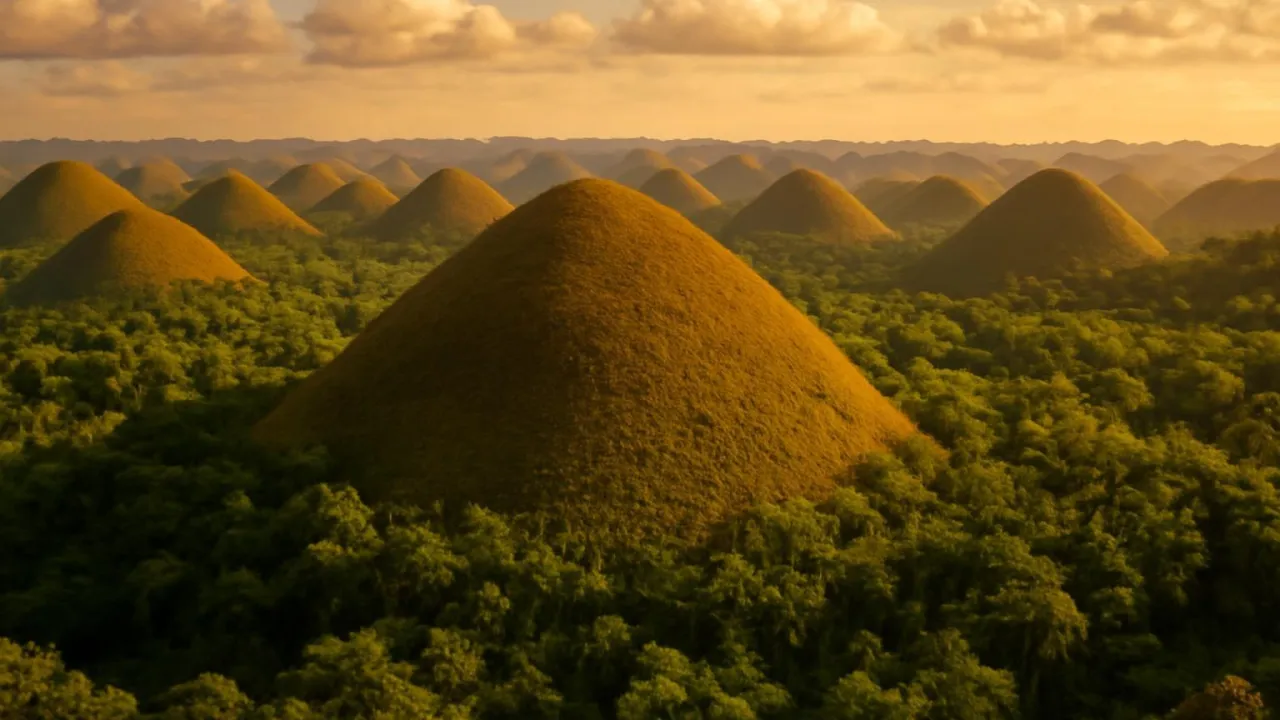
The Chocolate Hills of Bohol look like a field of giant chocolate candies. During the dry season, the sun dries the grass, turning the hills a deep brown color. This makes them look delicious from far away. People travel from many countries to see this natural wonder.
2
How Did the Hills Form?
Scientists say the hills are a formation, made from ancient coral and limestone. Rainwater slowly dissolved the limestone, shaping the hills over millions of years. Wind and helped make them smooth and round. Today, there are over 1,260 hills in the area.
3
A Place Full of Adventure
Visitors can climb a staircase to a special view deck. From there, you see hundreds of hills, all with similar size and shape. The tallest hills reach about 164 feet (50 meters) high. It’s a favorite spot for taking photos and exploring.
4
Legends and Local Stories
Some say the hills were made by giants throwing rocks during a fight. Others believe they are the tears of a heartbroken giant. Scientists know the real story is about and ancient seas. But the make visiting the hills even more magical.
1. What natural process helped shape the Chocolate Hills?
2. Why do people call them 'Chocolate Hills'?
🤯 Mind-Blowing Fact • Grade 4
The Chocolate Hills are made of limestone from ancient coral reefs that once covered Bohol!
✨ Word Sparks (Grade 4 Glossary)
Tap 🔊 to hear
limestone
A soft rock made from ancient sea life
monument
A special place protected for its importance
panoramic
A wide, all-around view
🪝
What if you could hike across a landscape that looks like a giant box of chocolate truffles?
1
A Unique Landscape in the Philippines
The Chocolate Hills are a famous natural landmark found on Bohol Island in the Philippines. Spanning an area of over 20 square miles, the hills create a breathtaking view, especially during the dry season when they turn chocolate-brown. This color change happens because the sun dries out the green grass that covers each hill. Tourists from around the world come to witness this one-of-a-kind sight.
2
Geology: How the Hills Were Made
Geologists classify the Chocolate Hills as a karst landscape, formed by the dissolution of bedrock. Millions of years ago, this region was covered by ancient coral reefs and seashells, which slowly turned into limestone. Rainwater, slightly acidic, seeped into cracks and dissolved the rock, while erosion and weathering shaped the hills into their smooth, conical forms. There are at least 1,260 hills, but some counts reach over 1,700.
3
Exploring and Protecting the Hills
Visitors can climb a 214-step staircase to a viewing deck that offers a view of the hills. Most hills stand between 98 and 164 feet tall, and their uniform shape makes the landscape look almost unreal. The Chocolate Hills are a protected natural , which helps preserve their unique beauty and prevents damage from development. Local guides share both scientific facts and fun legends with curious travelers.
4
Legends and Cultural Importance
Local legends say the hills were formed by giants—either from a rock-throwing battle or from a giant’s tears. These stories are part of Bohol’s rich culture and are shared during festivals and tours. While science explains the hills’ formation, the legends add a magical feeling to the visit. The Chocolate Hills are now recognized as a National Geological and are considered one of the Philippines’ top wonders.
1. What causes the hills to turn brown every year?
2. What type of rock makes up the Chocolate Hills?
🤯 Mind-Blowing Fact • Grade 5
The Chocolate Hills’ nearly perfect conical shapes are so uniform that scientists still debate exactly why they formed this way.
✨ Word Sparks (Grade 5 Glossary)
Tap 🔊 to hear
karst
Land shaped by water dissolving soft rock
geomorphology
The study of how landforms are made
tectonic uplift
When Earth’s crust rises and forms new land
🪝
Imagine stepping onto a viewing deck and gazing across a sea of perfectly shaped brown mounds, each one a silent witness to millions of years of Earth’s history.
1
A Geological Marvel in the Heart of Bohol
The Chocolate Hills, located on Bohol Island in the Philippines, are one of the world’s most visually striking landscapes. Spanning approximately 20 square miles, this site features at least 1,260 individual hills, though some surveys count as many as 1,776. During the dry season, the hills’ grass cover dries out and transforms into a rich chocolate-brown color, giving the landscape its famous name. These conical mounds are nearly symmetrical, creating a mesmerizing pattern that draws thousands of visitors each year. The Chocolate Hills have been designated a National Geological Monument and are a candidate for UNESCO World Heritage status.
2
Formation: From Ancient Coral Reefs to Hills
Geologists have determined that the Chocolate Hills are composed primarily of marine limestone formed from ancient coral reefs and shells deposited millions of years ago. Over time, raised these sediments above sea level, where they were exposed to weathering. Rainwater, slightly acidic due to dissolved carbon dioxide, percolated through cracks in the limestone, gradually dissolving the rock and creating sinkholes and ridges. Continuous erosion and chemical weathering sculpted the landscape into the iconic conical hills seen today, with each hill ranging from 98 to 164 feet (30 to 50 meters) in height.
3
Ecology and Seasonal Transformation
The hills are covered with hardy grasses, including Imperata cylindrica and Saccharum spontaneum, which thrive in the region’s tropical climate. During the wet season, these grasses remain lush and green, but as the dry season arrives, the vegetation withers and the hills turn a uniform brown. This dramatic transformation, visible from panoramic view decks, is unique among the world’s landscapes. The Chocolate Hills’ ecosystem supports a variety of wildlife, including birds, insects, and small mammals adapted to the open, grassy terrain.
4
Cultural Legends and National Significance
The Chocolate Hills hold deep cultural meaning for the people of Bohol, inspiring legends that explain their origin. One popular tale describes two giants hurling rocks at each other, leaving behind the scattered mounds. Another legend tells of a giant whose tears formed the hills after a lost love. These stories are woven into local festivals, art, and tourism, enriching the scientific narrative with cultural heritage. The hills are protected by Philippine law, ensuring their preservation for future generations and promoting sustainable tourism in the region.
5
Scientific Study and Global Recognition
Researchers continue to study the Chocolate Hills to better understand processes and tropical . The uniformity and density of the hills make them a valuable natural laboratory for investigating limestone weathering and erosion. The site attracts geologists, ecologists, and tourists alike, each drawn by its unique appearance and scientific significance. As a symbol of Philippine natural heritage, the Chocolate Hills highlight the importance of conserving rare geological formations. Their nomination for UNESCO status underscores their value as a world-class natural wonder.