🇺🇸 U.S. HISTORY
🏛️ Virginia & U.S. Civil Engineering Milestone • Opened April 15, 1964
VA History & Social Science SOL K.1, 1.2, 2.4, VS.1–VS.10, USI & USII
Chesapeake Bay Bridge-Tunnel
Where Cars Dive Under the Ocean So Ships Sail Overhead!
Grade 2 • Developing • 113 words
⏳ Era / StatehoodConstructed 1960–1964; Opened April 15, 1964 (Parallel Span Added 1999)
🗺️ Region / Capital17.6 Miles Shore-to-Shore Linking Virginia Beach to Virginia's Eastern Shore
📜 Key MilestoneCombines 12 miles of trestle bridges, 4 artificial islands, and 2 mile-long undersea tunnels
⚡ Historical SparkDips highway traffic beneath deep Chesapeake shipping channels so Navy aircraft carriers and cargo ships never get blocked!
🤯 Mind-Blowing Fact • Grade 1
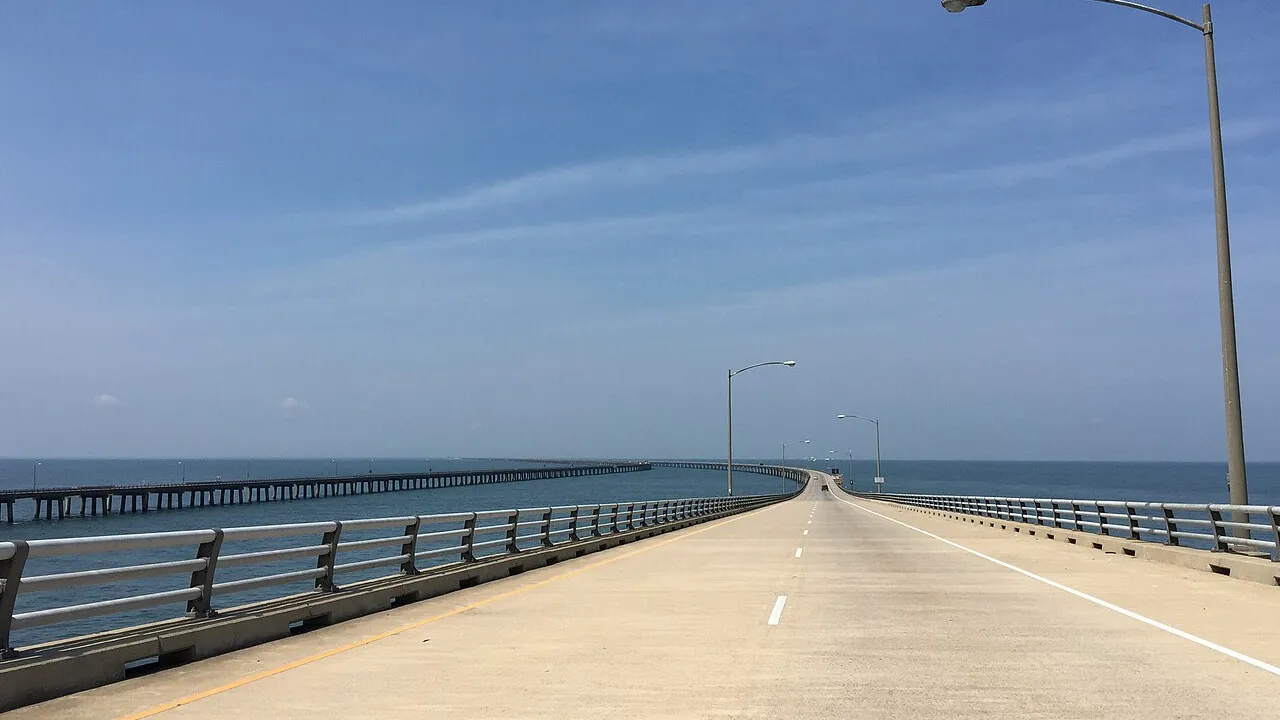
Drivers cross so far out over the mouth of the Chesapeake Bay that for part of the drive you cannot see land in front of you or behind you—only open water!
✨ Word Sparks (Grade 1 Glossary)
Tap 🔊 to hear
trestle
Long low bridge held up by pillars
tunnel
Underground or underwater passage for cars
bay
Wide body of water partly surrounded by land
🪝
Have you ever seen a highway disappear right into the middle of the ocean?
1
Across the Big Bay
Zoom! Cars drive out over sparkling blue waves on a seventeen-mile bridge in Virginia. Seagulls glide beside the railings!
2
Down Into the Tunnel!
Suddenly, the road reaches a small rocky island and dives into a bright under the water! Above the tunnel roof, giant ships sail past.
3
Connecting Two Shores
Opened in 1964, the Chesapeake Bridge- connects Virginia Beach to Virginia's Eastern Shore in less than half an hour!
1. Why does the Chesapeake Bay Bridge-Tunnel dip underwater into tunnels instead of using only bridges?
2. Which state is home to the 17.6-mile Chesapeake Bay Bridge-Tunnel?
🤯 Mind-Blowing Fact • Grade 2
When the Chesapeake Bay Bridge-Tunnel opened on April 15, 1964, engineers around the globe named it one of the 'Seven Engineering Wonders of the Modern World'!
✨ Word Sparks (Grade 2 Glossary)
Tap 🔊 to hear
peninsula
Strip of land surrounded by water on three sides
artificial
Made by human builders rather than nature
channel
Deepest water lane where large ships steer
🪝
How did engineers build four brand-new rocky islands right where Chesapeake Bay meets the Atlantic Ocean?
1
Goodbye Slow Ferryboats
Before 1964, families and farm trucks waited in long lines for ferries that took nearly ninety minutes to cross the choppy mouth of the Chesapeake Bay! Virginia leaders asked engineers to design a faster crossing that could survive Atlantic storms.
2
Why Tunnels Beat Tall Bridges
Right nearby in Norfolk sits the world's largest Navy base! Naval leaders worried that if a hurricane ever knocked down a tall suspension bridge, wreckage could trap ships inside the harbor—so engineers combined low bridges with two mile-long underwater tunnels.
3
Four Man-Made Islands
Crews dumped millions of tons of sand and heavy granite boulders to create four five-acre islands right in the bay, giving cars safe ramps to dive underwater and pop back up into sunshine!
1. How many man-made islands hold the tunnel entrances and exits along the Chesapeake Bay Bridge-Tunnel?
2. Before the Bridge-Tunnel opened in 1964, how did travelers cross directly between Virginia Beach and Cape Charles on the Eastern Shore?
🤯 Mind-Blowing Fact • Grade 3
Each underwater tunnel section was 300 feet long, towed 1,700 miles through the Gulf of Mexico and up the Atlantic Coast to Virginia like a giant floating submarine!
✨ Word Sparks (Grade 3 Glossary)
Tap 🔊 to hear
nor'easter
Strong coastal storm blowing from the northeast
seabed
Sandy muddy floor beneath ocean water
watertight
Sealed so tightly zero water leaks inside
🪝
How do you build a watertight car tunnel nearly a hundred feet beneath crashing ocean waves?
1
Taming Hurricane Waves
Feel salty ocean spray whip across the mouth of the Chesapeake Bay where fresh river water meets surging Atlantic swells! Designing a 17.6-mile crossing between Virginia Beach and Cape Charles in 1960 meant conquering fierce currents, fog, and storms.
2
Giant Floating Machines
Because waves rocked ordinary barges too hard, engineers invented giant spider-like 'walking platforms' nicknamed the Big D and the Two-Headed Monster! Standing on long steel legs planted on the bay floor, they drove hollow concrete piles deep into the to hold twelve miles of low trestle bridges.
3
Sinking Steel Tunnel Tubes
Workers built thirty-seven huge steel-and-concrete tunnel tubes—each as long as a football field—in Texas, towed them 1,700 miles by tugboat to Virginia, lowered them into deep underwater trenches, and bolted them before pumping out the water!
4
Linking Virginia's Regions
Opened April 15, 1964—and expanded with a twin parallel bridge in 1999—this Virginia landmark connects Eastern Shore farms and seafood harvesters swiftly to Hampton Roads and East Coast markets.
1. How did engineers place the two mile-long tunnels underneath the Chesapeake Bay shipping channels?
2. Which two Virginia regions does the Chesapeake Bay Bridge-Tunnel directly connect?
🤯 Mind-Blowing Fact • Grade 4
The Chesapeake Bay Bridge-Tunnel was built without a single penny of local, state, or federal tax money—drivers paid back the $200 million construction bonds through bridge tolls!
✨ Word Sparks (Grade 4 Glossary)
Tap 🔊 to hear
estuary
Coastal bay where river freshwater meets ocean
riprap
Heavy boulders stacked to block wave damage
revenue bond
Construction loan repaid later using user tolls
🪝
Why was the Chesapeake Bay Bridge-Tunnel chosen over skyscrapers and dams as the top civil engineering achievement in America in 1965?
1
Geography of Virginia's Largest Estuary
Look at a map of Virginia's Coastal Plain (Tidewater) and spot the Delmarva Peninsula—home to Virginia's Eastern Shore counties of Accomack and Northampton—separated from mainland Hampton Roads by seventeen miles of open water at the mouth of Chesapeake Bay! As America's largest , the bay serves both Baltimore cargo ships and Naval Station Norfolk, meaning any crossing had to leave Thimble Shoal and Chesapeake shipping channels completely unobstructed.
2
Immersed Tubes and Granite Riprap Islands
Led by designer Leif J. Sverdrup between 1960 and 1964—and financed entirely through $200 million in toll rather than tax dollars—crews constructed four 5.25-acre artificial islands armored with boulders weighing up to twenty tons apiece! Beneath the two shipping lanes, deep-sea divers working largely by touch in murky currents guided thirty-seven prefabricated 300-foot steel-and-concrete tubes into dredged trenches nearly a hundred feet below sea level.
3
High Bridges, Trestles, and Twin Spans
Connecting the islands to shore required over 2,500 prestressed concrete piles supporting twelve miles of low trestle roadway twenty-eight feet above storm waves, plus two high-level bridges near Fisherman Island for local fishing boats. In 1999, engineers added a parallel bridge span doubling above-water traffic to four safe lanes.
4
Artificial Reefs Teeming With Marine Life
An unexpected ecological bonus soon appeared: the submerged boulders and concrete pilings formed four giant artificial reefs attracting mussels, barnacles, sea bass, tautog, striped bass, and migratory seabirds—making the crossing a world-famous marine habitat as well as a vital U.S. Route 13 corridor!
1. Why did U.S. Navy leaders insist on underwater tunnels instead of giant suspension bridges over the Chesapeake Bay's main shipping channels?
2. How did the Bridge-Tunnel's rocky islands and concrete pilings unexpectedly benefit Chesapeake Bay wildlife?
🤯 Mind-Blowing Fact • Grade 5
To expand the Thimble Shoal Tunnel in the 21st century without disturbing bay waters or shipping above, engineers used a giant 42-foot-wide tunnel-boring machine affectionately nicknamed 'Chessie' to carve straight through deep seabed clay!
✨ Word Sparks (Grade 5 Glossary)
Tap 🔊 to hear
prestressed
Strengthened beforehand with tight internal steel cables
aquaculture
Sustainable farming of oysters clams and fish
bespoke
Custom-designed specifically for one unique challenge
🪝
How did civil engineers conquer open-ocean swells, deep shipping lanes, and soft seabed silt across 17.6 miles—and how do modern tunnel-boring machines expand it today?
1
Bridging Virginia's Maritime Divide
For over three centuries, water separated Virginia's Eastern Shore (the southern tip of the Delmarva Peninsula) from the Tidewater mainland, requiring an eighty-five-minute ferry voyage across the turbulent mouth of the Chesapeake Bay or a two-hundred-mile overland detour around Maryland. Chartered by the Virginia General Assembly in 1954 and financed solely through $200 million in private toll revenue bonds in 1960, the Chesapeake Bay Bridge and Tunnel Commission commissioned Sverdrup & Parcel to engineer a 17.6-mile shore-to-shore crossing along U.S. Route 13.
2
Strategic Imperative of Immersed-Tube Tunnels
Because Hampton Roads harbors the U.S. Navy's Atlantic Fleet at Norfolk along with major coal and container terminals, the Navy prohibited tall suspension spans across the two primary navigation lanes—Thimble Shoal Channel (serving Hampton Roads) and Chesapeake Channel (serving upper Chesapeake Bay and Baltimore)—lest structural collapse ever trap vessels inside. Engineers answered with a hybrid design: twelve miles of low-level concrete trestle, two high-level steel bridges over secondary boat channels, four 5.25-acre man-made islands armored in twenty-ton quarry granite, and two mile-long immersed-tube tunnels.
3
Custom Marine Construction Machines
Open-Atlantic storm swells swiftly proved conventional floating barges too unstable. Contractors designed jack-up platforms: the 'Big D' drove fifty-four-inch hollow cylinder piles up to 170 feet into the bay floor; the 'Two-Headed Monster' capped piles and placed roadway decks concurrently; and the 'Slab Setter' aligned thirty-seven double-walled steel tunnel segments fabricated in Orange, Texas, ballasted with concrete, and sunk into gravel-lined trenches nearly a hundred feet below water.
4
Economic, Ecological, and Recognition Milestones
Opening on April 15, 1964—and honored in 1965 by the American Society of Civil Engineers as the Outstanding Civil Engineering Achievement and one of the 'Seven Engineering Wonders of the Modern World'—the facility slashed crossing times to twenty-five minutes, cutting seventy-five miles off coastal New York–to–Florida freight routes and linking Eastern Shore agriculture, , and Wallops Island aerospace facilities directly to Hampton Roads. Meanwhile, its 1.5 million tons of submerged granite riprap evolved into one of the Mid-Atlantic's richest artificial reef ecosystems.
5
Parallel Bridges and 21st-Century Tunnel Boring
After completing a $200 million parallel above-water trestle in 1999 to provide four divided lanes over open water, engineers advanced twenty-first-century expansion using a massive forty-two-foot-diameter earth-pressure-balance tunnel-boring machine ('Chessie') to bore a new parallel Thimble Shoal Tunnel deep beneath the seabed—minimizing disturbance to Chesapeake Bay marine habitats overhead.