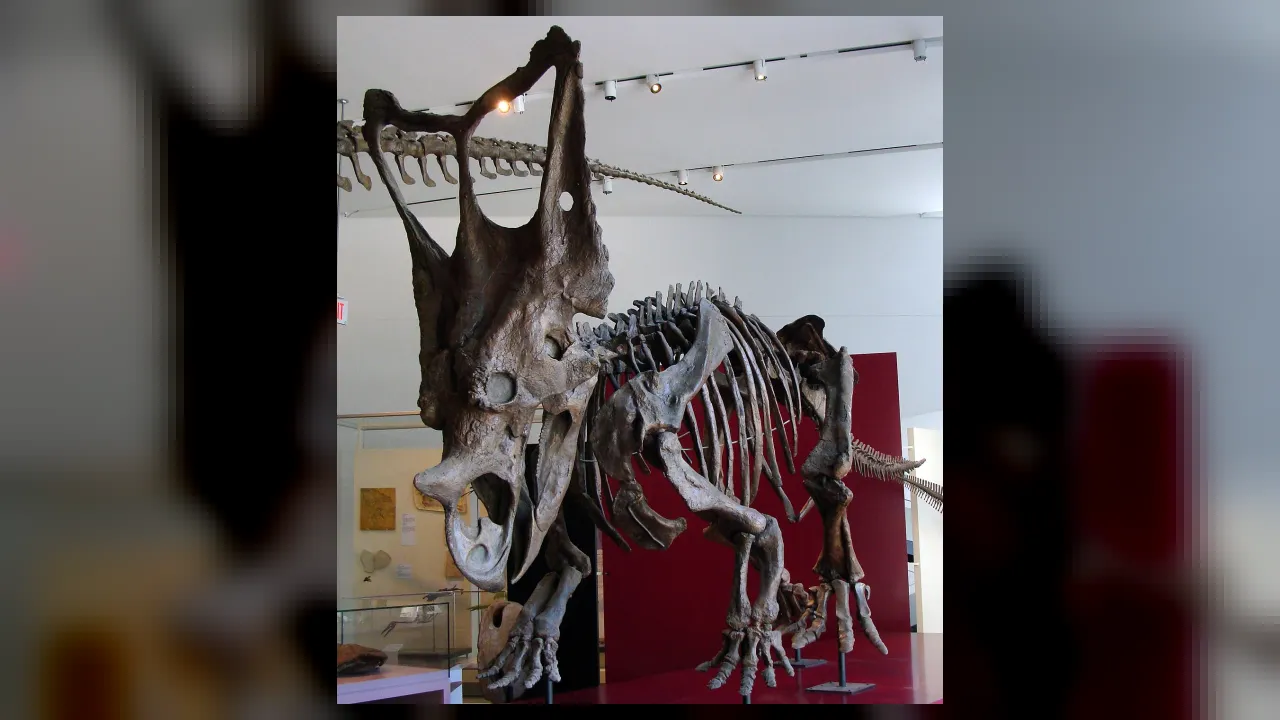
1. Why wasn't Chasmosaurus's huge heart-shaped frill too heavy for its neck?
2. What shape did the outer rim of Chasmosaurus's frill look like from the front?
🤯 Mind-Blowing Fact • Grade 2
Large fossilized skin patches from Chasmosaurus revealed big five-sided rosettes surrounded by neat rings of smaller scales!
✨ Word Sparks (Grade 2 Glossary)
Tap 🔊 to hear
Billboard
A wide, flat surface meant to be seen
Canvas
Strong, tight material stretched across a frame
Rosette
A flower-like circle of scales on skin
🪝
Was Chasmosaurus's giant neck frill built like armor—or like a peacock's tail?
1
Opening Lizard
Step into a dappled conifer forest in ancient Canada 76 million years ago. Tilting its head in a sunbeam stands Chasmosaurus, a 16-foot horned dinosaur weighing two tons! Its name means 'opening lizard,' thanks to two enormous windows inside its bony frill.
2
Built to Dazzle, Not Block Bites
Because the bone frame around those openings was surprisingly thin, the frill could not stop a tyrannosaur's bite! Instead, tough skin stretched across the frame like on a kite, turning its head into a colorful .
3
Adorable Dinosaur Toddler
In 2010, scientists unearthed an almost complete three-year-old Chasmosaurus baby just five feet long with a cute, rounded frill!
2. About how long was the three-year-old baby Chasmosaurus skeleton found in Alberta?
🤯 Mind-Blowing Fact • Grade 3
Fossilized Chasmosaurus skin was one of the first ever discovered for any horned dinosaur, featuring big two-inch polygonal scales arranged in neat rows!
✨ Word Sparks (Grade 3 Glossary)
Tap 🔊 to hear
Chasmosaurine
Horned dinosaur group with long, wide frills
Polygonal
Shaped with several straight sides and corners
Browser
Herbivore that picks specific leaves and twigs
🪝
What did the world's cutest baby horned dinosaur fossil teach scientists about Chasmosaurus?
1
Leader of the Long-Frills
Stroll along a shady riverbank in Alberta's Dinosaur Provincial Park 76 million years ago, and you might spot two kinds of horned dinosaurs sharing the woods. While Centrosaurus traveled in mega-herds with short spiky frills, Chasmosaurus gave its name to the —the long-frilled family that later produced Triceratops!
2
Living Kite Frame
Stretching longer than the rest of its skull, Chasmosaurus's broad, V-notched frill held two enormous fenestrae framed by slender bone bars and triangular edge hornlets. Blood vessels grooved into the bone could flush skin over the frill with vivid patterns to impress mates or startle rivals.
3
Picky Forest Browser
Compared to wide-snouted Centrosaurus, Chasmosaurus had a longer, narrower beak for plucking tender shoots, cycads, and flowering shrubs in smaller family groups.
4
A Toddler Frozen in Sand
Unearthed by Philip Currie's team in 2010, a five-foot juvenile Chasmosaurus belli showed short, rounded frill corners that stretched into wide heart-wings only as adults matured—plus sinking gently in calm river sand without a single predator bite mark!
1. How did Chasmosaurus share the exact same forests with Centrosaurus without fighting over food?
2. How did a baby Chasmosaurus's frill differ from an adult's?
🤯 Mind-Blowing Fact • Grade 4
Charles Sternberg's 1920s Chasmosaurus mummy patch preserved large 55-millimeter feature scales arranged in neat rows, proving horned dinosaurs had strikingly patterned hides!
✨ Word Sparks (Grade 4 Glossary)
Tap 🔊 to hear
Epoccipital
Small triangular bone edging a ceratopsid frill
Vascularized
Richly supplied with tiny branching blood vessels
Articulated
Bones preserved still joined in natural position
🪝
How did thin bone struts, mosaic skin scales, and a three-year-old juvenile unlock the secrets of Chasmosaurus?
1
Founding Member of Chasmosaurinae
In 1898, geologist Lawrence Lambe uncovered part of a bizarre, wide-windowed neck shield in Alberta's Red Deer River badlands, naming Chasmosaurus belli fully in 1914. Living 76.5 to 75.5 million years ago, this two-ton, 4.8-meter herbivore stands as an early classic member of Chasmosaurinae—the long-frilled, narrow-beaked lineage that culminated ten million years later in giant Triceratops and Torosaurus.
2
Engineering an Ultra-Light Visual Shield
In adult Chasmosaurus, the rectangular-to-heart-shaped parietal-squamosal frill exceeded the rest of the skull in both length and width! Yet lifting it required surprisingly little neck strain because two cavernous parietal fenestrae removed most of the interior bone mass, leaving slender struts bordered by triangular . Far too fragile to parry a tyrannosaur's bone-crushing jaws, this frame supported taut, keratinized skin purely for species recognition, courtship, and intimidation.
3
Two Species in Stacked Time
Lower rock layers in Dinosaur Provincial Park preserve Chasmosaurus russelli, which sported tall, backward-curving brow horns, whereas slightly younger layers above hold Chasmosaurus belli, whose brow horns often shrank to low stubs while its sweeping heart-shaped frill grew even broader.
4
Lessons From Juvenile UALVP 52613
Described by Philip Currie and colleagues in 2016, an 1.5-meter toddler skeleton revealed an unexpected surprise: baby Chasmosaurus lacked wide elbows and splayed postures, walking upright on slender limbs with a narrow, arched back and a short, rounded frill!
1. How did Chasmosaurus russelli from older rock layers differ from slightly younger Chasmosaurus belli?
2. What did the articulated 1.5-meter toddler skeleton UALVP 52613 prove about Chasmosaurus posture?
🤯 Mind-Blowing Fact • Grade 5
Specimen UALVP 52613 was preserved with a gentle hollow sinkhole right around its body in sandstone, showing the little toddler quietly drowned in a river current without a single scavenger finding it!
✨ Word Sparks (Grade 5 Glossary)
Tap 🔊 to hear
Integument
Natural outer covering like skin and scales
Parasagittal
Legs positioned straight underneath the body upright
Emarginated
Having a notched dip along an edge
🪝
What do mosaic integument impressions and the most intact juvenile ceratopsid ever found reveal about Chasmosaurus?
1
Defining the Chasmosaurine Blueprint
First collected along Berry Creek in 1898 by Lawrence Lambe—who initially mistook its partial frill for a short-frilled Monoclonius before erecting Chasmosaurus belli in 1914—this 4.8-meter (16-foot), two-metric-ton herbivore anchored our understanding of the subfamily Chasmosaurinae. Inhabiting the Campanian alluvial forests of Alberta's Dinosaur Park Formation (76.5 to 75.5 million years ago), it contrasted ecologically with sympatric centrosaurines by traveling in smaller social groups and browsing selectively with an elongated, narrow rostrum.
2
Fenestrated Frill Mechanics and Evolution
True to the Greek chasma ('wide opening'), enormous sub-triangular parietal fenestrae occupied nearly the entire central expanse of its expansive, posteriorly frill, reducing cranial mass to a slender median bar and lateral squamosal-parietal struts. Stratigraphic succession within Dinosaur Provincial Park documents evolutionary modification from lower-zone Chasmosaurus russelli—bearing distinct postorbital brow horns and an incomplete posterior bar—into upper-zone C. belli, which frequently resorbed or minimized supraorbital horns while accentuating lateral epiparietal corners into a dramatic heart-shaped display sail.
3
Integumentary Architecture
Specimen CMN 2280, excavated by George F. Sternberg, preserved extensive right-flank skin impressions that remain benchmark evidence for ceratopsid . Rather than uniform pebbles or osteoderms, large pentagonal-to-hexagonal 'feature scales' up to 55 millimeters across sat spaced in longitudinal rows, each encircled by rosettes of smaller non-overlapping basement tubercles.
4
Ontogeny Illuminated by UALVP 52613
Because small juvenile dinosaurs suffer rapid scavenging and fluvial scattering, baby ceratopsid skeletons are exceedingly rare. In 2010, Philip Currie's team recovered UALVP 52613, a virtually complete, uncrushed three-year-old Chasmosaurus belli measuring 1.5 meters long—missing only its forefeet—entombed in low-energy channel sandstone.
5
Posture and Growth Allometry
Published in 2016, UALVP 52613 proved juvenile frills were narrow, posteriorly rounded, and tight against the shoulders before positive allometry flared their posterior corners outward at maturity, while intact pectoral joints confirmed (upright) forelimb posture from early youth.