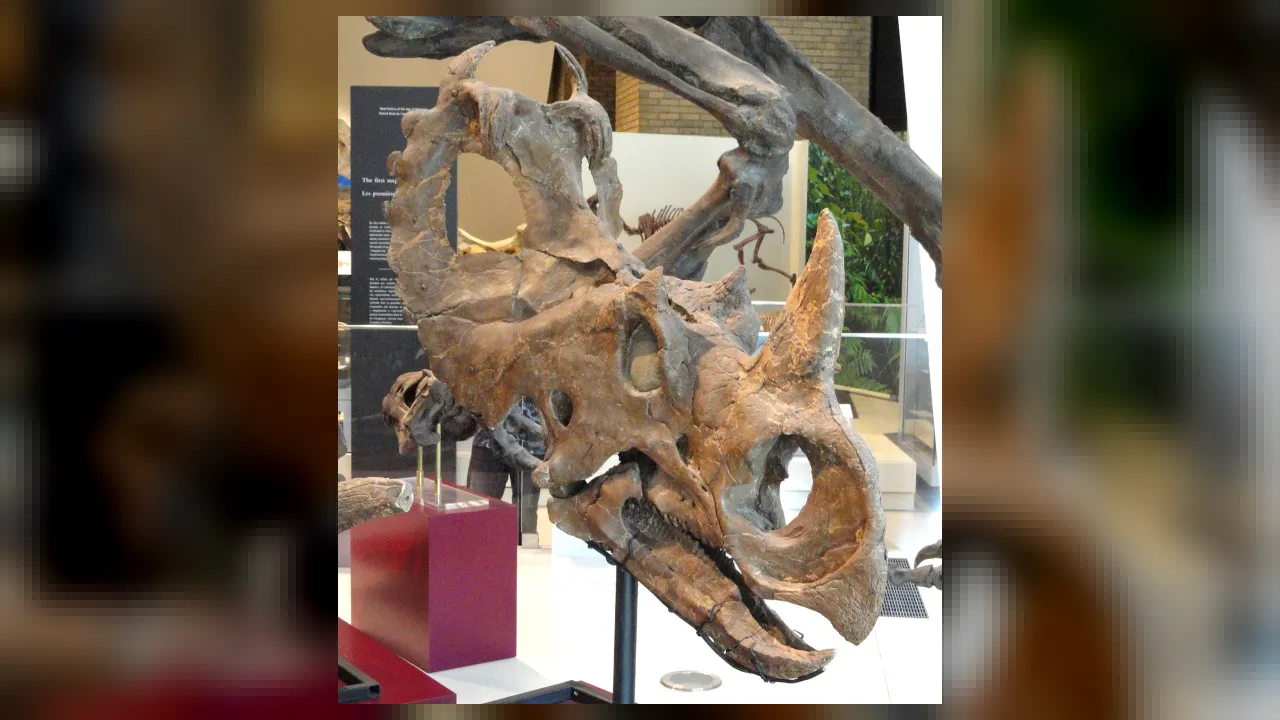
1. What curled forward from the top edge of a Centrosaurus frill?
2. How did Centrosaurus like to travel across ancient Canada?
🤯 Mind-Blowing Fact • Grade 2
Vast Centrosaurus bonebeds in Alberta stretch across whole valleys, covering spaces bigger than hundreds of football fields!
✨ Word Sparks (Grade 2 Glossary)
Tap 🔊 to hear
Hornlet
A small bony bump edging a frill
Wildebeest
African herd mammal famous for giant migrations
Wade
To walk steadily through shallow river water
🪝
Why does the name Centrosaurus mean 'pointed lizard' when its biggest horn sat on its nose?
1
Surprise Behind the Name
Splash! Mud flies as a herd of rhino-sized Centrosaurus across a wide river in ancient Alberta 76 million years ago. You might guess its name came from its big nose horn, yet scientists actually named it 'pointed lizard' for the row of small lining its neck frill!
2
Curving Every Which Way
Its tall nose horn could stand straight up, curve forward, or bend slightly backward depending on the dinosaur's age! Meanwhile, two thick bony hooks curled neatly down over the windows of its frill.
3
Safety in Giant Numbers
Moving in herds like modern helped Centrosaurus watch out for hungry tyrannosaurs prowling the woods.
1. Which body part actually inspired Lawrence Lambe to name Centrosaurus 'pointed lizard'?
2. Did every Centrosaurus nose horn curve the exact same way?
🤯 Mind-Blowing Fact • Grade 3
Skin impressions preserved beside a Centrosaurus skeleton show large round scales surrounded by rings of smaller pebble scales across its sides!
✨ Word Sparks (Grade 3 Glossary)
Tap 🔊 to hear
Delta
Flat, marshy land where rivers meet seas
Monsoon
Seasonal wind bringing heavy pouring rainstorms
CT Scan
Special X-ray camera taking 3D inside pictures
🪝
How could doctors diagnose an illness in a Centrosaurus leg bone that is 76 million years old?
1
Wildebeest of the Cretaceous
Stand on a breezy bluff in Late Cretaceous Alberta 76 million years ago, and the coastal plain below looks alive with moving shields! Stretching 18 feet long and weighing nearly three tons, Centrosaurus traveled in enormous herds across swampy river .
2
Changing Horns as They Grew
Paleontologist Peter Dodson and later researchers compared dozens of skulls from Alberta bonebeds and spotted a cool pattern: teenagers grew backward-curving nose horns, while mature adults reshaped those horns to tilt forward! Two stout hooks also curled downward from the top of the frill.
3
Tropical Storm Floods
Massive bonebeds in Dinosaur Provincial Park formed when seasonal or coastal storms flooded rivers, catching huge Centrosaurus herds as they tried to swim across.
4
Helping a Limping Friend
In 2020, medical doctors and paleontologists teamed up to CT-scan an unusual Centrosaurus lower-leg bone. Even with a serious bone illness that made it limp, the dinosaur survived to adulthood safely inside its protective herd!
1. How did a limping Centrosaurus with a badly swollen leg bone survive so long around predators?
2. What caused the giant Centrosaurus bonebeds in Dinosaur Provincial Park?
🤯 Mind-Blowing Fact • Grade 4
Comparing that 76-million-year-old Centrosaurus leg bone directly with modern human bone scans showed cancer cells behaved the exact same way in the Cretaceous Period as today!
✨ Word Sparks (Grade 4 Glossary)
Tap 🔊 to hear
Remodeling
Cells reshaping living bone during an animal's life
Fibula
The outer, thinner bone of the lower leg
Fenestra
A natural window-like opening in skull bone
🪝
How did Centrosaurus bonebeds clear up fake dinosaur species AND make medical history in 2020?
1
Mega-Herds Along the Seaway
Between 76.5 and 75.5 million years ago, warm waves of the Western Interior Seaway lapped against lush floodplains in southern Alberta. Centrosaurus apertus—whose species name means 'open,' honoring the twin large fenestrae in its rounded frill—dominated these coastal lowlands. Stocky, barrel-chested, and equipped with vertical tooth batteries, thousands of individuals cropped tough palms and woody shrubs in synchronized migrations.
2
Bone Remodeling Solves a Mystery
Early fossil hunters named several different Centrosaurus species because some skulls had forward-swept nose horns while others curved backward or stood straight. By measuring hundreds of skulls across growth stages from Alberta's Bonebed 43, paleontologists proved they all belonged to Centrosaurus apertus! As youngsters matured, microscopic bone cells actively remodeled the nasal horn forward while curling two thick parietal hooks down over the frill windows.
3
A Landmark Medical Diagnosis
Originally collected in 1989, a malformed Centrosaurus (lower leg bone) was long assumed to be a healed fracture. In 2020, physician Mark Crowther, paleontologist David Evans, and oncology specialists performed high-resolution CT scans and thin-section microscopy—diagnosing osteosarcoma, the first confirmed malignant bone cancer ever identified at the cellular level in a dinosaur!
4
Proof of Herd Protection
On its own, a slow, limping herbivore would have been easy prey for Gorgosaurus, proving mega-herd companionship shielded vulnerable herdmates until a flood buried the entire group together.
1. Why did early paleontologists mistakenly split Centrosaurus apertus into several separate species?
2. What historic discovery did physicians and paleontologists make in a Centrosaurus fibula in 2020?
🤯 Mind-Blowing Fact • Grade 5
The Hilda mega-bonebed in Alberta covers 2.3 square kilometers—making it the largest known horned-dinosaur fossil graveyard on planet Earth!
✨ Word Sparks (Grade 5 Glossary)
Tap 🔊 to hear
Paleopathology
Study of ancient injuries and illnesses in fossils
Monodominant
Bonebed containing mostly one single animal species
Morphometric
Measuring bone shapes mathematically to compare growth
🪝
What do vast monodominant bonebeds and cellular paleopathology reveal about the social life and biology of Centrosaurus apertus?
1
Eponym of the Centrosaurinae
First described in 1904 by Lawrence Lambe from a partial parietal frill unearthed along Alberta's Red Deer River, Centrosaurus apertus lent its name to Centrosaurinae—one of the two great subfamilies of horned ceratopsids. Flourishing between 76.5 and 75.5 million years ago in the lower Dinosaur Park Formation, this 5.5-meter (18-foot), 2.7-metric-ton herbivore navigated low-gradient coastal plains bordering the Western Interior Seaway.
2
Ontogenetic Cranial Remodeling
Whereas Lambe's initial specimen highlighted only scalloped marginal epiparietals and twin hooked processes (locus P1) curving ventrally across wide parietal fenestrae, complete skulls later revealed a towering nasal horn core alongside diminutive supraorbital horncores. Comprehensive studies by Michael Ryan, Caleb Brown, and Frederick Dodson across hundreds of bonebed elements demonstrated striking ontogenetic plasticity: juvenile nasal horns recurved posteriorly, straightened at subadulthood, and procured anteriorly in mature individuals while P2 hooks grew medially across the midline bar.
3
Taphonomy of Mega-Bonebeds
At Hilda along the South Saskatchewan River, David Eberth and colleagues mapped a coalesced Centrosaurus bonebed spanning 2.3 square kilometers and preserving an estimated 1,000 to several thousand individuals! Sedimentological evidence points toward catastrophic coastal storm surges or monsoonal floods overwhelming vast seasonal aggregations, followed by scavenging and fluvial sorting.
4
Cellular Paleopathology Milestone
In 2020, Seper Ekhtiari, David Evans, Mark Crowther, and collaborators published a landmark study in The Lancet Oncology on specimen ROM 767, a pathological Centrosaurus fibula from Bonebed 43. Combining micro-CT imaging, three-dimensional reconstruction, and thin-section bone histology, the team diagnosed advanced osteosarcoma—establishing the ancient evolutionary roots of malignant bone tumors.
5
Ecological Refuge Within the Herd
Because advanced limb pathology severely impaired locomotion in an environment prowled by Daspletosaurus and Gorgosaurus, ROM 767's prolonged survival prior to drowning alongside healthy herdmates offers compelling indirect evidence that mega-herd gregariousness buffered compromised individuals against apex predation.