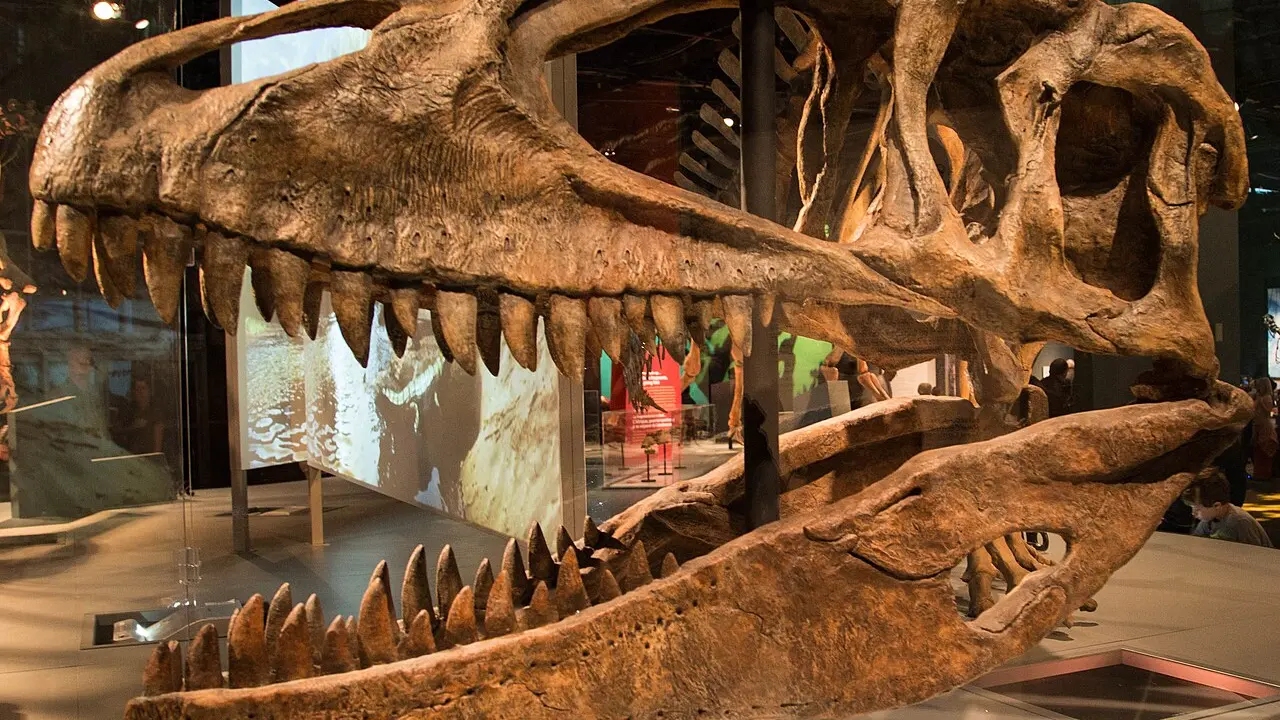
⚡ Survival SuperpowerEight-inch flat serrated teeth shaped like Great White Shark blades
🤯 Mind-Blowing Fact • Grade 1
A single Carcharodontosaurus skull stretched over five feet long—longer than most kids are tall!
✨ Word Sparks (Grade 1 Glossary)
Tap 🔊 to hear
serrated
Having tiny saw-like notches along a sharp edge
skull
The bony frame that shapes an animal's head
swamp
Wet land filled with trees and shallow water
🪝
Why does this giant land dinosaur have a name that means shark-toothed lizard?
1
Teeth Like a Shark!
Boom, boom! The ground shakes as a giant hunter steps out of the trees. Open wide! Carcharodontosaurus had flat, sharp teeth shaped just like Great White Shark teeth.
2
Bigger Than T. rex?
This dinosaur grew longer than a city bus! Its huge head alone was taller than a first grader.
3
King of Green Swamps
Long ago, North Africa had big rivers and tall trees. Carcharodontosaurus ran on two strong legs across the sunny land.
1. Why was Carcharodontosaurus named after sharks?
2. Roughly how long was the skull of Carcharodontosaurus?
🤯 Mind-Blowing Fact • Grade 2
Carcharodontosaurus lived right alongside another giant dinosaur hunter, Spinosaurus, by hunting on dry land while Spinosaurus fished in rivers!
✨ Word Sparks (Grade 2 Glossary)
Tap 🔊 to hear
expedition
A team journey made for science and discovery
prowl
To move quietly while searching for food
rival
A competitor that matches another in size or skill
🪝
How did scientists rediscover a lost giant dinosaur skull in the Moroccan desert?
1
A Giant Rival to T. rex
Imagine standing beside a dinosaur over forty feet long and weighing seven tons! Ninety-five million years ago, Carcharodontosaurus prowled ancient North Africa as one of the biggest meat-eating dinosaurs ever to walk the Earth. It even stretched slightly longer than many Tyrannosaurus rex skeletons!
2
Built Like Serrated Blades
While T. rex had thick, banana-shaped teeth for crushing bone, Carcharodontosaurus grew thin, flat teeth up to eight inches long. Tiny saw-like edges lined each tooth, matching the slicing teeth of Great White Sharks.
3
Lost and Found Fossils
Its first museum bones were lost in 1944, so scientists cheered in 1995 when an uncovered a giant skull in Morocco!
1. How were Carcharodontosaurus teeth different from T. rex teeth?
2. Where did scientists uncover a huge new Carcharodontosaurus skull in 1995?
🤯 Mind-Blowing Fact • Grade 3
Brain scans of the Moroccan Carcharodontosaurus skull showed huge smell centers and an inner ear tuned to low-frequency rumbles made by distant giant sauropods!
✨ Word Sparks (Grade 3 Glossary)
Tap 🔊 to hear
enamel
The hard, shiny outer coating protecting a tooth
sauropod
A giant plant-eating dinosaur with a long neck
titan
An animal or thing of enormous size and power
🪝
How could ancient North Africa support two different forty-foot meat-eating dinosaurs at the same time?
1
Land of Giant Predators
Heat shimmers above giant ferns and braided river deltas in Late Cretaceous North Africa 96 million years ago. Pounding across the dry floodplain comes Carcharodontosaurus saharicus, a twelve-to-thirteen-meter weighing nearly seven tons. Remarkably, this colossal hunter shared its world with the even longer Spinosaurus and other large theropods.
2
Shark-Toothed Precision
Its tongue-twister name comes from Carcharodon, the scientific name for Great White Sharks. Unlike thick tyrannosaur teeth built to shatter bone, Carcharodontosaurus teeth were narrow from side to side, reaching twenty centimeters long with wrinkled and razor-sharp serrations.
3
Mystery of the Lost Bones
German paleontologist Ernst Stromer named this dinosaur in 1931 from Egyptian fossils, which were tragically destroyed during World War II. Fifty-one years later, paleontologist Paul Sereno unearthed a magnificent 1.6-meter skull in Morocco's Kem Kem Beds.
4
Dividing the Menu
While Spinosaurus hunted huge river fish, Carcharodontosaurus stayed on firm ground to track giant long-necked like Paralititan.
1. What happened to the original Carcharodontosaurus fossils studied by Ernst Stromer?
2. What did inner-ear scans tell scientists about Carcharodontosaurus?
🤯 Mind-Blowing Fact • Grade 4
Biomechanics studies show Carcharodontosaurus could lift over 900 pounds (424 kg) in its jaws alone—about the weight of a grand piano!
✨ Word Sparks (Grade 4 Glossary)
Tap 🔊 to hear
endocast
A 3D model of a brain cavity inside skull bone
olfactory bulb
The brain region that processes smells and scents
fenestrated
Having natural window-like openings that lighten skull bone
🪝
What did CT scans of Carcharodontosaurus's braincase reveal about how giant predators thought and hunted?
1
Solving Stromer's Riddle
Imagine standing at the edge of the vast Kem Kem river system in Cenomanian-stage Morocco 96 million years ago. Emerging from conifer groves is Carcharodontosaurus saharicus, a 12.5-meter apex carnivore balancing a massive 1.6-meter skull above powerful hind limbs. Paleontologist Ernst Stromer first recognized its distinctive shark-like teeth in Egypt's Bahariya Oasis, and after wartime loss claimed his fossils in 1944, Paul Sereno's 1995 Moroccan skull restored this giant to science.
2
Inside the Brain of a Giant
In 2001, paleontologist Hans Larsson used CT imaging to build a 3D of Carcharodontosaurus's brain cavity. Unlike later bird-like coelurosaurs such as Tyrannosaurus rex, Carcharodontosaurus possessed an S-shaped brain layout closer to modern crocodilians in proportion, paired with enormous that gave it an extraordinary sense of smell.
3
Head Posture and Neck Strike
Semicircular canals in its inner ear revealed that Carcharodontosaurus held its snout tilted slightly downward while walking, giving it a clear forward view of terrain and prey. Combined with heavily muscled neck vertebrae, its narrow, skull acted like a giant hatchet lined with twenty-centimeter serrated blades.
4
Balancing the Kem Kem Food Web
By targeting colossal terrestrial titanosaurian and rebbachisaurid sauropods, Carcharodontosaurus thrived alongside river-dwelling Spinosaurus and swift Deltadromeus without exhausting one single food source.
1. What did semicircular canals in the inner ear reveal about how Carcharodontosaurus carried its head?
2. Which brain feature stood out most in the 3D endocast of Carcharodontosaurus?
🤯 Mind-Blowing Fact • Grade 5
In 2007, paleontologists Stephen Brusatte and Paul Sereno named a second species from Niger, Carcharodontosaurus iguidensis, proving multiple giant shark-toothed species ruled different parts of ancient Africa!
✨ Word Sparks (Grade 5 Glossary)
Tap 🔊 to hear
osteophagy
The specialized feeding ability to crush and digest bones
denticle
One tiny saw-like projection along a serrated tooth edge
allosauroid
A major branch of large blade-toothed theropod dinosaurs
🪝
How did Carcharodontosaurus saharicus evolve into Gondwana's supreme sauropod hunter before tyrannosaurs ever grew giant?
1
Apex of the Cenomanian Greenhouse
Ninety-six million years ago during the mid-Cretaceous hothouse, rising sea levels flooded low-lying basins across North Africa, nurturing the sprawling Kem Kem and Bahariya deltaic ecosystems. Commanding the drier uplands and floodplain margins stood Carcharodontosaurus saharicus, an theropod stretching twelve to thirteen meters long and weighing between six and eight metric tons—rivaling Tyrannosaurus rex and South America's Giganotosaurus among the largest terrestrial carnivores in Earth's history.
2
From Algerian Teeth to Moroccan Skulls
French paleontologists Charles Depéret and Justin Savornin first described isolated serrated teeth from Algeria in 1925, before Ernst Stromer established the genus Carcharodontosaurus in 1931 using partial skeletons from Egypt's Bahariya Formation. After a 1944 Allied air raid destroyed Munich's museum collection, the taxon remained enigmatic until Paul Sereno's 1995 expedition unearthed a 1.6-meter cranium in Morocco, followed in 2007 by a second species, Carcharodontosaurus iguidensis, discovered in Niger.
3
Craniodental Slicing Mechanics
Whereas tyrannosaurids evolved broad, fused nasals and D-shaped teeth for (bone-crushing), Carcharodontosaurus constructed a tall, narrow skull lightened by expansive antorbital fenestrae. Its laterally compressed, twenty-centimeter maxillary crowns featured transverse enamel wrinkles and high-density engineered to slice deep into thick sauropod hide using powerful neck-driven pull-back strokes.
4
Neuroanatomy of an Allosauroid
Computed-tomography endocasts published by Hans Larsson demonstrated that Carcharodontosaurus possessed a non-coelurosaurian cerebrum paired with hypertrophied olfactory bulbs, while inner-ear labyrinth geometry indicated a slightly downturned alert head posture and sensitivity to low-frequency ground-borne vibrations.
5
Turnover of the Giant Theropods
Near the end of the Cenomanian stage (~94 MYA), changing sea levels and sauropod faunal shifts ended carcharodontosaurid rule, clearing ecological space for abelisaurids in the south and tyrannosaurids in the north.