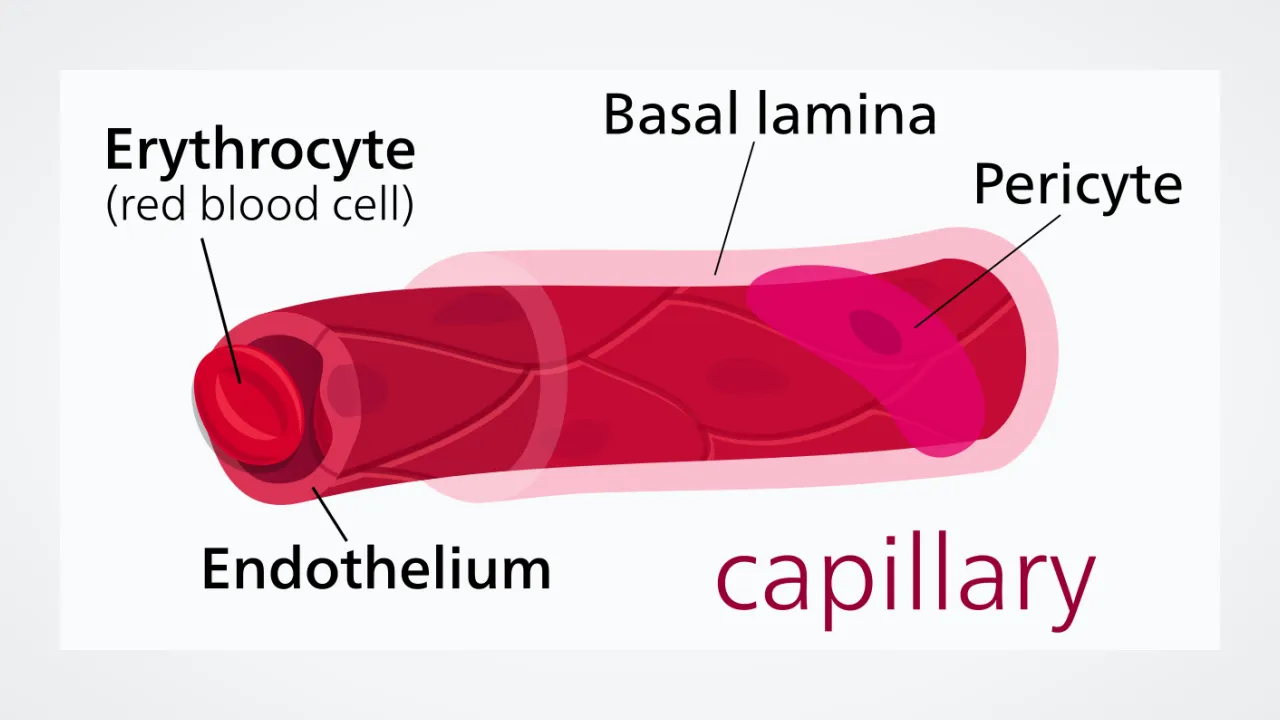
2. How do red blood cells travel through narrow capillaries?
🤯 Mind-Blowing Fact • Grade 2
Almost every living cell in your body sits closer than the thickness of an eyelash to a friendly neighborhood capillary!
✨ Word Sparks (Grade 2 Glossary)
Tap 🔊 to hear
nutrient
helpful food building block that powers cells
carbon dioxide
waste gas cells make and lungs breathe out
exchange
giving fresh supplies while picking up waste
🪝
Why can't big arteries and veins feed your cells directly without tiny capillaries?
1
Where the Real Delivery Happens
Imagine delivery trucks zooming down a fenced freeway without ever turning onto neighborhood streets—nobody would get their packages! Thick arteries and veins are like freeways, while microscopic capillaries are the cozy side streets reaching almost every cell.
2
Walls One Cell Thin
A capillary wall is only one single flat cell thick! Because that wall is ultra-thin and blood slows down to a gentle crawl inside, oxygen and lunch slip effortlessly out to hungry cells.
3
Picking Up the Recycling
At the exact same moment, cells hand over gas and leftover waste so capillaries can carry them away into veins!
2. Why is it helpful that blood slows way down inside capillary webs?
🤯 Mind-Blowing Fact • Grade 3
If your clear front eye window—the cornea—had red blood capillaries running across it, you would look out at the world through a pink fog!
✨ Word Sparks (Grade 3 Glossary)
Tap 🔊 to hear
capillary bed
branching web of microscopic exchange vessels
cornea
clear front eye dome with zero capillaries
sphincter
tiny circular muscle ring controlling flow
🪝
Which body part lets you see right through it because it has ZERO blood capillaries?
1
Billions of Hair-Fine Loops
Look closely at the Latin word capillaris—it literally means 'like a hair,' though your capillaries are actually ten times finer! Branching into lacy nets called , roughly ten to forty billion capillaries bridge arterioles on one side to venules on the other.
2
Slowing From Sprint to Stroll
Even though each capillary is tiny, billions of them side by side create a huge combined width—just like a narrow canyon river spreading into a wide marsh! Blood slows to less than a millimeter per second so diffusion swaps oxygen, glucose, and carbon dioxide smoothly.
3
Opening Beds on Demand
Tiny muscle rings called precapillary guard the entrances to many , opening extra lanes in active muscles during tag and resting quiet lanes while you read.
4
Rare Zones Without Capillaries
Only a few living tissues skip capillaries completely—including your outer epidermis, joint cartilage, and the crystal-clear window at the front of your eye, which absorbs oxygen straight from tears and air!
1. Why does blood slow down so dramatically when entering capillary beds?
2. How does the clear cornea at the front of your eye get oxygen without capillaries?
🤯 Mind-Blowing Fact • Grade 4
Inside your brain, continuous capillaries zip their endothelial cells together so tightly—forming the 'blood-brain barrier'—that harmful toxins and germs in blood are locked out while glucose and oxygen get VIP passes!
wide-gapped capillary letting whole blood cells enter
🪝
How did peering at a frog's lung under an early microscope in 1661 solve the missing link of blood circulation?
1
Marcello Malpighi Finds the Missing Bridges
When William Harvey proved in 1628 that blood loops from arteries into veins, critics asked one stumper: how does blood cross over when nobody can see a connection? Thirty-three years later, in 1661, Italian scientist Marcello Malpighi aimed a magnifying lens at a thin lung membrane and gasped—tiny invisible vessels bridged the gap! He had discovered capillaries, completing the human circulatory map.
2
Three Custom Capillary Designs
Not all capillaries are built alike; your organs customize three distinct styles! Most muscles, lungs, and your tightly guarded brain use 'continuous capillaries' with snug cell seams. Your kidneys and small intestine use ' capillaries' punched with microscopic sieve windows to filter fluids and absorb nutrients fast. Meanwhile, your liver and bone marrow build wide-gapped 'sinusoidal capillaries' large enough for brand-new blood cells to slip right in!
3
Push-and-Pull Fluid Balance
At the arterial start of a capillary, gentle blood pressure pushes a trickle of clear plasma water and nutrients out to bathe cells. Near the venous end, thirsty blood proteins pull most of that fluid right back inside, while nearby lymphatic vessels tidy up every remaining drop.
4
Building New Capillaries With Exercise
Train for soccer, swimming, or running over months, and your muscle cells release growth signals that sprout brand-new capillaries—upgrading oxygen delivery for endurance!
1. Why do bone marrow and the liver use wide-gapped 'sinusoidal' capillaries?
2. What happens inside skeletal muscles when you do regular endurance exercise for months?
🤯 Mind-Blowing Fact • Grade 5
Laid end to end, all the microscopic capillaries inside an adult human body span tens of thousands of miles—all packed inside a body you can hug with two arms!
✨ Word Sparks (Grade 5 Glossary)
Tap 🔊 to hear
pericyte
helper cell wrapping and stabilizing outer capillaries
oncotic pressure
water-pulling force of proteins dissolved in blood
angiogenesis
sprouting of brand-new capillaries from existing vessels
🪝
Why do five-micrometer tubes force eight-micrometer red blood cells to fold like parachutes on every lap?
1
Microcirculation Where All Life Trades
Every beat of your heart, every elastic recoil of your aorta, and every muscular adjustment of your arterioles exists to serve one microscopic destination: the capillary bed. Measuring just five to ten micrometers in internal diameter with walls a mere 0.5 micrometers thick—composed of a single rolled endothelial cell resting on a thin basal lamina and hugged by contractile —your roughly twenty billion capillaries provide hundreds of square meters of exchange surface across your tissues.
2
Parachute Deformation and Fick's Law
Notice a fascinating geometry puzzle: a human red blood cell measures 7.5 micrometers across, yet many capillaries narrow to five micrometers! Squeezing through single file folds each erythrocyte into a flexible parachute shape, wiping away stagnant plasma layers and pressing hemoglobin right against the endothelial membrane. According to Fick's law of diffusion—which favors huge surface area and ultra-short distances—oxygen and carbon dioxide equilibrate in less than half a second as blood crawls at 0.5 millimeters per second.
3
Starling Forces and Lymphatic Recovery
In 1896, physiologist Ernest Starling explained fluid exchange across capillary walls as a tug-of-war between two forces: outward capillary hydrostatic pressure (~30 mmHg at the arteriolar end) driving plasma ultrafiltration into interstitial spaces, balanced against inward colloid osmotic (oncotic) pressure (~28 mmHg) exerted by plasma albumin proteins. Roughly three liters of excess interstitial fluid daily enter blind-ended lymphatic capillaries to rejoin venous blood.
4
August Krogh's Nobel Capillary Discovery
In 1920, Danish physiologist August Krogh won the Nobel Prize for demonstrating capillary recruitment: resting skeletal muscle keeps most capillaries closed, then opens dense parallel beds within seconds of exercise, shrinking diffusion distances dramatically.
5
Angiogenesis in Growth and Repair
Guided by vascular endothelial growth factor (VEGF), sprouting endothelial tip cells build fresh capillary bridges whenever tissues heal a scrape or adapt to high-altitude mountain air.