2. What exciting news did scientists share about Brontosaurus in 2015?
🤯 Mind-Blowing Fact • Grade 2
Scientists spent five years measuring 477 different bone features across dozens of skeletons to prove Brontosaurus is its own distinct dinosaur!
✨ Word Sparks (Grade 2 Glossary)
Tap 🔊 to hear
cousin
a closely related member of the same family
retire
to stop using something officially
distinct
clearly different from other similar things
🪝
How could one of the world's most famous dinosaurs disappear from science books for over a hundred years—and then return?
1
A Name Everyone Loved
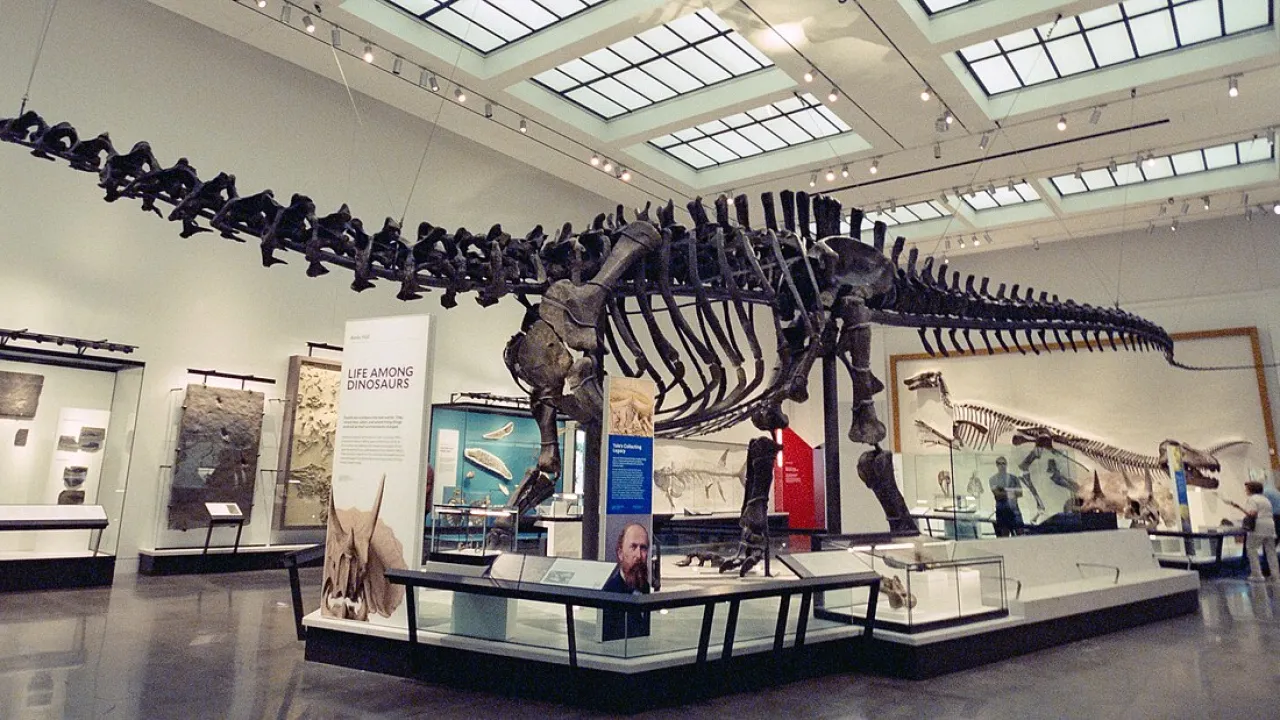
Boom, boom! When fossil hunters dug up a giant skeleton in Wyoming in 1879, they named it Brontosaurus, the 'thunder lizard.' Kids and museums fell in love with the giant plant-eater right away.
2
Lost for a Century
In 1903, scientists decided Brontosaurus looked too much like its Apatosaurus, which had been named two years earlier. Under science rules, the older name won, and Brontosaurus was retired for 112 years!
3
The Big Comeback!
In 2015, researchers measured hundreds of bone details and spotted clear differences! Brontosaurus had a higher, narrower neck than stocky Apatosaurus—winning its famous name back at last.
1. Why did scientists stop using the scientific name Brontosaurus in 1903?
2. How did Brontosaurus's neck differ from the neck of Apatosaurus?
🤯 Mind-Blowing Fact • Grade 3
When the U.S. Postal Service printed Brontosaurus stamps in 1989, critics complained it wasn't a real genus—until the 2015 study proved the stamp right after all!
✨ Word Sparks (Grade 3 Glossary)
Tap 🔊 to hear
priority
the rule that the earliest scientific name wins
genus
a group of very closely related species
mudstone
fine-grained rock hardened from ancient mud
🪝
What turned a rushed nineteenth-century fossil race into a 136-year scientific detective story?
1
Unearthed at Como Bluff
Picture cold winds whipping across Como Bluff, Wyoming, in 1879 as diggers pry gigantic stone vertebrae from Jurassic ! Paleontologist Othniel Charles Marsh rushed to describe the remarkably complete skeleton as Brontosaurus excelsus, meaning 'noble thunder lizard.'
2
Why Science Changed Its Mind Twice
Twenty-four years later, paleontologist Elmer Riggs argued that Brontosaurus was simply another species of Apatosaurus. Because scientific naming rules give to whichever name was published first, textbooks spent the next century telling disappointed readers that Brontosaurus didn't exist!
3
477 Clues Bring Back a Legend
By 2015, many more sauropod skeletons filled museum drawers. Leading a five-year study across twenty museums, Emanuel Tschopp and his colleagues compared 477 anatomical traits and discovered Brontosaurus differed from Apatosaurus just as clearly as lions differ from tigers!
4
Life on the Jurassic Floodplain
Stretching seventy-two feet long and weighing around fifteen tons, Brontosaurus strolled Late Jurassic river valleys stripping horsetails and conifers while snapping its whiplash tail.
1. Where was the original 1879 Brontosaurus excelsus skeleton discovered?
2. Why does the Brontosaurus story show how good science works?
🤯 Mind-Blowing Fact • Grade 4
The 2015 scientific study that officially resurrected Brontosaurus was nearly 300 pages long and examined 81 individual sauropod skeletons across two continents!
✨ Word Sparks (Grade 4 Glossary)
Tap 🔊 to hear
calipers
precision tools used to measure exact bone widths
astragalus
a key upper ankle bone supporting leg weight
classification
sorting living things into related family groups
🪝
How do paleontologists decide where one dinosaur genus ends and a brand-new genus begins?
1
Rivalry in the Bone Wars
During the 1870s 'Bone Wars,' rival paleontologists Othniel Charles Marsh and Edward Drinker Cope raced so fiercely to name new Jurassic giants that mistakes were bound to happen. After naming a partial skeleton Apatosaurus ajax in 1877, Marsh named a second, much more complete Wyoming sauropod Brontosaurus excelsus in 1879—sparking a century-long tug-of-war.
2
Specimen-by-Specimen Detective Work
When Elmer Riggs merged the two genera in 1903, scientists knew of only a handful of diplodocid skeletons, so minor differences looked like age variation. More than a century later, Emanuel Tschopp's European research team visited museums across Europe and the United States with digital , scoring 477 skeletal features on eighty-one individual specimens rather than lumping species ahead of time.
3
Spotting the Thunder Lizard's Signature
Computer family-tree analysis revealed a sharp boundary between the two cousins. Whereas Apatosaurus possessed low-slung, extraordinarily wide cervical vertebrae built like battering rams, Brontosaurus carried a higher-angled, narrower neck, reshaped shoulder-blade joints, and a differently proportioned ankle bone called the .
4
Air-Filled Giant of the Morrison
Weighing fifteen to seventeen tons yet lightened by extensive air sacs threading through its spine, Brontosaurus browsed Jurassic conifers and tree ferns across western North America for four million years.
1. Why couldn't scientists in 1903 see the clear boundary between Apatosaurus and Brontosaurus that researchers found in 2015?
2. Besides its narrower, higher-held neck, which other bones helped distinguish Brontosaurus from Apatosaurus?
🤯 Mind-Blowing Fact • Grade 5
The 2015 revival didn't bring back just one Thunder Lizard—it recognized three distinct species: Brontosaurus excelsus, Brontosaurus parvus, and Brontosaurus yahnahpin!
✨ Word Sparks (Grade 5 Glossary)
Tap 🔊 to hear
synonymy
merging two scientific names referencing the same group
phylogenetics
reconstructing evolutionary family trees using shared traits
monograph
a long, deeply detailed scientific research report
🪝
How did specimen-level phylogenetics overturn 112 years of taxonomic consensus to resurrect paleontology's most iconic 'thunder lizard'?
1
Icon of Como Bluff and Taxonomic Synonymy
Unearthed in 1879 by William Harlow Reed at Quarry 10 in Wyoming's Morrison Formation, Yale Peabody Museum specimen YPM 1980 remains one of the most complete Late Jurassic sauropod skeletons ever recovered. Othniel Charles Marsh christened it Brontosaurus excelsus, mounting it as a centerpiece of early museum halls. Yet in 1903, Field Museum paleontologist Elmer Riggs argued its anatomical distinctions from Marsh's 1877 Apatosaurus ajax merited only species-level separation—reclassifying it as Apatosaurus excelsus under the International Code of Zoological Nomenclature's Principle of Priority.
2
The 2015 Specimen-Level Breakthrough
For 112 years, 'Brontosaurus isn't real' stood as paleontology's most famous piece of trivia—until Emanuel Tschopp, Octávio Mateus, and Roger Benson undertook an unprecedented five-year revision of Diplodocidae. Rather than grouping fossils into assumed species beforehand, their 299-page scored 477 morphological characters individually across 81 sauropod specimens, letting parsimony algorithms measure objective anatomical distance.
3
Diagnostic Anatomy of Apatosaurinae
Statistical clustering revealed that differences separating YPM 1980 (and two sister species, Brontosaurus yahnahpin and Brontosaurus parvus) from Apatosaurus ajax equaled or exceeded generic boundaries across all other diplodocids. Unlike the extreme ventrolateral widening of Apatosaurus cervicals, Brontosaurus possessed taller, narrower, higher-set neck vertebrae with less massive cervical ribs, alongside diagnostic proportions in the scapular blade, coracoid, and astragalus.
4
Paleobiology in a Multi-Sauropod Ecosystem
Measuring roughly 22 meters (72 feet) in length and 15 to 17 metric tons in mass, Brontosaurus combined pneumatic skeletal lightening with a whip-tipped tail of roughly eighty caudals. Slightly lighter neck musculature suggests less emphasis on heavy ventral neck-slamming than in Apatosaurus, hinting at subtle behavioral divergence across Morrison floodplains.
5
Why Taxonomy Evolves With Evidence
Far from nostalgic whim, the resurrection of Brontosaurus exemplifies modern quantitative systematics—proving that even century-old museum icons yield fresh discoveries when interrogated with larger datasets and reproducible computational methods.