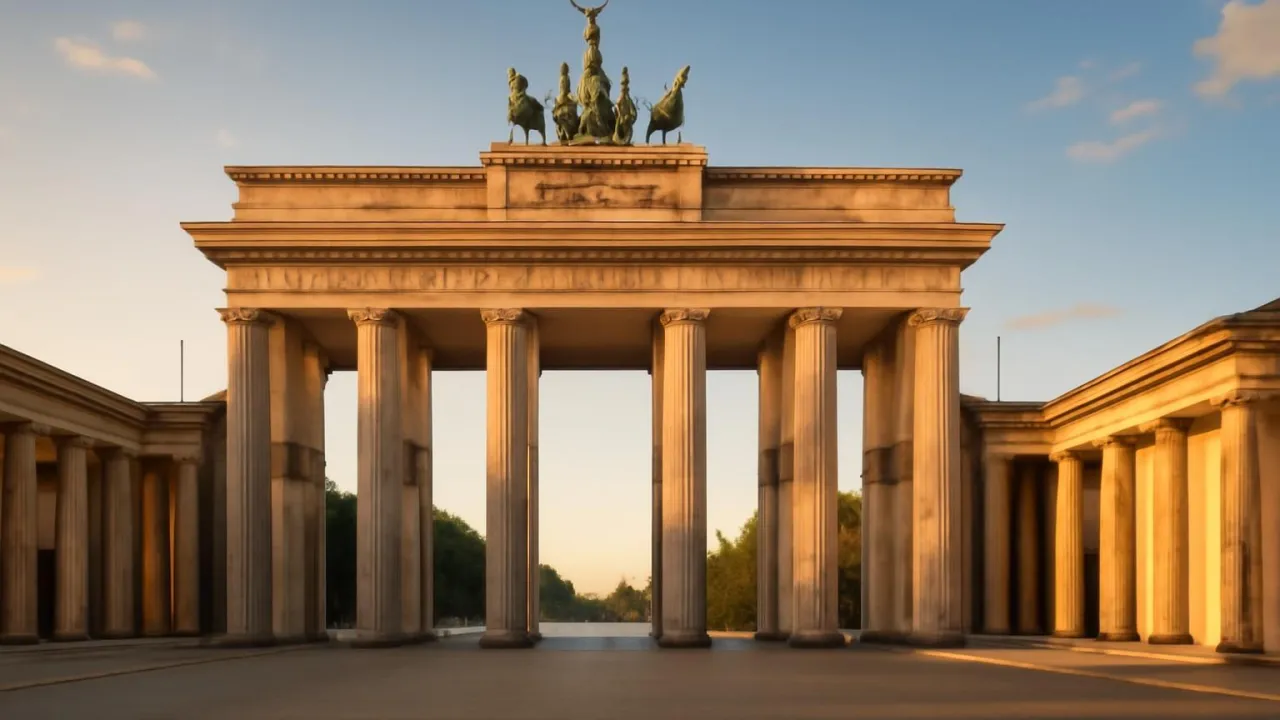
The gate has twelve columns—six on each side of the road!
✨ Word Sparks (Grade 2 Glossary)
Tap 🔊 to hear
Berlin
A big city in Germany
symbol
A sign that means something
peace
When people get along
🪝
Have you ever heard your footsteps echo under a giant stone arch?
1
A Gate in Berlin
Brandenburg Gate stands tall in , Germany. It has six huge stone columns, and people walk through its arches every day. The gate is a famous spot in the city.
2
Built Long Ago
Workers built the gate more than 200 years ago. They used strong stone blocks and made it look like a Roman arch. Today, people visit to learn about its history.
3
A Symbol for People
The gate is a of and togetherness. Families take photos and friends meet there. Horses and a chariot sit on top, watching over the city.
The Quadriga statue was once taken to France and later returned to Berlin!
✨ Word Sparks (Grade 3 Glossary)
Tap 🔊 to hear
Doric
A simple, strong Greek column style
Quadriga
A chariot pulled by four horses
sandstone
A kind of soft, grainy rock
🪝
Can you imagine hearing music and cheers echoing through a giant stone gate?
1
A Historic Berlin Landmark
Brandenburg Gate rises above the busy streets of Berlin, Germany. Its six columns hold up a wide stone roof, forming five grand passageways. The gate was inspired by ancient Greek and Roman architecture. Visitors from all over the world come to see its impressive arches.
2
Building the Monument
Construction began in 1788 and took three years to finish. Workers used blocks to create the gate’s strong, sturdy structure. The columns help support the heavy roof and keep the monument standing tall. Over time, the gate has survived wars and many changes in Berlin.
3
Symbols of Peace and Unity
On top of the gate is a sculpture called the . It shows a chariot pulled by four horses, driven by the goddess of victory. The gate became a symbol of peace, especially after Berlin was divided and later reunited. People gather here for celebrations and important events.
4
How Arches and Columns Work
Arches and columns use special shapes to spread weight evenly. The arch’s curve lets it hold up heavy stones without falling. The columns transfer the weight down to the ground. This clever design makes the gate strong and long-lasting.
During the Cold War, the gate stood locked between two sides of Berlin for 28 years.
✨ Word Sparks (Grade 4 Glossary)
Tap 🔊 to hear
neoclassical
A style copying ancient Greek and Roman buildings
compression
A force that pushes things together
division
When something is split into parts
🪝
What stories could the echoing stone of Brandenburg Gate tell after centuries of history?
1
A Monument of Neoclassical Design
Standing at the heart of Berlin, the Brandenburg Gate is a masterpiece of architecture. Designed by Carl Gotthard Langhans, it was modeled after the ancient Propylaea in Athens. The gate’s six Doric columns create five passageways, allowing people and vehicles to pass through. Its impressive size and symmetry make it a striking symbol in the city.
2
Engineering Strength and Beauty
Built between 1788 and 1791, the gate’s sandstone blocks were carefully stacked and shaped. The Doric columns and rounded arches distribute the weight of the heavy roof evenly. This engineering design uses the principles of and load transfer, making the structure stable and durable. The gate has survived wars, weather, and city changes for over two centuries.
3
A Symbol Through Time
The Quadriga statue on top shows the goddess of victory driving a four-horse chariot. This sculpture has been a symbol of peace, unity, and hope for Berliners. During the Cold War, the gate stood between East and West Berlin, representing both and the dream of freedom. When the Berlin Wall fell in 1989, people celebrated at the gate, marking a new era of togetherness.
4
Cultural Impact and Global Recognition
Today, Brandenburg Gate is recognized around the world as a symbol of peace and freedom. Tourists, leaders, and locals gather here for festivals, concerts, and historical events. Its image appears on German coins and stamps, showing its importance to the country. The gate’s story continues to inspire people everywhere about the power of unity and hope.
1. Why is the Brandenburg Gate important to Berliners?
2. What engineering idea helps the gate stand strong?
🤯 Mind-Blowing Fact • Grade 5
Napoleon once took the Quadriga statue to Paris, but Berliners brought it back in 1814!
✨ Word Sparks (Grade 5 Glossary)
Tap 🔊 to hear
entablature
The main beam resting on columns
erosion
Slow wearing away by wind or water
reunification
Coming together again after being apart
🪝
If you stood beneath the Brandenburg Gate at sunrise, what echoes of history and engineering would surround you?
1
Neoclassical Inspiration and Grand Design
Brandenburg Gate, designed by Carl Gotthard Langhans, was inspired by the Propylaea gateway of the Acropolis in Athens. Its neoclassical style features twelve massive Doric columns, each over 49 feet (15 meters) tall, supporting a heavy and a flat roof. The monument’s five passageways were originally intended for royal processions, carriages, and pedestrians. The gate’s symmetry and proportions create a sense of balance and grandeur that commands attention in Berlin’s Pariser Platz.
2
Engineering Principles: Arches, Columns, and Compression
The gate’s enduring strength comes from the use of Doric columns and rounded arches, which distribute the massive weight of the sandstone superstructure. Compression forces push down through the columns, transferring the load safely into the ground. The rounded arches above the central passageways allow the structure to span wide openings without collapsing. This clever use of classical engineering principles has allowed the Brandenburg Gate to withstand centuries of weathering, war, and urban change.
3
Historical Evolution and Political Symbolism
Since its completion in 1791, Brandenburg Gate has witnessed the rise and fall of empires, wars, and revolutions. It became a symbol of victory, then division, as it stood between East and West Berlin during the Cold War. When the Berlin Wall fell in 1989, the gate transformed into an international emblem of freedom and . The Quadriga statue atop the gate, depicting the goddess Victoria driving a four-horse chariot, was even taken to Paris by Napoleon in 1806 and triumphantly returned eight years later.
4
Cultural Impact: Celebrations and World Recognition
Today, Brandenburg Gate is a focal point for national celebrations, international diplomacy, and cultural events. It has hosted New Year’s Eve festivities, concerts, and speeches by world leaders, including U.S. presidents and German chancellors. Its image appears on coins, stamps, and even the German passport, symbolizing the nation’s resilience and hope. The gate attracts millions of visitors each year, making it one of Europe’s most photographed and recognized landmarks.
5
Preservation and Legacy
Ongoing restoration efforts ensure the gate’s sandstone blocks and sculptures are protected from pollution and weathering. Engineers monitor the structure for signs of or stress, using modern technology to preserve its historic integrity. The Brandenburg Gate stands not only as a triumph of architecture and engineering but also as a living reminder of the power of unity and peace. Its story continues to inspire people around the world, reminding us that history and hope can be built in stone.