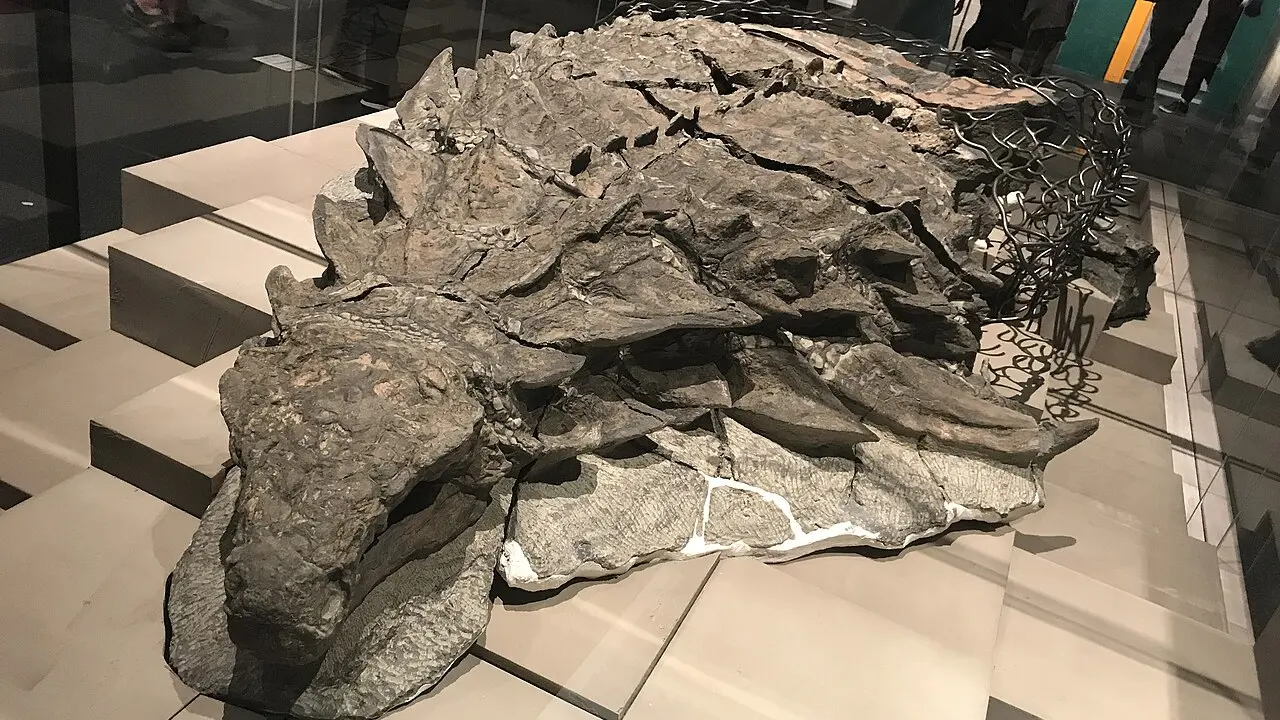
1. What color was the top of Borealopelta's armor in real life?
2. What did scientists find preserved inside Borealopelta's stomach?
🤯 Mind-Blowing Fact • Grade 2
Tiny pieces of charcoal mixed with its stomach ferns suggest Borealopelta loved snacking in forests regrowing after wildfires!
✨ Word Sparks (Grade 2 Glossary)
Tap 🔊 to hear
Mummy
A fossil preserving skin and body shape
Mineral
Natural crystal building block that forms rock
Scavenger
An animal that feeds on dead remains
🪝
How did a land dinosaur end up buried perfectly at the bottom of an ancient sea?
1
A Surprise at the Mine
In 2011, a heavy-machine operator in Alberta, Canada, spotted weird patterned rocks inside a quarry wall. He stopped digging right away! Inside the stone lay Borealopelta, an 18-foot armored nodosaur preserved in 3D.
2
Swept Out to Sea
About 110 million years ago, a river flood washed this plant-eater far out into a cool inland sea. When it sank into soft, oxygen-poor seafloor mud, hardened around it before could disturb its skin or armor.
3
Hiding Despite Armor
Even weighing over a ton with long shoulder horns, Borealopelta used dark reddish-brown back scales and a lighter belly to blend into forest shadows!
1. Where did Borealopelta sink so its skin and armor stayed in 3D shape?
2. Why were bits of charcoal found inside Borealopelta's stomach meal?
🤯 Mind-Blowing Fact • Grade 3
Growth rings inside woody twigs from Borealopelta's stomach showed it ate its last meal in late spring or mid-summer!
✨ Word Sparks (Grade 3 Glossary)
Tap 🔊 to hear
Countershading
Dark back and light belly camouflage pattern
Gastrolith
A swallowed stone that grinds stomach food
Preparator
An expert who cleans rock off fossils
🪝
Why would a 3,000-pound armored tank still need forest camouflage?
1
A Sculpture Carved by Time
Step up to Borealopelta at Canada's Royal Tyrrell Museum, and your jaw might drop! Instead of flattened bones, you see pebbled skin scales, mosaic head tiles, 20-inch bull-like shoulder horns, and every armor plate still locked in life position from 110 million years ago.
2
Countershading Secret
Chemical tests found traces of reddish-brown pigment on its upper scales, fading to pale cream underneath. This pattern, called , cancels out natural shadows in sunlight—proving that even heavily armored dinosaurs needed camouflage against giant Early Cretaceous predators like Acrocanthosaurus!
3
Reading Its Final Meal
In 2020, scientists sliced thin samples of its soccer-ball-sized stomach mass under microscopes. Eighty-eight percent of its meal consisted of tender leptosporangiate fern leaves, swallowed alongside gizzard stones called that ground up tough stems.
4
Honoring Patient Hands
Its species name, Borealopelta markmitchelli, means 'Mark Mitchell's northern shield,' honoring the museum who spent over five years gently freeing every scale from ironstone.
1. What does Borealopelta's countershading tell scientists about Early Cretaceous predators?
2. Who is honored in the scientific name Borealopelta markmitchelli?
🤯 Mind-Blowing Fact • Grade 4
Forty-eight different types of fossil pollen and spores trapped inside Borealopelta's stomach reconstructed the exact forest it walked through on its final day!
✨ Word Sparks (Grade 4 Glossary)
Tap 🔊 to hear
Concretion
A hard mineral lump cementing around fossils
Pheomelanin
Natural pigment creating reddish-brown hair or scales
Cololite
Fossilized food preserved inside the digestive tract
🪝
How did one oil-sands fossil solve mysteries about dinosaur color, horn sheaths, and diet all at once?
1
Miracle in the Clearwater Sea
On March 21, 2011, excavator operator Shawn Funk struck an unusually hard in the Millennium Mine near Fort McMurray, Alberta. Rather than coastal forest rock, the quarry held 110-million-year-old marine shales of the Clearwater Formation! After dying near a river, the bloated carcass of an 18-foot nodosaur had floated miles offshore before sinking upside-down onto the seabed, where siderite ironstone rapidly encased it before water pressure could flatten its body.
2
Keratin Sheaths and Dual-Purpose Spines
Normally, keratin rots away before fossilization, forcing paleontologists to guess how much bigger horns and plates looked in life. Borealopelta preserved dark organic sheaths over all 172 visible osteoderms! Most dramatically, its curved shoulder spines stretched over 50 centimeters long and resembled bull horns, likely serving both as defensive weapons and eye-catching billboards to attract mates or warn rivals.
3
Predation Pressure Revealed by Pigment
Using mass spectrometry, Caleb Brown and colleagues detected benzothiazole—a chemical breakdown signature of reddish-brown —across Borealopelta's dorsal film, vanishing toward its belly. Modern megaherbivores heavier than a ton, like rhinos, rarely bother with countershading because lions seldom attack adults. Borealopelta's stealth cloak proves multi-ton Early Cretaceous carcharodontosaurids hunted by vision and threatened even heavily armored nodosaurs.
4
Microscopic Forensics of a Cololite
Preserved inside its abdominal cavity sat a pristine —fossilized stomach contents. Ignoring plentiful conifer needles and cycad leaves nearby, Borealopelta selectively cropped spore-rich ferns, swallowing pea-sized quartz gastroliths and bits of wildfire charcoal six hours before death.
1. Why wasn't Borealopelta flattened like a pancake under tons of rock?
2. What surprised scientists when they compared Borealopelta's stomach ferns to the surrounding forest plants?
🤯 Mind-Blowing Fact • Grade 5
Measurements of Borealopelta's preserved keratin sheaths proved paleontologists had previously underestimated the real-life size of ankylosaur armor spikes by up to a quarter!
✨ Word Sparks (Grade 5 Glossary)
Tap 🔊 to hear
Taphonomy
Science studying how organisms decay and fossilize
Anoxic
Containing almost zero dissolved oxygen in water
Palynomorph
Microscopic fossil pollen grain or plant spore
🪝
What taphonomic chain of events preserved Borealopelta markmitchelli from microscopic pigment chemistry down to its final afternoon meal?
1
Taphonomy of an Underwater Time Capsule
Around 110 million years ago, during the Albian stage of the Early Cretaceous Period, the boreal Western Interior Seaway flooded northern Alberta. Carried seaward from coastal woodlands by a flooding river, a 5.5-meter (18-foot), 1.3-metric-ton nodosaurid drifted belly-up until decomposition gases escaped. Plunging dorsum-first into soft, glauconitic muds 50 meters deep, the carcass triggered rapid bacterial precipitation of siderite carbonate, sealing skin, horn sheaths, and viscera inside a three-dimensional concretion before compaction could occur.
2
Dermal Armor and Keratinous Amplification
Formally described in 2017 by Caleb Brown and colleagues after Mark Mitchell's painstaking 7,000-hour preparation at the Royal Tyrrell Museum, the specimen preserves the anterior half of the animal from snout to hips in unprecedented fidelity. Articulated osteoderms remain embedded within polygonal epidermal scales, capped by fossilized keratin sheaths that lengthened bony cores by up to 25 percent. Sweeping posterolaterally from the shoulders are bovid-like parascapular spines exceeding half a meter, combining mechanical deterrence with high-contrast socio-sexual signaling.
3
Chemical Paleocolor and Ecological Countershading
Time-of-flight secondary ion mass spectrometry (ToF-SIMS) of organic films coating the dorsal epidermis identified benzothiazole derivatives diagnostic of reddish-brown pheomelanin, grading sharply into unpigmented ventral scales. In modern terrestrial ecosystems, herbivores exceeding 1,000 kilograms outgrow predation risk and shed cryptic coloration. Borealopelta's countershading demonstrates that gigantic Early Cretaceous theropods—such as six-ton Acrocanthosaurus—relied on acute visual hunting and exerted intense top-down predation pressure even upon heavily armored thyreophorans.
4
Palynological Forensics of the Last Meal
In 2020, David Greenwood, Caleb Brown, and collaborators published a landmark histological analysis of the fist-sized cololite preserved inside the body cavity. Over 85 percent of ingested plant tissue comprised leptosporangiate fern fronds, accompanied by quartzose gastroliths, 48 taxa, and six percent fusain (fossilized wildfire charcoal).
5
Reconstructing a Single Cretaceous Day
Growth rings in ingested dicot twigs alongside mature fern sporangia pinpointed the animal's foraging to late spring or mid-summer inside a fire-regenerating clearing—only hours before a riverbank collapse or flash flood swept it into geologic immortality.