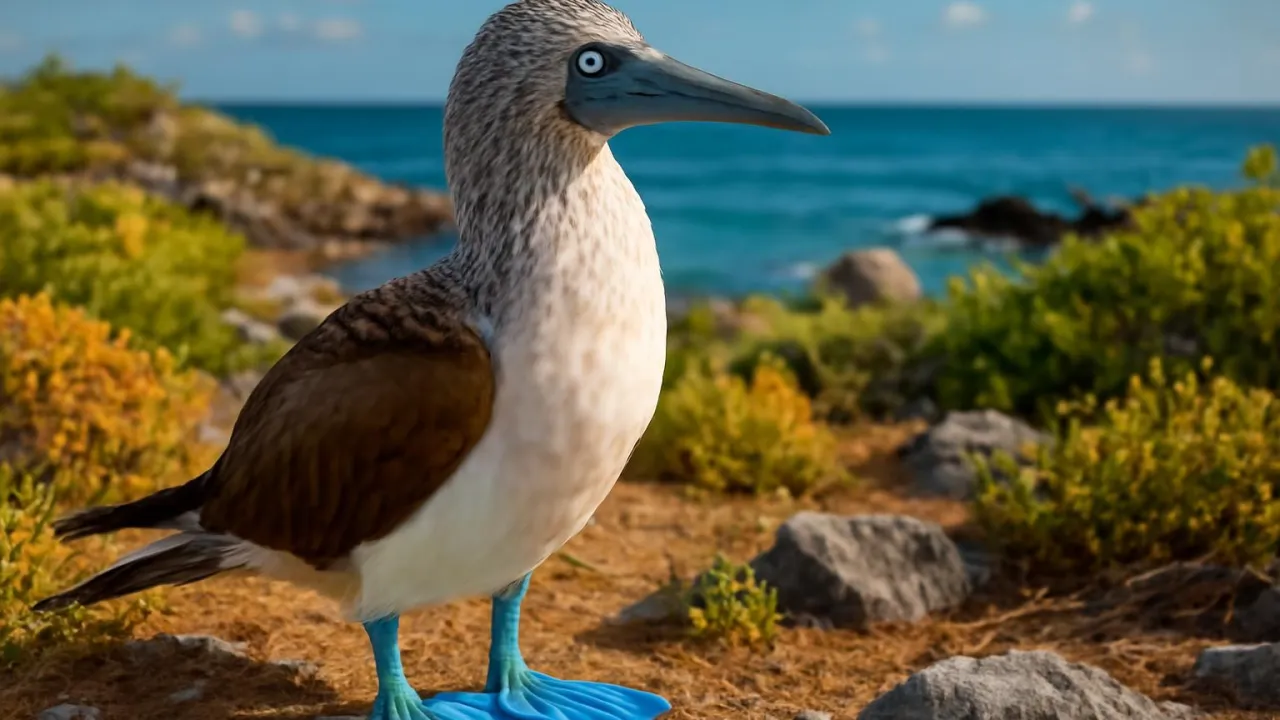
Blue-footed boobies use their bright feet to dance and find friends.
✨ Word Sparks (Grade 2 Glossary)
Tap 🔊 to hear
mate
A bird's special friend for having babies
nest
A home birds build to lay eggs
webbed
Feet with skin between toes for swimming
🪝
Have you ever seen a bird with bright blue feet dancing?
1
Bright Blue Feet Show Off
The blue-footed booby has bright blue feet that it shows to others. It lifts its feet high when it dances. This dance helps it find a . The brighter the feet, the more it impresses.
2
Ocean Home and Life Cycle
This bird lives along the Pacific coast near warm ocean water. It builds on rocky shores or islands. The female lays two or three eggs. The parents take turns keeping the eggs warm.
3
Fishing Skills and Body Features
The blue-footed booby dives deep into the ocean to catch fish. Its sharp beak grabs slippery fish quickly. It has feet to help swim underwater. These features help it survive in its ocean home.
Blue-footed boobies can dive from heights over 80 feet to catch fish underwater.
✨ Word Sparks (Grade 3 Glossary)
Tap 🔊 to hear
adaptation
A body change that helps survival
camouflage
Colors that help hide from predators
courtship
Special actions to find a mate
🪝
Why do blue-footed boobies have such bright blue feet?
1
Colorful Feet for Attraction
Blue-footed boobies use their bright blue feet to attract mates during . The color comes from pigments in their skin that show health. Males with brighter feet are more likely to find a partner. This is a key for survival.
2
Habitat and Nesting
These birds live mainly on islands in the Pacific Ocean, like the Galápagos. They build nests on bare rocky ground, which helps avoid predators. Their nesting sites are close to the ocean for easy fishing. This habitat supports their life cycle well.
3
Hunting and Feeding
Blue-footed boobies are skilled hunters that dive from the air into the water to catch fish. Their sharp beaks and webbed feet help them swim quickly underwater. This hunting technique is an important to get enough nutrients. They mainly eat small fish like sardines.
4
Survival and Camouflage
Their brown and white feathers provide against rocky and ocean backgrounds. This helps protect them from predators when resting. Camouflage is a survival strategy that reduces danger. Their feet remain bright blue for social signaling.
1. What helps blue-footed boobies catch fish underwater?
2. Why do blue-footed boobies have brown and white feathers?
🤯 Mind-Blowing Fact • Grade 4
Blue-footed boobies’ feet can appear dull if they don’t get enough good food.
✨ Word Sparks (Grade 4 Glossary)
Tap 🔊 to hear
food web
How animals eat and depend on each other
conservation
Protecting animals and their homes
geographic
About places where animals live
🪝
How do blue-footed boobies use their bright feet and feathers to survive?
1
Bright Feet and Mating Success
Blue-footed boobies use their bright blue feet in a special courtship dance that helps them attract mates. The color intensity signals the bird’s health and strength, which influences mate choice. Males with brighter feet usually have higher mating success. This cause-and-effect relationship is vital for their reproduction.
2
Ecosystem Role and Food Web
As skilled predators, blue-footed boobies control fish populations by feeding mainly on small fish like sardines and anchovies. They are also prey for larger animals like hawks and snakes, fitting into the . Their presence helps maintain balance in coastal ecosystems. Human fishing activities can impact their food supply.
3
Habitat and Geographic Distribution
These birds are found along the Pacific coasts of Central and South America, especially the Galápagos Islands. They prefer rocky shorelines and islands where they nest safely away from many predators. Their distribution is limited to warm ocean environments. Climate changes can affect their habitat and survival.
4
Human Impact and Conservation
Human activities such as fishing and pollution threaten blue-footed boobies by reducing fish availability and damaging habitats. efforts include protecting nesting sites and regulating fishing near colonies. These actions help ensure populations remain stable. Understanding their ecological role supports better protection.
1. What does the brightness of blue-footed booby feet show?
2. Why is conservation important for blue-footed boobies?
🤯 Mind-Blowing Fact • Grade 5
Blue-footed boobies can dive from over 80 feet high, reaching speeds near 60 miles per hour underwater.
✨ Word Sparks (Grade 5 Glossary)
Tap 🔊 to hear
taxonomy
How scientists group and name animals
physiology
How a body works and moves
sexual selection
Choosing mates based on traits like color
🪝
What makes the blue-footed booby a unique seabird in its Pacific environment?
1
Taxonomy and Scientific Classification
The blue-footed booby, scientifically named Sula nebouxii, belongs to the Sulidae family of seabirds. It is closely related to other boobies and gannets that share similar diving behaviors. This species is distinguished by its vivid blue feet, which are a key taxonomic trait. Understanding its classification helps scientists study its evolutionary history.
2
Physiological Mechanics of Diving and Swimming
Blue-footed boobies have streamlined bodies and strong muscles that allow them to dive from heights over 80 feet into the ocean at high speeds. Their webbed feet act as powerful paddles underwater, enabling swift swimming to catch fish. Their eyes have special adaptations for clear underwater vision. These physiological traits optimize their hunting efficiency.
3
Conservation Status and Human Impact
Though currently listed as least concern, blue-footed boobies face threats from overfishing, pollution, and habitat disturbance. Declines in fish populations reduce their food sources, affecting breeding success. Conservation programs focus on protecting nesting sites and monitoring populations to prevent future declines. Public education raises awareness of their ecological importance.
4
Ecological Role and Quantitative Comparisons
Blue-footed boobies play a critical role in coastal food webs by regulating small fish populations such as sardines and anchovies. They consume approximately 200 grams of fish daily, diving up to 25 meters deep. Compared to other seabirds, their diving speed can reach 60 miles per hour. These quantitative measures highlight their ecological impact.
5
Botanical History and Cultural Significance
The blue-footed booby’s striking appearance has made it a symbol of the Galápagos Islands and a popular subject in ecotourism. Indigenous cultures historically observed their unique mating dances as signs of seasonal changes. Scientific studies of their behavior have contributed to understanding and adaptation in animals. Their botanical environment includes coastal plants that support their nesting habitats.