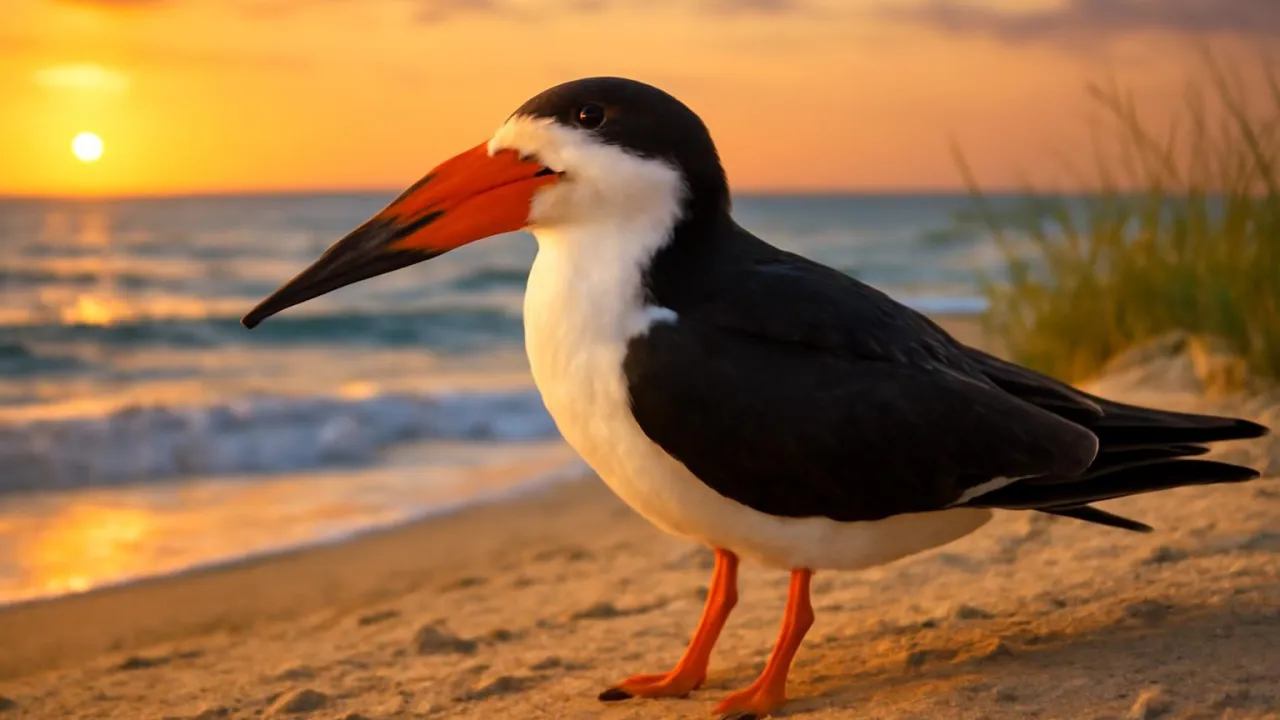
1. What is special about the Black Skimmer’s beak?
2. Where do Black Skimmers like to live?
🤯 Mind-Blowing Fact • Grade 2
Black Skimmers can fly with their lower beak in the water to catch fish while flying!
✨ Word Sparks (Grade 2 Glossary)
Tap 🔊 to hear
estuary
A place where rivers meet the ocean water.
crustacean
Small water animals with hard shells like crabs.
nest
A bird’s home made to hold eggs and babies.
🪝
Have you ever seen a bird use its beak like a fishing tool?
1
Amazing Beak Shape
The Black Skimmer’s lower beak is longer than the upper one, which helps it catch fish. It flies just above the water surface and skims its beak through the water to find food. This unique beak shape is different from most other birds.
2
Where It Lives and Grows
Black Skimmers live along sandy beaches and estuaries in the Americas. They build on the ground near water, where the chicks hatch and grow. These birds return to the same places to raise their young every year.
3
Catching Food in Water
While flying low, the bird’s lower beak slices through the water to catch small fish and . Its eyes help it see fish near the surface, and it quickly snaps its beak shut to grab them. This skill helps it survive in its watery home.
1. What does the Black Skimmer use its longer lower beak for?
2. Where do Black Skimmers build their nests?
🤯 Mind-Blowing Fact • Grade 3
Black Skimmers use their longer lower mandible to skim water and catch fish while flying low!
✨ Word Sparks (Grade 3 Glossary)
Tap 🔊 to hear
mandible
The upper or lower part of a bird’s beak.
camouflage
Colors or patterns that help hide animals.
ecosystem
All living and nonliving things in a place.
🪝
How does the Black Skimmer’s beak help it catch fish while flying?
1
Unique Beak Adaptation
The Black Skimmer’s lower is longer than the upper mandible, allowing it to skim water surfaces. This adaptation helps the bird catch small fish by slicing through water while flying low. Its beak shape is a special adaptation for its feeding style.
2
Habitat and Nesting
These birds live in coastal estuaries and sandy beaches where they find food and build nests. They lay eggs in shallow scrapes on the sand, which provides from predators. The chicks rely on their parents for food until they can fly.
3
Feeding Behavior
While flying just above water, the Black Skimmer’s lower beak cuts through the water to catch fish and crustaceans. This feeding method requires precise flight control and sharp eyesight to spot prey near the surface. The bird’s behavior is a unique example of adaptation.
4
Role in the Ecosystem
Black Skimmers help control fish and crustacean populations in their habitats, balancing the food web. They also serve as prey for larger birds and mammals, contributing to health. Their presence indicates a healthy coastal environment.
1. Why is the Black Skimmer’s lower mandible longer?
2. What role do Black Skimmers play in their ecosystem?
🤯 Mind-Blowing Fact • Grade 4
Black Skimmers fly with their lower mandible slicing water to catch fish, a rare feeding method.
✨ Word Sparks (Grade 4 Glossary)
Tap 🔊 to hear
symbiosis
When two animals live closely and help each other.
incubate
To keep eggs warm so babies can grow.
mudflat
A wet, muddy area near water where animals live.
🪝
What makes the Black Skimmer’s feeding method unique among birds?
1
Specialized Beak and Flight
The Black Skimmer’s lower mandible is longer than the upper one, which allows it to skim the water surface while flying low. This unique adaptation helps it catch small fish and crustaceans by slicing through water. Its precise flight control and timing are essential for successful feeding, especially during low light conditions.
2
Habitat and Distribution
Black Skimmers inhabit coastal beaches and estuaries along the Americas, ranging from the United States to South America. They prefer sandy shores, , and calm waters where fish are abundant. Human activities such as coastal development and pollution sometimes threaten their habitats, causing population declines in certain areas.
3
Ecosystem Role and Relationships
These birds play an important role in coastal food webs by controlling fish and crustacean populations, which helps maintain ecological balance. They also serve as prey for larger predators, contributing to a healthy ecosystem. Occasionally, Black Skimmers nest near other bird species, demonstrating symbiotic relationships that benefit both.
4
Reproduction and Survival
Black Skimmers lay eggs in shallow scrapes on sandy beaches that blend with the environment, providing camouflage from predators. Both parents share incubation duties and feed the chicks after hatching, increasing the young’s chances of survival. This cooperative care is vital in their challenging coastal habitats.
The Black Skimmer’s lower mandible has sensory receptors that help it catch fish by touch while flying.
✨ Word Sparks (Grade 5 Glossary)
Tap 🔊 to hear
mandible
The upper or lower part of a bird’s beak.
conservation
Protecting animals and places from harm.
ecology
How animals and plants live and work together.
🪝
How does the Black Skimmer’s unique beak design reflect its evolutionary success and ecological niche?
1
Taxonomy and Scientific Context
The Black Skimmer, scientifically named Rynchops niger, belongs to the family Laridae, which includes gulls and terns. Its genus name Rynchops means “beak face,” referring to its distinctive bill shape. This species is the only skimmer widely found across the Americas’ coastal regions, highlighting its unique evolutionary path.
2
Physiological Mechanics of Feeding
The Black Skimmer’s lower is longer and more flexible than the upper mandible, enabling it to slice through water while flying just above the surface. Sensory receptors in the bill detect contact with fish, triggering a rapid snapping motion to capture prey. This specialized feeding mechanism is unique among birds and allows efficient nocturnal hunting.
3
Conservation Status and Human Impact
While Black Skimmers are currently listed as Least Concern, habitat destruction from coastal development and pollution threatens some local populations. efforts focus on protecting nesting beaches and monitoring human disturbance to maintain healthy breeding colonies. Public awareness campaigns help reduce negative impacts and promote coexistence.
4
Ecological Role and Quantitative Comparisons
Black Skimmers regulate small fish and crustacean populations in coastal ecosystems, maintaining balance in food webs. They typically fly at speeds around 25 miles per hour (40 km/h) while skimming water surfaces. Their nests are shallow scrapes just a few centimeters deep, blending into sandy environments to avoid predation and environmental exposure.
5
Evolutionary Adaptations and Behavioral Ecology
The evolution of the elongated lower likely arose to exploit a unique feeding niche unavailable to other birds, reducing competition. Behavioral adaptations include synchronized pair flights and cooperative chick rearing, which enhance survival rates. Their nocturnal feeding habits also reduce predator encounters, demonstrating complex ecological strategies.