🎵 INSTRUMENTS
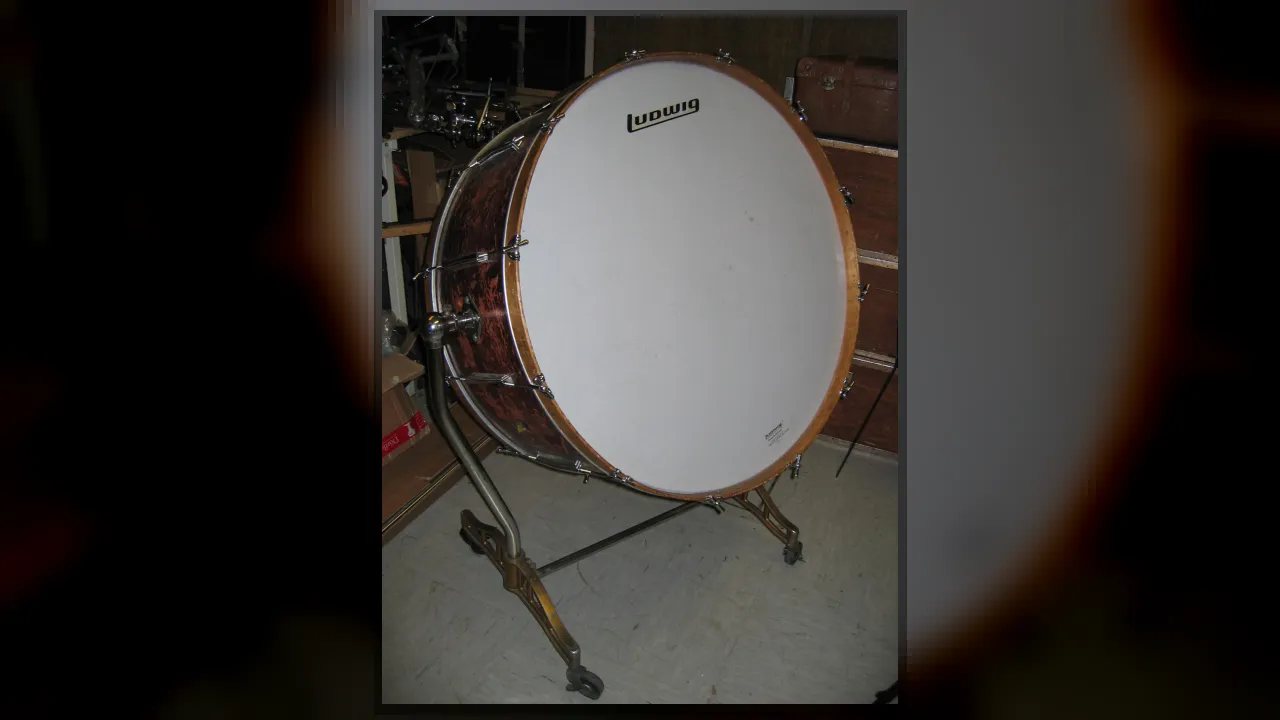
🎶 Large Double-Headed Cylindrical Membranophone (Hornbostel-Sachs 211.212.1)
VA Music, Fine Arts & Sound Physics SOL 5.5
Bass Drum
Deep Heartbeat You Feel Inside Your Chest
Grade 2 • Developing • 110 words
🎶 Instrument Family & OriginPercussion family; ancient Near Eastern frame/barrel drums entering European orchestras via 18th-century Turkish davul bands
🪵 Materials & RangeHeavy wood cylinder (concert model 32–40 in / 81–102 cm wide × 18–22 in deep) on a tilting stand; unpitched deep bass (~35–120 Hz)
🔊 How Sound Is MadeHeavy fleece or felt beaters strike off-center to launch slow, massive pressure waves from two giant coupled heads
⚡ Signature Sound SparkProduces the lowest, most earth-shaking acoustic rumble in the symphony—felt physically in your ribcage
🤯 Mind-Blowing Fact • Grade 1
An orchestral bass drum can measure over three feet wide—tall enough for a puppy to curl up inside if the heads came off!
✨ Word Sparks (Grade 1 Glossary)
Tap 🔊 to hear
giant
Huge in size and full of power
beater
Heavy padded stick used on big drums
muffle
Touch gently to quiet a ringing sound
🪝
Which giant drum is taller than a first grader on its stand?
1
THOOM! Feel That Beat!
THOOOOOM! A , round wave of sound rolls across the room! You do not just hear it with your ears. You feel that deep boom right in your chest!
2
Biggest Drum in Town
Look at that huge wooden hoop hanging on a strong metal frame! Two drum skins stretch tight across both wide sides.
3
Fluffy Beater, Quiet Knee
The player swings a big, fluffy mallet to make thunder. Pressing one hand or knee gently on the skin stops the boom!
1. How does a concert bass drummer quiet the long booming ring after a loud hit?
2. What kind of stick usually strikes a giant concert bass drum?
🤯 Mind-Blowing Fact • Grade 2
In high school and drum-corps marching bands, five or six players carry differently sized 'tonal' bass drums and split fast melodies one note per person!
✨ Word Sparks (Grade 2 Glossary)
Tap 🔊 to hear
kick drum
Floor bass drum played with foot pedal
swivel
Tilt smoothly to a comfortable playing angle
heartbeat
Steady deep pulse holding music together
🪝
How do marching bands, rock drummers, and orchestras all play the bass drum in totally different ways?
1
One Family, Three Cool Styles!
BOOOOM! Nothing wakes up a concert hall, stadium, or rock show faster than the mighty of a bass drum! Depending on where you listen, this low-rumbling giant shows up in three very different outfits.
2
Concert Cradle, Foot Kick, and Marching Harness
On a symphony stage, a massive forty-inch concert bass drum tilts on a stand so the player can strike it with plush beaters. On a rock drum set, a smaller twenty-two-inch sits on the floor played by a foot pedal, while marching bands carry tuned bass drums strapped to their chests!
3
Whispers and Cannon Shots
Despite its huge size, a concert bass drum can purr as softly as distant summer thunder—or roar like an 1812 cannon!
1. How does a rock or jazz drum-set player strike their floor bass drum?
2. How do marching band 'bass lines' play fast musical runs across the field?
🤯 Mind-Blowing Fact • Grade 3
Purdue University's famous 'World's Largest Drum,' built in 1921, stands over eight feet tall on a wheeled carriage and needs a whole crew to roll it across the stadium!
Why does an orchestral score often call the giant bass drum *gran cassa*—Italian for 'big box'?
1
Turkish Drums Inspire Mozart and Beethoven
Three hundred years ago, European audiences went wild for the thrilling sound of Ottoman Turkish Janissary bands marching with cymbals, triangles, and deep two-headed drums called ! Composers like Mozart and Beethoven loved that earth-shaking pulse and brought an even bigger version—nicknamed the —into the symphony orchestra.
2
Why Off-Center Beats Sound Deepest
Walk up to a thirty-six-inch concert bass drum and notice where the percussionist aims: partway between the center and the rim! Hitting dead center produces a dry, boxy punch, whereas striking slightly off-center lets slow, rich overtones bloom for several seconds.
3
No Fixed Pitch Means Pure Power
Unlike copper timpani tuned to exact notes, a concert bass drum has two loose, heavy heads over an open wooden cylinder. Its low rumble stays unpitched, blending seamlessly beneath any chord!
4
Rolling With Twin Beaters
Holding two matched double-ended mallets like timpani sticks lets players sustain ominous, floor-trembling rolls.
1. Where did 18th-century composers like Mozart get the inspiration to add bass drums to European orchestras?
2. Why do concert bass drummers hang the shell from rubber straps on a ring frame instead of resting it flat on the floor?
🤯 Mind-Blowing Fact • Grade 4
For the fiery 'Dies Irae' in Verdi's *Requiem*, percussionists tighten the concert bass drum slightly higher and strike near the center with a firm chamois-leather beater so each blow cracks through the hall like lightning!
How did one clever 1909 foot pedal let a single drummer do the job of two band members—and launch the modern drum set?
1
Birth of the 'Double Drumming' Pedal
In 19th-century theater pits, two separate percussionists sat side by side: one playing snare drum and another booming the bass drum and cymbals. In 1909, Chicago brothers William and Theobald Ludwig patented a fast, spring-return floor bass-drum pedal so one seated musician could kick low beats with their right foot while hands flew across snare and cymbals—giving birth to the modern drum kit!
2
Sub-Bass Physics of a One-Meter Membrane
In the symphony hall, the suspended gran cassa measures 90 to 102 centimeters (36 to 40 inches) across and 45 to 55 centimeters deep. Tensioned loosely with thick calfskin or textured synthetic FiberSkyn heads, its primary fundamental oscillates between 35 and 55 Hz—low enough to couple directly with the air cavity of a listener's ribcage!
3
Glancing Blows and Damping Artistry
Rather than stabbing straight into the head, orchestral specialists draw a 400-gram lambswool beater in an upward glancing arc off-center, coaxing warm low modes without slapping high plastic transients. Meanwhile, placing fingertips on the opposite resonant head shapes exact note length just like releasing a piano pedal.
4
Verdi's Roars and Mahler's Whispers
Giuseppe Verdi's Requiem unleashes terrifying solo gran cassa cannonades during the 'Dies Irae,' whereas Gustav Mahler uses feather-soft solo strokes to evoke solemn funeral bells.
1. How did William and Theobald Ludwig's 1909 bass-drum pedal change popular music forever?
2. Why does a concert percussionist control the un-struck rear head with one hand or fingertips?
🤯 Mind-Blowing Fact • Grade 5
When struck fortissimo in Stravinsky's *The Rite of Spring*, the center of a forty-inch calfskin bass drumhead physically flexes inward and outward by more than a full centimeter!
✨ Word Sparks (Grade 5 Glossary)
Tap 🔊 to hear
detuning
Setting two drumheads at slightly different tensions
excursion
Physical distance a vibrating surface moves outward
polyrhythm
Layering contrasting rhythmic patterns at once
🪝
Why does tuning the two heads of a concert bass drum to slightly *different* tensions create a deeper, richer rumble?
1
Organology of the Cylindrical Bass Membranophone
Classified under Hornbostel-Sachs 211.212.1 as an individual double-headed cylindrical drum without snares, the orchestral gran cassa occupies the lowest acoustic register of the unpitched percussion battery. Built from thick multi-ply mahogany, maple, or birch shells 91 to 102 centimeters (36 to 40 inches) in diameter and suspended via elastomeric straps from a tilting ring stand, it moves tens of liters of air with each .
2
Coupled-Membrane Detuning and Indefinite Pitch
If both giant heads of a concert bass drum are tensioned identically, pneumatic coupling locks their axisymmetric (0,1) and (1,1) modes into pronounced, boomily pitched peaks that clash with orchestral harmony. Seasoned symphonic percussionists deliberately tune the resonant head a musical second or minor third lower (or higher) than the batter head! This intentional splits coupled modal resonances into closely spaced, gently beating pairs between 35 Hz and 95 Hz, erasing definite pitch perception while prolonging warm, subterranean decay.
3
Strike-Point Nodal Physics
Every circular membrane exhibits nodal rings where specific vibration modes remain stationary. Striking dead center maximally excites the fundamental (0,1) air-pumping mode and the (0,2) mode—producing a short, cannon-like punch—while completely silencing all diametric (1,1) and (2,1) modes. Shifting the beater impact roughly one-third to one-half radius off-center awakens rich asymmetric modes, yielding dark, rolling sustain.
4
Acoustic Contrast: Symphonic Versus Studio Kick Drum
Whereas an unported 36-inch concert drum rings freely for four to six seconds, a 22-inch studio kick drum cuts a 12-centimeter Helmholtz port in its front head and rests internal foam against the shell, shortening decay below 200 milliseconds for tight microphone punch.
5
Symphonic Milestones
From Igor Stravinsky's primal in The Rite of Spring (1913) to Aaron Copland's thunderous Fanfare for the Common Man, the concert bass drum commands visceral acoustic gravity.