2. What favorite food did scientists find fossilized inside Baryonyx?
🤯 Mind-Blowing Fact • Grade 2
Baryonyx had nearly twice as many teeth as Tyrannosaurus rex, packing 96 pointed teeth into its slender jaws!
✨ Word Sparks (Grade 2 Glossary)
Tap 🔊 to hear
quarry
An open pit where stone or clay is dug
nostril
An opening on the nose used for breathing
slender
Thin and narrow from side to side
🪝
What happened when a fossil hunter spotted one giant claw sticking out of English clay?
1
A Clay Pit Surprise
Imagine hunting for fossils on a rainy winter afternoon in Surrey, England. In 1983, plumber William Walker cracked open a lump of clay and uncovered a massive, curved claw over twelve inches long! Scientists rushed to the and dug up one of Europe's best meat-eating dinosaur skeletons.
2
Built Like a Crocodile
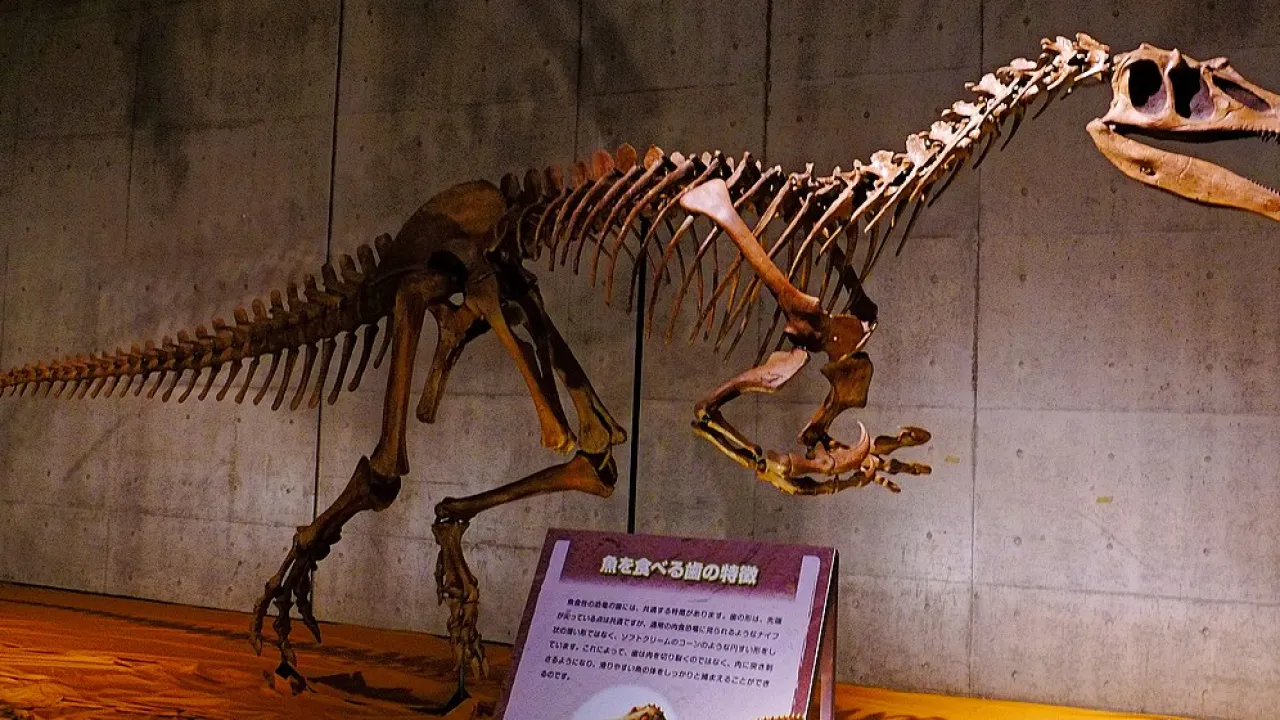
Unlike most land hunters with tall, thick skulls, Baryonyx had a long, narrow snout shaped like a crocodile's mouth. Its sat back from the tip so it could breathe easily while dipping its jaws underwater.
3
Surf and Turf Menu
With ninety-six cone-shaped teeth and giant hook claws, Baryonyx snagged big river fish, though bones in its belly show it ate small dinosaurs too.
1. Why were the nostrils of Baryonyx set back from the tip of its snout?
2. Who discovered the famous giant thumb claw of Baryonyx in 1983?
🤯 Mind-Blowing Fact • Grade 3
Baryonyx was the very first dinosaur ever proven by direct stomach-content fossils to be a specialized fish-eater!
✨ Word Sparks (Grade 3 Glossary)
Tap 🔊 to hear
piscivore
An animal whose diet consists mainly of fish
rosette
A rounded, spoon-shaped cluster of teeth at jaw tips
delta
Wet, fan-shaped land where rivers meet the sea
🪝
How did Baryonyx prove for the first time that some dinosaurs hunted like grizzly bears and crocodiles?
1
Stalking Cretaceous Lagoons
Mist rises over a lush in Early Cretaceous England 128 million years ago. Wading knee-deep into the calm shallows comes Baryonyx, a thirty-foot relative of Spinosaurus. Before its discovery, paleontologists thought almost all giant theropods chased land herbivores across dry ground, but Baryonyx changed dinosaur science forever.
2
Tools of a Master Angler
Every part of Baryonyx's front half was specialized for catching slippery aquatic prey. Its elongated jaws flared into a spoon-shaped at the tip, packed with ninety-six finely serrated, conical teeth that pierced scales like fishhooks. Tiny pits on the tip of its snout likely held pressure sensors that felt ripples in murky water.
3
The Famous Heavy Claw
Supported by unusually thick, muscular forearms, each three-fingered hand carried a curved twelve-inch claw on the thumb. Much like a modern grizzly bear swatting salmon at a waterfall, Baryonyx could gaff large fish straight out of the current.
4
Fossilized Last Meal
Inside its fossilized rib cage, scientists discovered acid-etched scales of the meter-long fish Scheenstia alongside bones of a young Iguanodon, proving Baryonyx enjoyed varied meals.
1. What special sensors were likely hidden inside tiny pits on Baryonyx's snout?
2. What two foods were preserved inside the stomach area of the Baryonyx fossil?
🤯 Mind-Blowing Fact • Grade 4
Because early Spinosaurus fossils were destroyed decades earlier, the 1986 description of Baryonyx served as the Rosetta Stone showing what spinosaurid skulls and bodies truly looked like!
✨ Word Sparks (Grade 4 Glossary)
Tap 🔊 to hear
secondary palate
A bony roof strengthening the mouth against twisting forces
ungual
A specialized toe or finger bone supporting a claw
niche partitioning
Different predators using separate foods to avoid competing
🪝
How did one skeleton from an English clay pit unlock the mystery of the entire spinosaurid family?
1
Solving a Paleontological Puzzle
Picture the warm, marshy Wealden floodplains of southern England 128 million years ago, where horsetails and tree ferns bordered winding waterways. Standing motionless in the shallows is Baryonyx walkeri, a nine-meter, two-ton spinosaurid watching silver flashes beneath the surface. When paleontologists Alan Charig and Angela Milner described its skeleton in 1986, its bizarre mix of crocodile jaws and massive forelimb claws stunned researchers worldwide.
2
Biomechanics of a Fish-Catching Skull
Most large theropods evolved deep, wide skulls to crush bone or slice thick muscle, yet Baryonyx possessed a long, narrow snout reinforced by a fused bony on the roof of its mouth. That bony ceiling prevented its slender jaws from twisting when thrashing fish fought back. Meanwhile, neurovascular openings dotting the snout tip connected to branches of the trigeminal nerve, registering subtle water-pressure waves.
3
Dense Bones and Heavy Forelimbs
Unlike lighter sprint-built theropods, Baryonyx had robust humerus bones and dense ribs that improved stability while wading in swift currents. Its S-shaped neck could strike downward like a heron's, while its thirty-one-centimeter thumb anchored slippery quarry.
4
Sharing Ecosystems Without Clashing
By specializing in aquatic prey such as armored Scheenstia fish while opportunistically scavenging or ambushing juvenile ornithopods, Baryonyx avoided head-to-head competition with land-focused predators like Neovenator.
1. How did the fused bony secondary palate help Baryonyx when hunting?
2. How did Baryonyx peacefully share its habitat with land hunters like Neovenator?
🤯 Mind-Blowing Fact • Grade 5
The lower jaw of Baryonyx held 64 closely packed teeth while the upper jaw held only 32 larger ones, creating a specialized interlocking cage for slippery river fish!
✨ Word Sparks (Grade 5 Glossary)
Tap 🔊 to hear
convergence
Unrelated animals independently evolving similar body shapes for survival
mechanoreceptor
A nerve ending that senses touch, vibrations, or pressure
rostrum
The projecting snout or beak structure of a skull
🪝
What anatomical adaptations allowed Baryonyx walkeri to bridge terrestrial theropod ancestry and semiaquatic predation?
1
Discovery in the Weald Clay
In January 1983, amateur collector William Walker split a large siderite nodule in the Smokejacks Pit of Surrey, England, exposing the core of an enormous ungual claw. Excavations led by Natural History Museum paleontologists Alan Charig and Angela Milner over three weeks recovered roughly sixty-five percent of an articulated subadult skeleton preserved in Barremian-stage Weald Clay deposits laid down 128 million years ago. Named Baryonyx walkeri in 1986, this two-ton, nine-meter predator revolutionized how scientists reconstruct spinosaurid anatomy.
2
Craniodental Convergence with Gavials
Baryonyx exhibits striking evolutionary with fish-eating crocodilians. Its premaxillae and maxillae elongate into a slender terminating in a spatulate terminal rosette, while external nares retract posteriorly to keep airways clear at the waterline. Sixty-four dentary teeth in the lower jaw—twice the count of its upper jaw—interlocked with thirty-two upper teeth to create a precision fish trap lined with longitudinal ridges and microscopic serrations.
3
Neurosensory Snout and Neck Kinematics
Micro-CT scans of the premaxilla reveal branching neurovascular canals linked to capable of detecting hydrodynamic disturbances in silt-laden estuaries. Cervical vertebrae suggest strong ventroflexion muscles, enabling rapid downward strikes toward submerged targets.
4
Forelimb Hypertrophy and Taphonomic Diet Proof
Unusual among large tetanuran theropods, Baryonyx possessed heavily muscled radii and ulnae driving a thirty-one-centimeter manual digit I claw. Within its thoracic cavity lay gastric-acid-etched ganoid scales of the holostean fish Scheenstia alongside abraded juvenile iguanodontian bones and smooth gastroliths.
5
European Cradle of Spinosaurids
Together with Iberian relatives such as Iberospinus and Ceratosuchops, Baryonyx demonstrates that Early Cretaceous Europe served as a vibrant evolutionary hub before colossal sail-backed spinosaurids spread across Gondwana.