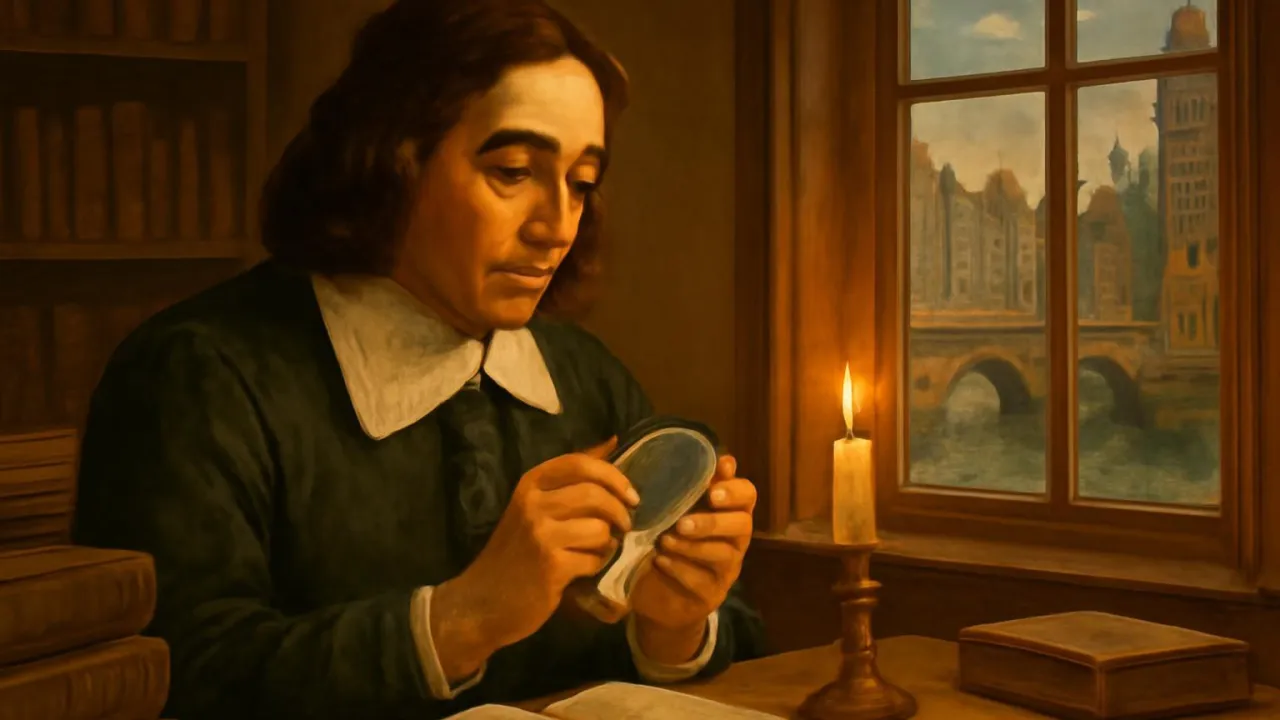
Spinoza’s lenses helped early scientists see things never seen before!
✨ Word Sparks (Grade 2 Glossary)
Tap 🔊 to hear
curiosity
Wanting to learn and ask questions
reason
Thinking carefully to find answers
microscope
A tool to see tiny things
🪝
Have you ever wondered why things happen the way they do?
1
Big Questions, Bright Ideas
Baruch Spinoza was always full of questions, even as a child. He wanted to know why the world worked the way it did. He loved to read books and talk with friends about ideas. His made him think deeply about everything.
2
The Magic of Lenses
Baruch learned how to grind glass into special shapes called lenses. These lenses helped people see tiny things under . He worked carefully with his hands, making each lens smooth and clear. His lenses helped scientists make new discoveries.
3
A Book of Brave Ideas
Baruch wrote a book called 'Ethics' to share his thoughts. He wanted people to use and kindness to live good lives. Some people did not agree with him, but Baruch kept writing. His ideas are still important for thinkers today.
Spinoza’s book 'Ethics' is still read and debated by philosophers worldwide.
✨ Word Sparks (Grade 3 Glossary)
Tap 🔊 to hear
perseverance
Not giving up, even when it’s hard
philosophy
The study of big ideas and questions
freedom
Being able to think and choose for yourself
🪝
Imagine looking through a tiny lens and seeing a whole new world—what would you discover?
1
A Childhood of Questions
As a young boy in Amsterdam, Baruch Spinoza was always curious about everything. He asked questions about nature, people, and why things happen as they do. His family wanted him to follow old traditions, but Baruch loved to think for himself. He believed that asking questions was the best way to learn.
2
The Art of Lens Grinding
Baruch became skilled at grinding glass to make lenses for microscopes. These tiny lenses let scientists see things like plant cells and insects up close. He worked with patience and care, shaping each lens by hand. His work helped other scientists make important discoveries.
3
Writing 'Ethics' and Facing Challenges
Baruch wrote a famous book called 'Ethics,' where he shared his ideas about truth and happiness. Some people disagreed with his new way of thinking and treated him unfairly. Still, Baruch stood by his beliefs and kept writing. He showed and bravery in the face of challenges.
4
A Legacy of Thought
Spinoza’s ideas changed how people think about life, nature, and . He believed that understanding the world with reason could lead to peace and happiness. Today, philosophers still study his work and learn from his questions. Spinoza’s story reminds us to be curious and think deeply.
Spinoza’s lenses helped scientists discover new worlds both big and small.
✨ Word Sparks (Grade 4 Glossary)
Tap 🔊 to hear
telescope
A tool to see things far away
natural laws
Rules that explain how nature works
legacy
What someone leaves behind for others
🪝
What happens when you dare to question everything you’ve ever been taught?
1
A Curious Mind in Amsterdam
Growing up in Amsterdam during the 1600s, Baruch Spinoza was surrounded by many different cultures and ideas. He was part of a Jewish community, but he often wondered about the world beyond his own traditions. From a young age, Spinoza asked deep questions about nature, people, and the universe. His curiosity sometimes made him stand out, but he was never afraid to think differently.
2
The Science of Making Lenses
Spinoza became an expert at grinding glass to make lenses for microscopes and . These delicate lenses allowed scientists to see details in plants, insects, and even stars that had never been seen before. He worked with great focus and precision, often spending hours shaping and polishing each lens. His craftsmanship helped advance both science and medicine in his time.
3
Writing 'Ethics' and Facing Opposition
Spinoza’s most famous work, 'Ethics,' introduced a bold new way of thinking about life, nature, and God. He argued that everything in the universe follows , and that people should use reason to guide their actions. Many people disagreed with his ideas, and some even rejected him from their communities. Despite this, Spinoza continued to write bravely, believing in the importance of free thought.
4
A Lasting Legacy of Reason
Spinoza’s ideas have influenced philosophers, scientists, and leaders for centuries after his death. His belief in freedom of thought and the power of reason helped shape modern philosophy. Today, his work is studied in universities around the world, inspiring new generations to question, explore, and seek understanding. Baruch Spinoza’s courage to think differently changed the world forever.
Spinoza’s ideas about freedom and reason helped inspire modern democracy and human rights.
✨ Word Sparks (Grade 5 Glossary)
Tap 🔊 to hear
excommunication
Being officially removed from a community
optics
The science of how light and lenses work
tolerance
Accepting and respecting different ideas or people
🪝
Can questioning old beliefs and searching for truth change how the world thinks forever?
1
A Young Philosopher in a Changing City
In the bustling city of Amsterdam during the 1600s, Baruch Spinoza grew up surrounded by merchants, scientists, and people from many cultures. From childhood, he was known for his relentless curiosity and willingness to challenge traditional beliefs. He asked questions about nature, religion, and society that few dared to explore. Spinoza’s family hoped he would follow their customs, but his independent spirit led him to seek answers beyond what he was taught. His early experiences shaped him into a thinker who valued reason above all else.
2
Mastering the Art and Science of Lenses
Spinoza became a skilled lens grinder, creating precise glass lenses for microscopes and telescopes. This delicate craft required steady hands, patience, and a deep understanding of . His lenses enabled scientists to observe cells, insects, and distant stars with clarity never before possible. Spinoza’s work in lens making not only supported his modest lifestyle but also contributed to the scientific revolution of his era. Through his craftsmanship, he bridged the worlds of science and philosophy, helping others see both the visible and invisible wonders of nature.
3
Writing 'Ethics': A Revolutionary Philosophy
Baruch Spinoza’s most influential work, 'Ethics,' presented a daring new vision of reality, God, and human happiness. He argued that everything in the universe, including people, follows natural laws that can be understood through reason. Spinoza believed true happiness comes from understanding our place in nature and acting with kindness and logic. His ideas challenged powerful religious and political leaders, leading to his from his community and isolation from many former friends. Despite these hardships, Spinoza continued to write, driven by his commitment to truth and intellectual freedom.
4
Challenges, Courage, and Lasting Influence
Spinoza faced significant opposition throughout his life, yet he remained steadfast in his pursuit of knowledge and honesty. He lived simply, refusing fame or wealth, and focused on his philosophical and scientific work. His courage to question authority and think independently inspired future philosophers like Leibniz and Einstein. Spinoza’s writings on reason, freedom, and laid the groundwork for modern democracy and human rights. Even today, his work is discussed in universities and philosophy circles worldwide.
5
A Legacy of Reason and Curiosity
Baruch Spinoza’s life teaches us the importance of asking questions, thinking deeply, and respecting others’ ideas. His blend of scientific skill and philosophical insight helped people see the world in new ways, both through his lenses and his words. Spinoza’s belief in reason, kindness, and freedom continues to inspire those who value truth and understanding. By daring to question what others accepted, he changed the course of philosophy and left a legacy that encourages us all to be curious thinkers. His story reminds us that one person’s questions can truly change the world.