1. What is special about the barreleye fish’s head?
2. Where does the barreleye fish live?
🤯 Mind-Blowing Fact • Grade 2
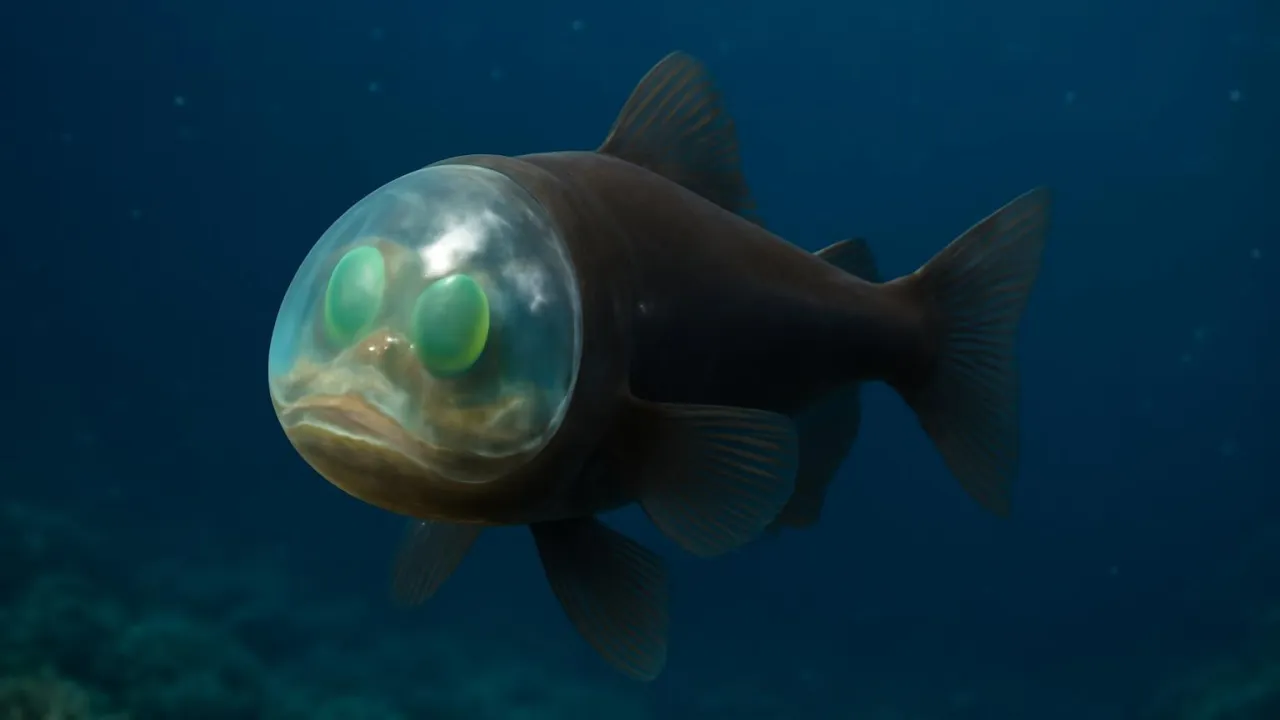
The barreleye fish’s head is so clear you can see its eyes and brain inside!
✨ Word Sparks (Grade 2 Glossary)
Tap 🔊 to hear
transparent
Clear so you can see through it
rotate
To turn or spin around
crustaceans
Sea animals with shells, like tiny crabs
🪝
Have you ever seen a fish with eyes that look up?
1
See-Through Head
The barreleye fish has a head that shows its eyes inside. This clear head helps it see in dark water. It lives very deep in the Pacific Ocean where sunlight is rare.
2
Unique Eyes
Its eyes are large and point upward to spot food above. The fish can also its eyes forward to see prey clearly. These special eyes help it survive in the deep sea.
3
Deep Ocean Life
This fish lives about 600 to 800 meters deep where it is very cold and dark. It swims slowly and eats small and jellyfish. Its body is soft and flexible to handle high pressure.
The barreleye fish’s eyes are inside a clear dome that acts like a window to the deep ocean!
✨ Word Sparks (Grade 3 Glossary)
Tap 🔊 to hear
adaptation
A body change that helps survival
camouflage
Colors or shapes that hide an animal
predator
An animal that hunts other animals
🪝
How does a fish see in the dark deep ocean with a clear head?
1
Transparent Head and Eyes
The barreleye fish has a transparent head that allows light to enter. Its tubular eyes are large and face upward to spot prey. These eyes can rotate forward to focus on food. This helps it survive in dark ocean depths.
2
Deep-Sea Habitat
It lives at depths of 600 to 800 meters where sunlight barely reaches. The water is cold and pressure is high in this environment. The barreleye fish’s soft body helps it withstand these conditions. It uses to avoid .
3
Diet and Feeding
This fish feeds mainly on small crustaceans and jellyfish floating above. Its upward-facing eyes help detect prey silhouetted against faint light. It can rotate its eyes to track moving food. This hunting method is key to its survival.
4
Survival Adaptations
The transparent head protects its sensitive eyes from stings and debris. Its body shape and slow movement conserve energy in nutrient-poor waters. These allow the barreleye fish to thrive in a challenging ecosystem.
The barreleye fish’s clear head acts like a window, letting it see prey in the darkest ocean depths!
✨ Word Sparks (Grade 4 Glossary)
Tap 🔊 to hear
ecosystem
A community of living things and their home
predator
An animal that hunts other animals for food
adaptation
A body feature that helps survival in nature
🪝
What special features help the barreleye fish survive in deep ocean darkness?
1
Transparent Head and Vision
The barreleye fish has a transparent, dome-shaped head that protects its tubular eyes. These eyes face upward and can rotate forward to track prey. This unique allows it to detect faint silhouettes in deep ocean darkness. The clear head also shields its sensitive eyes from jellyfish stings.
2
Deep Ocean Ecosystem Role
Living at depths between 600 and 800 meters, the barreleye fish is part of a complex food web. It preys on small crustaceans and jellyfish, helping control their populations. In turn, it serves as prey for larger deep-sea . Its slow swimming conserves energy in nutrient-poor waters.
3
Environmental Adaptations
The barreleye fish’s soft, flexible body withstands high pressure and cold temperatures. Its transparent head reduces the need for heavy protective tissue around its eyes. This improves its ability to gather light in the dark environment. Its upward-facing eyes are perfectly designed for spotting prey silhouetted against the faint light.
4
Geographic Distribution and Human Impact
This species is found mainly in the Pacific Ocean’s deep waters. Human activities like deep-sea fishing and pollution could threaten its habitat. However, its remote environment offers some protection. Studying this fish helps scientists understand deep ocean better.
1. How does the barreleye fish’s transparent head help it?
2. Why is the barreleye fish important in its ecosystem?
🤯 Mind-Blowing Fact • Grade 5
The barreleye fish’s eyes rotate inside a transparent dome, letting it see prey even in the darkest ocean depths!
✨ Word Sparks (Grade 5 Glossary)
Tap 🔊 to hear
mesopelagic
The ocean layer 600-1000 meters deep
ocular
Related to eyes or vision
cranial
Relating to the skull or head
🪝
How does the barreleye fish’s unique anatomy help it thrive in the deep ocean’s darkness and pressure?
1
Taxonomy and Scientific Context
The barreleye fish, scientifically named Macropinna microstoma, belongs to the family Opisthoproctidae. It is a small deep-sea fish inhabiting zones, typically between 600 and 800 meters deep. Its lineage is notable for adaptations to extreme low-light environments. This species is one of the few vertebrates with a transparent, fluid-filled dome.
2
Physiological Mechanics of Vision
The barreleye fish’s tubular eyes are enclosed within a transparent dome that allows light to enter from above. These eyes can rotate nearly 180 degrees, enabling upward and forward vision without moving the body. This unique structure enhances detection of prey silhouettes against dim ambient light. The dome protects the eyes from jellyfish stings and particulate matter in the water.
3
Ecological Role and Conservation
Occupying a niche in deep Pacific Ocean ecosystems, the barreleye fish preys on small crustaceans and gelatinous zooplankton. It plays a role in controlling prey populations and serves as prey for larger predators. Although deep-sea habitats are less impacted by human activity, threats such as deep-sea trawling and pollution pose risks. Conservation efforts focus on protecting deep ocean biodiversity.
4
Botanical History and Discovery
First described in 1939, the barreleye fish fascinated scientists due to its transparent head and upward-facing eyes. Advances in deep-sea submersibles allowed observation of live specimens in natural habitats. These observations revealed its eye rotation and feeding behavior, expanding understanding of deep-sea adaptations. Its discovery challenged previous assumptions about vertebrate eye anatomy.
5
Quantitative Comparisons and Adaptations
Measuring approximately 6 inches (15 centimeters) long, the barreleye fish lives in water temperatures near 4 degrees Celsius. Its eyes can rotate up to 90 degrees forward, a rare feature among fish. The transparent dome is filled with fluid that matches the refractive index of seawater, minimizing light distortion. These adaptations optimize vision and survival in the high-pressure, low-light zone.