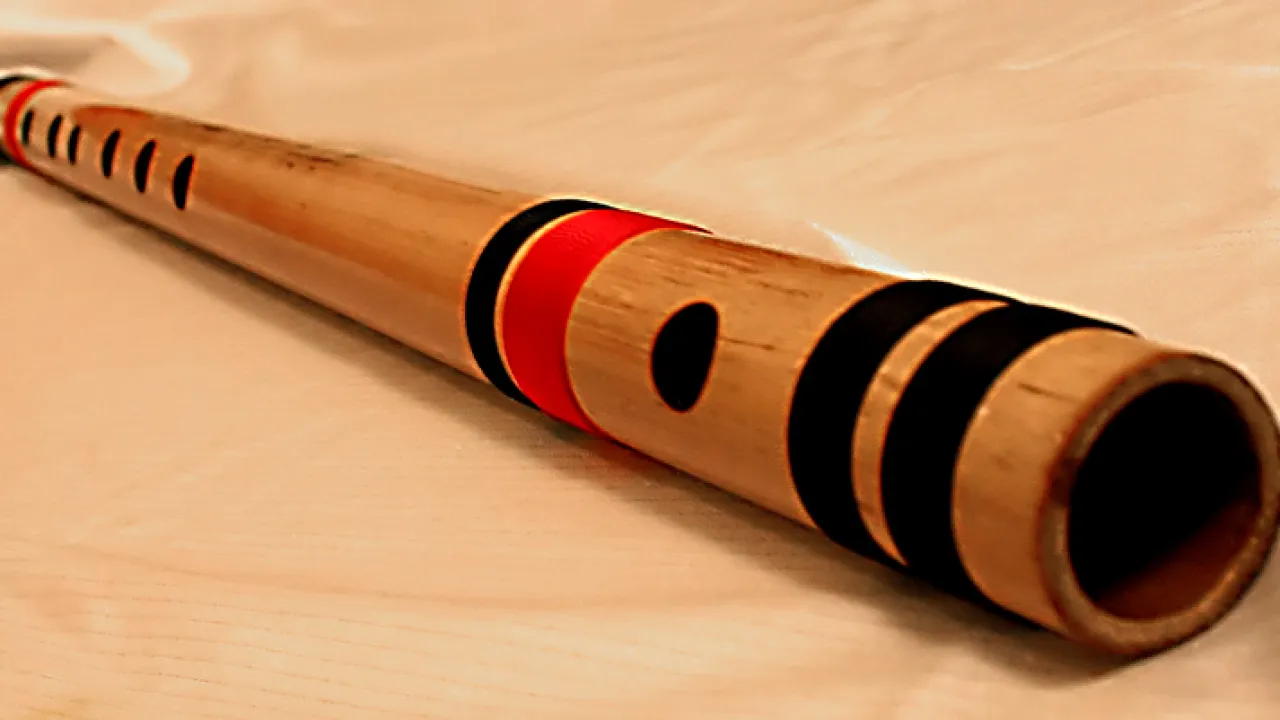
1. How does a musician hold a bansuri while playing?
2. What plant is used to craft a traditional bansuri?
🤯 Mind-Blowing Fact • Grade 2
Carvings on two-thousand-year-old stone temples in India show musicians playing side-blown bamboo flutes!
✨ Word Sparks (Grade 2 Glossary)
Tap 🔊 to hear
melody
A pleasing pattern of musical notes
stalk
The main tall stem of a plant
vibrations
Tiny rapid shakes that create sound
🪝
Why does this ancient Indian flute have bright threads wrapped tightly around its body?
1
A Whisper in the Morning
Soft air drifts across an open hole, and a warm wooden fills the room. For thousands of years in India, people have loved the peaceful voice of the bansuri.
2
Crafted from One Stalk
Flute makers choose thin, straight bamboo that grows in misty hills. They dry the carefully and burn neat finger holes with hot iron rods. Colorful silk threads wrap around the tube so the dry bamboo will not split.
3
Fingers That Sing
Because there are no metal keys, fingertips rest directly over the open holes. Lifting a finger just halfway lets one note melt gently into the next, sounding like a singer's voice. From quiet morning tunes to lively village dances, every song feels warm and alive.
1. Why do makers wrap tight silk threads around a bansuri?
2. How do bansuri players slide smoothly between two notes?
🤯 Mind-Blowing Fact • Grade 3
Twentieth-century pioneer Pannalal Ghosh invented the long seven-hole bass bansuri, giving the instrument a deep, velvety concert voice!
✨ Word Sparks (Grade 3 Glossary)
Tap 🔊 to hear
embouchure
How a player shapes lips to blow
octave
Eight-note span from low to high twin
raga
Traditional Indian melodic framework for music
🪝
How can a flute with zero metal keys play dozens of delicate notes across more than two octaves?
1
Splitting the Breath
Imagine blowing gently across the top of a glass bottle until it hums. When a flutist directs a focused ribbon of air across the bansuri's blowhole, the sharp rim splits the airstream and sets the air column vibrating inside.
2
Assam Bamboo Craft
Master makers search northeastern India for thin-walled bamboo with long spaces between natural knots. One end near the hole is sealed with cork, turning the rest of the cane into a smooth acoustic chamber.
3
Shorter Tube, Higher Pitch
Opening finger holes from the bottom upward shortens the vibrating column of air and raises the pitch. To leap into a higher , the musician blows faster with firmer lip control called .
4
Voice of the Raga
In Hindustani classical music, melodies called rely on graceful curves between notes. By rolling the pads of their fingers across open holes, bansuri artists imitate every sigh and ornament of classical singing. Accompanied by the steady hum of a tanpura drone and crisp tabla drums, the bamboo flute weaves unforgettable musical stories.
1. What happens inside a bansuri when a player uncovers finger holes toward the top?
2. How does a flutist jump to a higher octave on the same fingerings?
🤯 Mind-Blowing Fact • Grade 4
Every concert bansuri is unique because bamboo grows with slight natural tapers, requiring makers to fine-tune each hole with heated iron spindles by ear!
✨ Word Sparks (Grade 4 Glossary)
Tap 🔊 to hear
standing wave
Steady air vibration trapped inside a tube
meend
Smooth continuous glide between two musical pitches
microtonal
Using tiny pitch steps smaller than piano keys
🪝
What happens inside a single cylinder of wild bamboo when edge-tone physics meets centuries of Indian classical artistry?
1
Edge-Tone Resonance
Before a single mechanical key was ever bolted onto a silver flute, artisans in South Asia perfected acoustic simplicity. When a player shapes a precise embouchure and aims a thin air jet across the sharp rim of the blowhole, rapid eddies oscillate in and out of the bore, locking into a resonant .
2
Selecting the Ideal Cane
Concert instruments are crafted from Pseudostachyum polymorphum, a rare thin-walled bamboo thriving in the humid forests of Assam. Makers season the stalks for years so natural resins harden, then bore and scorch six or seven tone holes at meticulously measured intervals to tune the scale without deadening the wood's warmth.
3
Mastering the Meend
Mechanical keypads snap holes completely open or shut, which makes seamless pitch bending difficult on Western flutes. On a keyless bansuri, rolling a finger millimeter by millimeter across a wide hole creates a continuous glide called a , an essential expressive tool in North Indian ragas. Subtle turns of the head toward or away from the lips bend pitches even further for delicate emotional shading.
4
From Folk Pastures to Concert Halls
Once heard mainly in pastoral folk songs, ancient Sanskrit drama ensembles, and temple devotionals associated with Lord Krishna, the flute gained majestic depth when twentieth-century innovators lengthened the bore to seventy-five centimeters. Masters such as Pannalal Ghosh and Hariprasad Chaurasia proved that humble forest bamboo could command vast concert halls and hold audiences spellbound for hours.
1. Why are keyless tone holes an advantage rather than a flaw in Hindustani classical music?
2. Why must Assam bamboo stalks be seasoned for years before becoming concert flutes?
🤯 Mind-Blowing Fact • Grade 5
A concert E-bass bansuri stretches roughly 75 centimeters long, requiring such wide finger stretches that players rest the holes against their middle finger joints rather than their fingertips!
✨ Word Sparks (Grade 5 Glossary)
Tap 🔊 to hear
aerophone
Instrument producing sound primarily through vibrating air
harmonics
Higher whole-number multiples of a base frequency
shruti
Subtle microtonal pitch interval in Indian music
🪝
How does a keyless cylinder of thin-walled grass achieve microtonal precision that rivals the human larynx?
1
Aeroacoustics of the Transverse Bore
Listen closely in a hushed auditorium as a breathy shimmer crystallizes into a pure, round fundamental near 330 hertz. Classified in organology as a side-blown transverse (Hornbostel-Sachs 421.121.12), the bansuri converts a steady stream of breath into periodic pressure waves when an air jet oscillates across the sharp bevel of its embouchure hole.
2
Open-Pipe Harmonics and Overblowing
Although an internal cork seals the stalk just above the blowhole, the embouchure opening and distal end both vent to outside air, making the flute behave acoustically as an open-open cylinder. Consequently, it supports both odd and even ; narrowing the lip aperture and accelerating air velocity doubles or triples the frequency, unlocking two and a half octaves from just six or seven finger holes.
3
Botanical Engineering from Assam
Not just any bamboo can sustain concert projection. Luthiers prize thin-walled canes from northeastern India whose internodal segments stretch nearly a meter without interrupting woody septa. After slow curing, makers pierce and burnish tone holes with glowing iron rods, carefully undercutting rims to balance intonation across registers while binding the shaft with tensioned cord to resist longitudinal splitting.
4
Microtonal Acoustics of Shruti
Hindustani classical theory divides the octave into twenty-two subtle pitch nuances known as . By combining delicate jaw angles with fractional uncovering of tone holes, a virtuoso alters acoustic impedance gradually rather than abruptly, sculpting fluid glissandi called meend and rapid ornamental oscillations called gamak. Resting the flat middle phalanges of the fingers across wide tone holes ensures airtight seals while freeing the fingertips for effortless shading.
5
Modern Concert Legacy
For centuries, short soprano flutes accompanied dance and pastoral song, until mid-twentieth-century visionary Pannalal Ghosh engineered longer bass instruments tuned to concert E (spanning roughly B3 at 247 hertz to F6 at 1,397 hertz) with an added seventh hole. Later carried around the globe by Pandit Hariprasad Chaurasia, this unadorned cylinder of grass proved that supreme expressive complexity often emerges from minimal mechanical design.