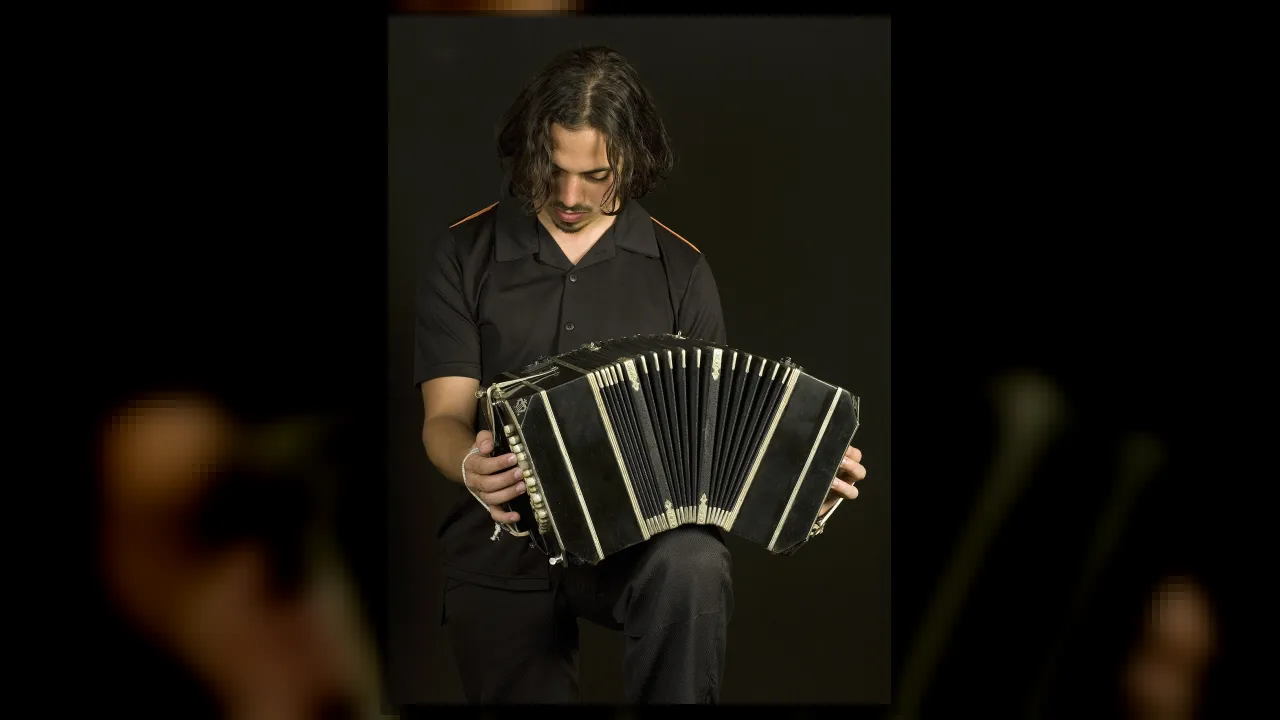
1. How does a seated musician hold a bandoneon while playing?
2. What happens if you hold down one bandoneon button while pulling open and then pushing shut?
🤯 Mind-Blowing Fact • Grade 2
The bandoneon is named directly after its German inventor, Heinrich Band!
✨ Word Sparks (Grade 2 Glossary)
Tap 🔊 to hear
port
Harbor city where ocean ships dock
hymn
Solemn song of praise sung together
air valve
Thumb lever letting bellows breathe without sound
🪝
How did a small German church instrument cross the ocean to become the star of South American tango?
1
A Long Ocean Journey
In the 1840s, a German music shop owner named Heinrich Band created a portable button box so small country churches could play . Decades later, sailors carried it across the Atlantic to the bustling of Buenos Aires and Montevideo.
2
Every Note Built by Hand
An accordion gives the left hand special shortcut buttons that play whole chords with one tap. A bandoneon has zero shortcut buttons! To sound a rich four-note chord, fingers must hunt down and press four separate buttons at once.
3
Breathing with an Air Lever
Thumb-pressed let the player silently gulp or sigh air to reset the long drooping bellows right in time with dancers' footsteps across polished wooden floors.
1. Why did Heinrich Band originally design the bandoneon in Germany?
2. How do you play a three-note chord on a bandoneon?
🤯 Mind-Blowing Fact • Grade 3
On vintage German bandoneons, buttons aren't numbered 1, 2, 3 in scale order—instead they bear quirky factory numbers and symbols left over from the 1800s!
✨ Word Sparks (Grade 3 Glossary)
Tap 🔊 to hear
bittersweet
Mixing tender sadness with beauty and warmth
nuevo tango
Modern concert tango blending jazz and classical
octave pair
High and low twin notes sounding together
🪝
Why did frustrated learners nickname the bandoneon's tangled button map 'the devil's box'?
1
Four Keyboards in One!
Imagine learning piano if all the keys were scrambled like a treasure map—and changed into brand-new notes whenever you breathed in! A classic bandoneon carries thirty-eight treble buttons on the right and thirty-three bass buttons on the left, producing one hundred forty-two tones.
2
Why the Buttons Look Scrambled
Early models only had a few folk notes. Whenever musicians asked for missing sharps and flats, workshops simply squeezed extra buttons around the outside edges instead of redesigning the grid! As a result, a learner must memorize four completely different finger maps: right hand opening, right hand closing, left hand opening, and left hand closing.
3
Octave Reeds That Sigh
Inside the walnut cases, each right-hand button opens two steel reeds tuned a full octave apart, giving tango melodies their , crying depth.
4
Standing Up for Nuevo Tango
Argentine master Astor Piazzolla famously stood on stage with one foot propped on a chair, resting the heavy box on his raised thigh while blending jazz harmonies and classical counterpoint into electrifying .
1. Why must a bandoneon player memorize four different note layouts on one instrument?
2. Why aren't bandoneon buttons arranged in a neat straight scale like a piano?
🤯 Mind-Blowing Fact • Grade 4
Golden-age 'Doble A' bandoneons crafted in East Germany before World War II are prized like Stradivarius violins by tango soloists around the world!
✨ Word Sparks (Grade 4 Glossary)
Tap 🔊 to hear
abriendo
Playing while pulling the bandoneon bellows open
milonga
Lively Argentine social tango dance and music
veneers
Thin resonant layers of fine cabinet wood
🪝
Why do Argentine tango masters insist that a bandoneon sounds sweetest while pulling open—and fieriest when snapping shut?
1
Acoustic Soul of the Rio de la Plata
Listen to a Buenos Aires orquesta tipica launch into a midnight : rows of four or five bandoneonists drop the center of their long, nineteen-fold bellows into a graceful V-curve across their knees, unleashing razor-sharp rhythmic staccatos called marcato before melting into velvet sighs alongside soaring violins and piano.
2
Rheinische Tonlage 142-Tone Architecture
Standardized in Saxony by factories like Alfred Arnold ('Doble A'), the prized Argentine system houses seventy-one buttons controlling paired steel reeds riveted onto heavy zinc or aluminum plates. Because gravity helps the heavy wooden bass end fall effortlessly away from the right hand during opening strokes (), tango players favor opening phrases for lyrical cantabile singing, reserving closing strokes for punchy rhythmic accents.
3
Zinc Plates and Woody Resonance
Unlike bright accordions clad in thick celluloid plastic, classic bandoneons feature thin, unvarnished hardwood and dense zinc reed plates with zero register switches. Every subtle twitch of finger, palm, or wrist transmits directly into the resonating wooden cabinet, letting each musician sculpt a deeply personal vocal tone.
4
From Port Milongas to World Symphony
Carried from immigrant port neighborhoods into grand concert halls by visionary bandleaders Pedro Laurenz, Anibal Troilo, Osvaldo Pugliese, and Astor Piazzolla, Rioplatense tango—anchored by the bandoneon's unmistakable voice—was inscribed by UNESCO onto its Intangible Cultural Heritage list in 2009.
1. Why do tango musicians especially prize playing lyrical melodies 'abriendo' (while opening the bellows)?
2. What material difference helps give vintage German bandoneons a darker, throatier tone than plastic-coated accordions?
🤯 Mind-Blowing Fact • Grade 5
Because of its quirky radial button layout, wide four-octave orchestral chord voicings that would require three hands on a piano can be played effortlessly by ten fingers on a bandoneon!
✨ Word Sparks (Grade 5 Glossary)
Tap 🔊 to hear
cerrando
Playing while compressing bandoneon bellows inward
substrate
Underlying base plate supporting mounted parts
syncopation
Placing rhythmic accents on unexpected off-beats
🪝
How did a non-linear German button matrix engineered without register switches become one of chamber music's most expressive polyphonic voices?
1
Ergonomics of Gravity and Drooping Bellows
A sharp percussive slap against the wooden casing breaks the silence before a five-voice minor ninth chord swells from an almost inaudible whisper. Organologically a hand-held bisonoric free-reed aerophone (Hornbostel-Sachs 412.132), the bandoneon dispenses with shoulder harnesses entirely; its disproportionately long, supple cardboard-and-goatskin bellows sags under its own mass between two compact square manuals, turning gravity itself into an expressive acoustic partner.
2
Acoustics of Octave-Coupled Steel on Zinc
In the canonical Argentine Rheinische Tonlage ('142-tone') model perfected in Carlsfeld by Alfred Arnold, seventy-one stepped buttons actuate long wooden lever arms inside thin walnut housings. Treble tones pair an 8-foot fundamental steel reed with a 4-foot octave reed riveted onto massive zinc plates without tone-switching shutters. Spanning roughly C2 (65.4 hertz) in the left-hand bass up to B6 (1,975 hertz) in the treble, the rigid zinc minimizes energy loss at the rivet while thin wood walls radiate warm mid-band formants.
3
Accretionary Button Geometry
Because nineteenth-century German builders expanded Heinrich Band's early 56- and 88-tone diatonic concertinas incrementally—grafting accidental pitches onto peripheral rows rather than reorganizing the core—adjacent chromatic pitches leap unpredictably across rows, and bellows reversal alters intervals asymmetrically. Paradoxically, wide chord clusters that stretch impossibly across a piano keyboard often fall right beneath three adjacent bandoneon fingers!
4
Articulation Vocabulary of Rioplatense Tango
Mastery demands choreographing thumb-operated air-release levers so lyrical phrases unfold primarily abriendo (opening), where lower internal turbulence softens transient attacks and blends octave reeds seamlessly, contrasted against biting (closing) , crisp variacion sixteenth-note cascades, and knee-driven arrastre glissandi.
5
Global Preservation and Reinvention
After post-war nationalization halted classic Saxon factories, surviving pre-war 'Premier' and 'Doble A' instruments grew exceedingly rare; today, dedicated Argentine university luthiery programs alongside German and French master builders—crafting both bisonoric Rheinische and unisonoric Kusopulos/Peguri systems—safeguard the irreplaceable voice immortalized by Anibal Troilo and Astor Piazzolla.