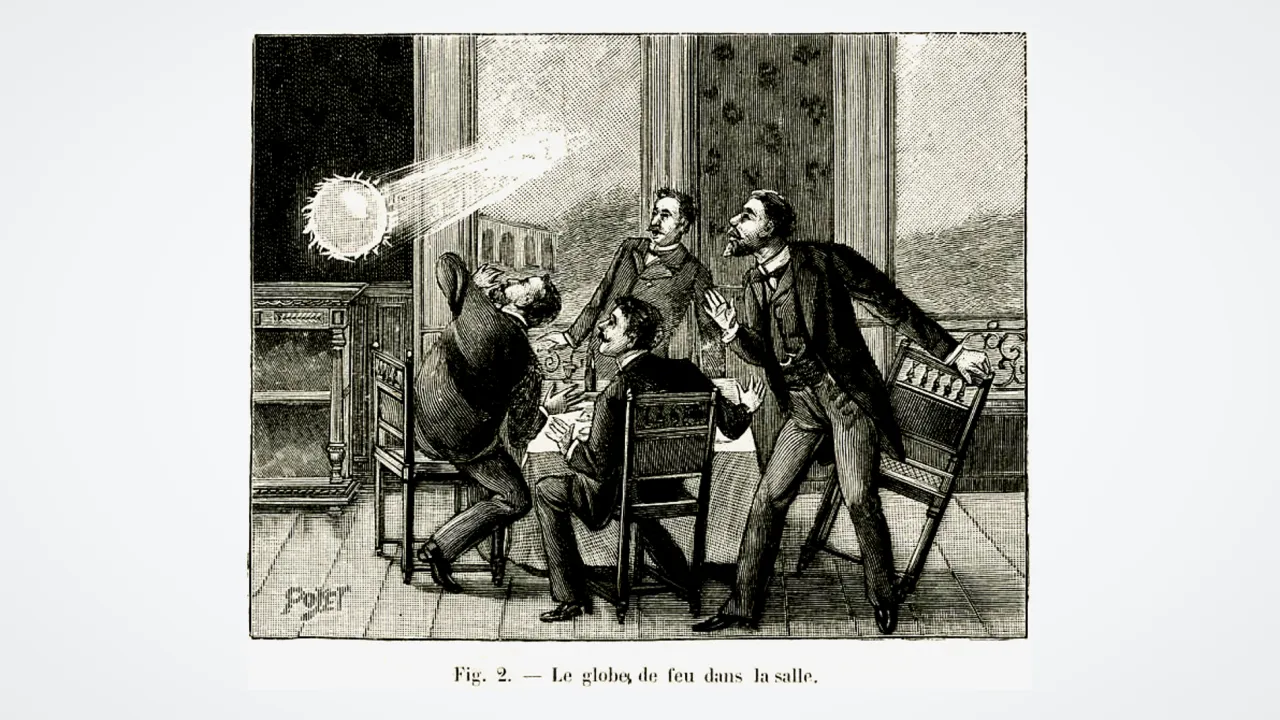
1. How does ball lightning behave differently from a normal zigzag lightning bolt?
2. About how big are most reported spheres of ball lightning?
🤯 Mind-Blowing Fact • Grade 2
In 2014, scientists in China studying ordinary lightning accidentally recorded the very first scientific video and light rainbow of real ball lightning!
✨ Word Sparks (Grade 2 Glossary)
Tap 🔊 to hear
eyewitness
a person who sees something happen firsthand
sphere
a completely round 3D ball shape
vanish
disappear suddenly out of sight
🪝
Why has it taken scientists hundreds of years to catch ball lightning on camera?
1
Floating Through Stormy Air
Imagine watching a fierce thunderstorm through a window when lightning strikes a tree outside—and suddenly a bright, hissing ball of orange light drifts across the yard at walking speed! For centuries, sailors, farmers, and pilots have reported this strange sight called ball lightning.
2
Seconds Before It Pops
Unlike a normal lightning bolt that almost instantly, a glowing ball lightning usually lasts from two to ten seconds. Then it either fades away quietly or disappears with a sharp bang!
3
Too Surprise-Filled to Chase
Because nobody knows where or when one will appear, pointing scientific cameras at the exact right spot took centuries of luck!
1. Why is ball lightning so hard for weather scientists to study outdoors?
2. How did scientists in China finally capture scientific measurements of ball lightning in 2014?
🤯 Mind-Blowing Fact • Grade 3
Light measurements from the famous 2012 Qinghai ball lightning showed glowing silicon, iron, and calcium—the exact ingredients of the dirt the lightning bolt had just struck!
✨ Word Sparks (Grade 3 Glossary)
Tap 🔊 to hear
silicon
common Earth element found in sand and soil
spectrograph
camera splitting light to identify glowing elements
hypothesis
a testable scientific explanation for a mystery
🪝
Could a glowing ball of lightning actually be made from vaporized dirt struck by a bolt?
1
Centuries of Startled Witnesses
Crack! Right after a blinding cloud-to-ground lightning strike, a luminous sphere the size of a bowling ball hovers three feet above the wet ground, humming softly as it glides sideways against the breeze! Thousands of reliable observers—even physicists and airline crews—have described ball lightning over the past three hundred years.
2
Clues From a Lucky Camera
For decades, skeptics wondered if people were just seeing bright spots in their eyes after a flash. Then in 2012, researchers on China's Qinghai Plateau filmed a glowing sphere drifting for 1.6 seconds right after a ground lightning strike—proving beyond doubt that ball lightning is real!
3
Glowing Soil Vapor Theory
Special light-splitting cameras revealed glowing , iron, and calcium inside that sphere—the exact minerals found in ordinary soil! One leading theory says lightning vaporizes dirt into tiny silicon specks that slowly burn with oxygen in midair like a floating sparkler.
4
Other Competing Ideas
Other physicists test whether trapped radio waves or magnetic plasma rings explain sightings indoors or near airplanes!
1. What surprising clue did the light-splitting camera find inside the ball lightning filmed in China?
2. Why is it exciting when scientists still have more than one hypothesis for ball lightning?
🤯 Mind-Blowing Fact • Grade 4
Scientists in laboratories have created brief glowing silicon fireballs lasting half a second by zapping silicon wafers with high-voltage electric arcs!
✨ Word Sparks (Grade 4 Glossary)
Tap 🔊 to hear
silica
mineral compound of silicon and oxygen in sand
nanoparticle
ultra-tiny speck thousands of times thinner than hair
electromagnetic
energy waves like light, radio, and microwaves
🪝
How can a ball of glowing energy hold itself together for five whole seconds without floating straight up like hot air?
1
Defying Everyday Expectations
Ask an Earth scientist to name the strangest puzzle in thunderstorm physics, and ball lightning tops nearly every list! Ordinary lightning plasma cools and vanishes within hundredths of a second as soon as current stops flowing. Moreover, a pocket of 30,000-degree gas ought to shoot straight upward like a miniature hot-air balloon! Yet thousands of historical accounts describe grapefruit-sized spheres hovering calmly near eye level, glowing as brightly as a 100-watt household lightbulb without scorching nearby curtains or grass.
2
The Vaporized-Silicon Nanoparticle Model
In 2000, researchers John Abrahamson and James Dinniss proposed an ingenious chemical explanation. When a fierce cloud-to-ground lightning bolt blasts sandy or clay-rich soil, intense heat vaporizes (silicon dioxide) while carbon in the soil strips away oxygen. Microscopic of pure silicon condense into wispy, web-like chains that trap air in a buoyant sphere and slowly recombine with atmospheric oxygen—glowing steadily for seconds until the fuel runs out!
3
Spectral Proof on the Tibetan Plateau
When Chinese physicists Jianyong Cen, Ping Yuan, and Simin Xue published the first accidental high-speed spectrum of natural ball lightning in 2014, emission lines of neutral silicon, iron, and calcium matched the soil model remarkably well!
4
Trapped Microwaves Near Aircraft
Still, soil cannot easily explain rare reports of ball lightning forming high in the sky near metal airplanes! For those cases, physicists investigate whether intense microwaves emitted by lightning get trapped inside a spherical shell of ionized plasma—proving nature may have more than one recipe for glowing spheres!
1. According to the Abrahamson–Dinniss soil hypothesis, what keeps a ball lightning sphere glowing for several seconds?
2. Why do physicists suspect more than one physical mechanism might produce ball-lightning-like sightings?
🤯 Mind-Blowing Fact • Grade 5
The famous ball lightning filmed in China pulsed in brightness 100 times per second—matching the exact alternating-current rhythm of a nearby 50-hertz electrical power line!
✨ Word Sparks (Grade 5 Glossary)
Tap 🔊 to hear
St. Elmo's fire
glowing electric sparks clinging to pointed objects
oxidation
chemical reaction combining a substance with oxygen
emission line
specific light color revealing an element's identity
🪝
Why did ball lightning violate Virial Theorem plasma limits until chemists and quantum physicists proposed wildly creative models?
1
The Plasma Confinement Paradox
For over a century, theoretical physicists struggled to reconcile eyewitness reports of ball lightning with fundamental electromagnetism. In the 1950s, Soviet Nobel laureate Pyotr Kapitsa pointed out a glaring dilemma: an unconfined ball of hot ionized plasma at atmospheric pressure should recombine and cool in milliseconds—and according to the magnetohydrodynamic virial theorem, internal magnetic fields alone cannot hold a plasma sphere together without external pressure! Something had to be supplying continuous energy or chemical structure.
2
Slitless Spectrograph Breakthrough at Lanzhou
Scientific skepticism gave way to hard data in July 2012, when researchers from Northwest Normal University operating high-speed video cameras (3,000 frames per second) and slitless spectrographs on China's Qinghai Plateau captured a cloud-to-ground stroke 900 meters away. Immediately at the strike point, a luminous five-meter-wide optical halo centered on a compact core drifted horizontally at 8.6 meters per second for 1.64 seconds, shifting from purple-white to orange-red before vanishing.
3
Emission Lines Confirm Vaporized Soil Chemistry
Beside nitrogen and oxygen air lines, the sphere's optical spectrum radiated strong atomic of Silicon I, Iron I, and Calcium I—elements abundant in local silicate soil! Even more telling, brightness oscillated subtly at 100 hertz, matching electromagnetic coupling from a nearby 50-hertz high-voltage power transmission line.
4
Aerogel Nanoparticle Networks vs. Microwave Solitons
That landmark spectrum bolstered the silicon-nanoparticle aerogel model, in which carbothermic reduction inside a ground strike spins porous chains of silicon nanoparticles whose surface oxide layers slow to a multi-second glow. Meanwhile, to explain airborne or window-penetrating reports, plasma physicists model relativistic-electron microwave cavities ('solitons') and topological magnetic knots called skyrmions.
5
Distinguishing St. Elmo's Fire From True Ball Lightning
Careful investigators also separate free-floating ball lightning from —a steady violet corona glow anchored directly onto pointed ship masts, church spires, or airplane noses under strong thunderstorm electric fields.