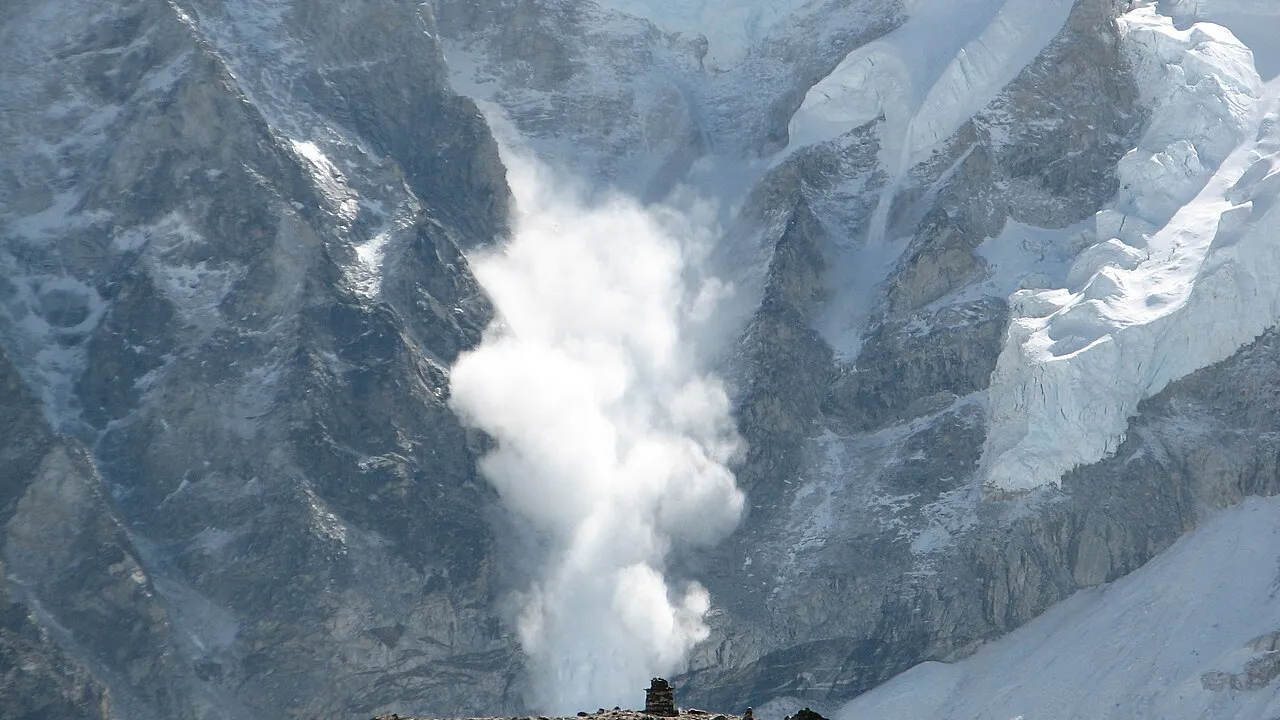
🌋 Where It FormsHigh-Altitude Mountain Slopes (Prime Angles of 30°–45°)
💎 Key PropertiesLayered Snowpack Weak Facets & Wind Slabs Racing 100–300 km/h
⚡ Planet Earth SparkTurns fluffy winter snow into a thundering white cloud hurtling downhill at highway-to-express-train speeds
🤯 Mind-Blowing Fact • Grade 1
Big snowy powder avalanches can race down steep mountainsides faster than 150 miles per hour!
✨ Word Sparks (Grade 1 Glossary)
Tap 🔊 to hear
avalanche
Large mass of snow sliding rapidly downhill.
layer
One flat sheet resting on top of another.
powder
Light, dry, fluffy snow newly fallen down.
🪝
How can quiet, fluffy white snow suddenly roar down a mountain faster than a car?
1
Stacked Layers of Snow
All winter long, storm after storm blankets tall mountains in white snow. Each storm leaves a new ! Some layers pack tight, and some stay crumbly like sugar.
2
WHOOSH Down the Hill!
When heavy new snow presses on a weak bottom , the top blanket cracks loose! Down rushes a roaring white river of snow called an .
3
Snow Patrol Heroes
Mountain rangers test snow and clear loose snow early so skiers stay safe!
1. What rushes down a mountain during an avalanche?
2. How do mountain snow rangers keep ski areas safe?
🤯 Mind-Blowing Fact • Grade 2
Contrary to cartoons, shouting cannot trigger an avalanche—sound waves bounce right off snow with tiny pressure compared to the weight of fresh snowfall!
✨ Word Sparks (Grade 2 Glossary)
Tap 🔊 to hear
slab
Thick, stiff layer of wind-packed snow.
snowpack
All stacked winter snow layers resting on ground.
snow shed
Tunnel-like roof protecting mountain roads from avalanches.
🪝
Does yelling loudly in the mountains really start avalanches like in cartoons?
1
Busting a Cartoon Myth!
In silly cartoons, a yodel or shout makes a whole mountain of snow tumble down! Scientists tested that myth and proved human voices are way too weak to shake snow loose. Instead, real avalanches happen because of weight, wind, and weather.
2
Potato Chips on Sugar
Picture laying a stiff potato chip on top of loose, rolling sugar crystals on a tilted tray! Wind packs top snow into a stiff ',' while cold weather underneath can turn deeper snow into sugary, weak crystals.
3
Snow Sheds Over Roads
When heavy new snow overloads that weak layer, the cracks and slides. In snowy passes, engineers build concrete '' like sturdy roofs over highways so avalanches glide harmlessly right over passing cars!
1. Can shouting or yodeling loudly actually trigger a mountain avalanche?
2. What structure do engineers build over steep mountain highways and railroads so snow slides safely over traffic?
🤯 Mind-Blowing Fact • Grade 3
When a fast avalanche suddenly stops at the bottom of a valley, friction heat briefly melts crystal edges that instantly refreeze—setting the snow as hard as concrete in seconds!
✨ Word Sparks (Grade 3 Glossary)
Tap 🔊 to hear
crown line
Sharp upper fracture cliff where a slab breaks.
snow pit
Trench dug by scientists to inspect snow layers.
forecaster
Scientist who predicts weather or snowpack safety.
🪝
Why do almost all big avalanches happen on slopes tilted between 30 and 45 degrees—not on steeper cliffs?
1
The Goldilocks Slope Angle
You might guess vertical 70-degree mountain cliffs have the biggest avalanches, yet they rarely do! On super-steep cliffs, fresh snow continually sluffs off in harmless dribbles during every storm. Slopes below 25 degrees are too gentle to slide fast, making 30-to-45-degree slopes the prime avalanche zone!
2
Loose-Snow vs. Slab Avalanches
Snow scientists study two main kinds of slides. Loose-snow ('point-release') avalanches start from one tiny spot and fan out into an upside-down V. Slab avalanches are much larger: a whole football-field-sized block of stiff snow fractures along a sharp '' all at once!
3
Reading a Snow Pit
Avalanche ski into the backcountry, dig neat rectangular , and examine crystals with magnifying lenses to spot fragile buried frost layers.
4
Rescue Dogs and Beacons
Trained avalanche rescue dogs use their amazing sense of smell alongside electronic rescue beacons to help ski patrollers keep winter mountains safe!
How do fragile six-sided snowflakes transform AFTER they land on the ground to build an invisible trap door inside a snowpack?
1
Snow Metamorphism Inside the Pack
Most people think a snowflake stops changing once it lands! In reality, a winter snowpack is a dynamic geologic layer cake undergoing constant 'metamorphism.' Ground beneath deep snow stays right around 0 °C, while clear winter nights chill the snow surface to -20 °C! That steep temperature gradient drives invisible water vapor upward from the warm ground, growing large, angular, cup-shaped ice crystals at the base called ''—weak and loose like dry ball bearings.
2
Buried Surface Hoar and Wind Slabs
Clear, calm nights can also grow feathery frost crystals—called —across top snow like shiny potato chips standing on edge. If howling ridge winds then drift dense, broken snow grains right on top of those delicate feathers, a heavy cohesive '' sits balanced precariously on a fragile weak layer!
3
Dry Powder Clouds vs. Wet Spring Slides
Midwinter dry-slab avalanches shatter into turbulent powder clouds racing over 200 kilometers per hour, pushing hurricane-force air blasts ahead of them that flatten swathes of alpine timber! Later in spring, warm sunshine and rain percolating into the pack lubricate deeper layers to trigger slower, ultra-heavy wet avalanches.
4
Avalanche Chutes Shape Mountain Ecosystems
Look across the Rockies or Cascades in summer, and bright green vertical stripes cut straight through dark evergreen forests: recurring avalanche paths clear tall pines, creating sunny meadows rich in berries and wildflowers for grizzly bears, elk, and marmots!
1. How do sugary, fragile 'depth hoar' crystals form near the bottom of a winter snowpack?
2. How do natural avalanche paths benefit alpine animals like bears and elk in summer?
🤯 Mind-Blowing Fact • Grade 5
When a porous frost layer collapses inside a snowpack with a booming 'WHUMPF!' sound, that invisible fracture wave zips sideways beneath the snow at nearly 100 miles per hour!
Gentle valley base where avalanches slow and stop.
🪝
How can a collapsing weak layer race sideways across a flat meadow—and trigger a slab avalanche hundreds of meters away up a ridge?
1
Anticrack Fracture Mechanics and 'Whumpfing'
Backcountry skiers crossing flat snow sometimes hear a deep, bass-drum 'WHUMPF!' and feel the snow settle a centimeter beneath their skis—right before an avalanche breaks loose on a steep 38-degree slope hundreds of meters upslope! Modern fracture mechanics solved how 'remote triggering' works. Porous weak layers—like faceted depth hoar or buried surface hoar—consist of up to 80 percent air space. When overloaded, the crystal lattice collapses volumetrically in what physicists call an ',' racing laterally through the buried weak layer at 20 to 50 meters per second until it reaches a slope steep enough (`>30°`) for gravity to pull the overlying slab away!
2
Temperature-Gradient vs. Equi-Temperature Metamorphism
Snowpack stability hinges on competing vapor-diffusion regimes. Under a small temperature gradient (`<10 °C/m`), rounded snow grains sinter together via ice necks, strengthening the snowpack over time ('equi-temperature rounding'). Conversely, thin snowpacks in cold continental climates like Colorado experience steep gradients (`>10–20 °C/m`) between 0 °C soil and frigid night skies. Rapid vapor flux strips water molecules off grain bottoms and plates sharp geometric facets onto neighboring grains ('kinetic growth'), destroying inter-grain bonds.
3
Three-Zone Avalanche Path Dynamics
Glaciologists divide every avalanche chute into a bowl-shaped starting zone, a channelized track, and a gentler (<15°) . Inside a full-scale powder-snow avalanche, a dense granular basal core (density ~200–300 kg/m³) hugs the bed while lofting fine ice crystals into a turbulent suspension cloud (~5–10 kg/m³) that reaches terminal velocities near 80 m/s (~290 km/h) and generates destructive air-blast pressures exceeding 100 kilopascals.
4
Sintering Lockup and 457-kHz Transceivers
During deceleration in the , frictional heating momentarily coats ice grains in microscopic melt films that freeze solid within seconds ('pressure '), raising deposit density threefold—which is why backcountry travelers carry standardized 457-kilohertz electromagnetic transceivers, collapsible probes, and metal shovels.
5
Gazex Exploders and Doppler Radar
Highway departments along alpine passes like Washington's Snoqualmie Pass and Switzerland's Alps deploy remote-controlled Gazex propane-oxygen canons, snow-supporting steel bridges in starting zones, and ground-based Doppler radar to keep winter lifelines open safely.