🌋 Geologic Period & RegionLate Cretaceous (70 MYA) • Patagonia, Argentina
📏 Size & Weight16–20 ft (5–6 m) long • 650–850 lbs (300–390 kg)
🦴 Diet & FossilsPiscivore / Carnivore • Allen Formation, Rio Negro
⚡ Survival SuperpowerLargest southern raptor, pairing raptor sickle toe claws with tiny arms and conical fish-catching teeth
🤯 Mind-Blowing Fact • Grade 1
Austroraptor is the biggest raptor dinosaur ever discovered anywhere in the Southern Hemisphere!
✨ Word Sparks (Grade 1 Glossary)
Tap 🔊 to hear
hemisphere
one half of planet Earth's globe
conical
shaped like a smooth, pointed cone
slippery
wet and smooth, hard to hold
🪝
Could a giant feathered raptor have tiny short arms AND fish-catching teeth?
1
Giant Southern Raptor
Splash, snap! Out of a warm river in South America leaps a feathered surprise! Austroraptor grew as heavy as a grizzly bear—much bigger than Velociraptor!
2
Tiny Little Arms!
Most raptors had long, wing-like arms. Not Austroraptor! Its feathery arms were super short, almost like a mini T. rex!
3
Pointy Fish Teeth
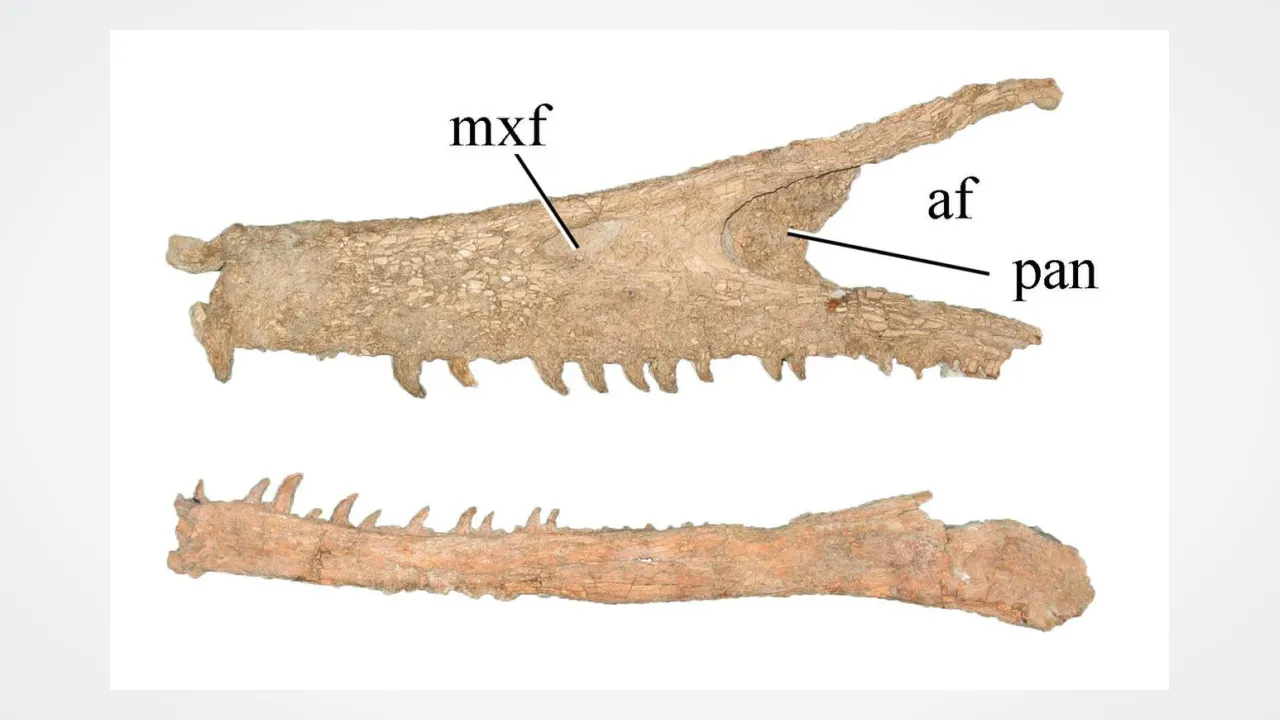
Its long snout held cone-shaped teeth to grab fish, while curved toe claws pinned food down.
1. How were the arms of Austroraptor different from northern raptors like Velociraptor?
2. What kind of teeth lined the long snout of Austroraptor?
🤯 Mind-Blowing Fact • Grade 2
Unlike almost every other raptor, Austroraptor's teeth had zero saw-like serrations—they were fluted cones just like spinosaur teeth!
✨ Word Sparks (Grade 2 Glossary)
Tap 🔊 to hear
piscivore
an animal that eats mostly fish
fluted
carved with lengthwise ridges and grooves
pin
to hold firmly down in place
🪝
What happens when a raptor evolves to fish like a giant stork?
1
Southern Thief of Patagonia
Wade into shallow marshes in southern Argentina seventy million years ago! Standing taller than a grown human and stretching nearly twenty feet long, Austroraptor cabazai—meaning southern thief—was a feathered giant among raptors.
2
Breaking the Raptor Rules
Before paleontologist Fernando Novas unveiled Austroraptor in 2008, people pictured every raptor with deep slicing jaws and long grasping arms. Austroraptor flipped both ideas upside down! Its upper arm bone was less than half the length of its thighbone, so it hunted using its long, low snout and lightning-fast legs instead.
3
Sickle Claw Still Ready
On each three-toed foot, the second toe still carried the famous raised, curved raptor claw to slippery fish, frogs, or small dinosaurs!
1. What was missing from the edges of Austroraptor's teeth compared with Velociraptor?
2. Which classic raptor weapon did Austroraptor still keep on its feet?
🤯 Mind-Blowing Fact • Grade 3
Austroraptor's narrow skull measured over two and a half feet long—so slender that scientists first wondered if pieces belonged to a fish-eating bird or crocodile cousin!
✨ Word Sparks (Grade 3 Glossary)
Tap 🔊 to hear
dromaeosaurid
scientific name for sickle-clawed raptor dinosaurs
Patagonia
windy fossil-rich region of southern Argentina
slender
narrow, graceful, and built for speed
🪝
Why did raptors in South America evolve into long-legged fishers while northern raptors stayed grapplers?
1
Split Continents, Different Raptors
When ancient Pangaea split into northern Laurasia and southern Gondwana, raptor dinosaurs—officially called —went down two fascinatingly different paths! While northern Deinonychus and Velociraptor kept stout legs and long grappling arms, South America's unenlagiine raptors evolved long, snouts and sprinter legs.
2
Giant of the Unenlagiines
Unearthed in 's Allen Formation and named in 2008 honoring museum founder Hector Cabaza, Austroraptor cabazai pushed this southern design to giant scale. Measuring up to nineteen feet long and weighing around seven hundred pounds, it rivaled Utahraptor and Achillobator as one of the largest raptors of all time!
3
Spinosaur-Style Snout
Its eighty-centimeter skull stretched remarkably low and narrow, lined with twenty-four small conical teeth per side grooved like spinosaur teeth—a textbook case of convergent evolution for snapping fish and marsh animals.
4
Built for Speed
Unlike stocky Utahraptor, Austroraptor had long, shin and foot bones built for swift wetland chases!
1. Why did Austroraptor evolve conical, grooved teeth similar to spinosaurs?
2. How did Austroraptor's hind legs compare with giant northern Utahraptor?
🤯 Mind-Blowing Fact • Grade 4
Austroraptor belonged to the same southern unenlagiine raptor branch as tiny crow-sized Buitreraptor—meaning the family ranged from three-pound insect-hunters to eight-hundred-pound giants!
✨ Word Sparks (Grade 4 Glossary)
Tap 🔊 to hear
unenlagiine
long-snouted southern subfamily of raptor dinosaurs
humerus
the upper arm bone below shoulders
seriema
long-legged South American bird with curved toe claws
🪝
How did short-armed Austroraptor share Patagonia with short-armed Carnotaurus cousins?
1
Land of Short-Armed Predators
Late Cretaceous South America seems to have specialized in shrinking dinosaur arms! Alongside stubby-armed abelisaurid predators like Carnotaurus and Quilmesaurus stalked Austroraptor cabazai, a five-to-six-meter giant discovered in Rio Negro Province, Argentina. Whereas northern dromaeosaurids boasted humeri nearly three-quarters the length of their femora, Austroraptor's measured well under half its femur length—forcing its jaws and feet to handle prey capture.
2
Delicate Skull, Precision Snapping
Computer stress models of its elongated, eighty-centimeter skull reveal another surprise: Austroraptor had a relatively light bite! Its slender snout could not withstand violent twisting from huge struggling herbivores. Instead, its dozens of small, non-serrated, fluted conical teeth excelled at lightning-quick snaps on lungfish, freshwater turtles, snakes, mammals, and juvenile ornithopods across coastal lagoons of the Allen Formation.
3
Pin-and-Swallow Raptor Tactics
Follow-up bones recovered in 2012 revealed its hands and sickle-clawed feet in crisp detail. Much like modern or eagles, Austroraptor could sprint down smaller terrestrial or aquatic targets, pin them beneath its enlarged pedal digit-two claw, and dispatch them swiftly with rapid snapping strikes.
4
Southern Unenlagiine Dynasty
Together with tiny flying-capable Rahonavis and swan-necked Halszkaraptor cousins, Austroraptor showcases just how wildly creative raptor evolution became before the end of the Cretaceous!
1. What did computer stress studies of Austroraptor's long, narrow skull show?
2. How big was the size range within South America's unenlagiine raptor subfamily?
🤯 Mind-Blowing Fact • Grade 5
Even though Austroraptor shrank its arms far shorter than typical raptors, wrist bones found in 2012 showed it still kept the half-moon-shaped folding wrist joint inherited from smaller wing-flapping ancestors!
✨ Word Sparks (Grade 5 Glossary)
Tap 🔊 to hear
paravian
clade uniting birds, raptors, and troodontids
pennaceous
structured vane feathers with central shafts
estuarine
living where freshwater rivers meet tides
🪝
How did Patagonia's five-meter Austroraptor upend northern-centric stereotypes of dromaeosaurid anatomy and ecology?
1
Discovery in the Allen Formation
Recovered from Campanian-Maastrichtian mudstones of the Allen Formation at Bajo de Santa Rosa in Argentina's Rio Negro Province, holotype MML-195—supplemented in 2012 by specimen MML-220 preserving forelimb and pedal elements—was named Austroraptor cabazai by Fernando Novas, Diego Pol, Juan Canale, Juan Porfiri, and Jorge Calvo in 2008. Reaching five to six meters in length and roughly 300 to 390 kilograms, it stands as the largest dromaeosaurid ever unearthed across Gondwana.
2
Extreme Forelimb Reduction in Paraves
Long, folding -feathered forelimbs were long considered universal hallmarks of Dromaeosauridae. Austroraptor shattered that generalization: its robust yet drastically shortened humerus measures less than forty-six percent of femoral length—paralleling independent forelimb reduction in tyrannosaurids and coeval Gondwanan abelisaurids while still retaining a semi-lunate carpal wrist inherited from smaller ancestors.
3
Spinosaur-Convergent Cranial and Dental Morphology
Equally striking is its eighty-centimeter, low-profile skull pierced by oversized antorbital fenestrae and housing dozens of small, conical, non-serrated teeth ornamented with longitudinal enamel flutes. Strikingly convergent with spinosaurids and piscivorous crocodylomorphs, this dentition minimized tearing resistance while impaling slippery lungfish, chelid turtles, and semi-aquatic vertebrates across plains.
4
Cursorial Hindlimbs and Raptorial Restraint
Unlike stocky Laurasian giant Utahraptor ostrommaysi, Austroraptor retained slender, elongated tibiae and arctometatarsalian-like cursorial foot proportions alongside a hyper-extendable pedal digit-two sickle ungual—combining high-speed pursuit across open mudflats with raptorial prey-pinning once slippery targets were overtaken.
5
Gondwanan Unenlagiinae Radiation
Nested firmly within Unenlagiinae alongside miniature Buitreraptor and Unenlagia, Austroraptor proves isolated Southern Hemisphere evolved specialized wetland megacarnivore niches while abelisaurids monopolized big-game terrestrial predation across Late Cretaceous South America.