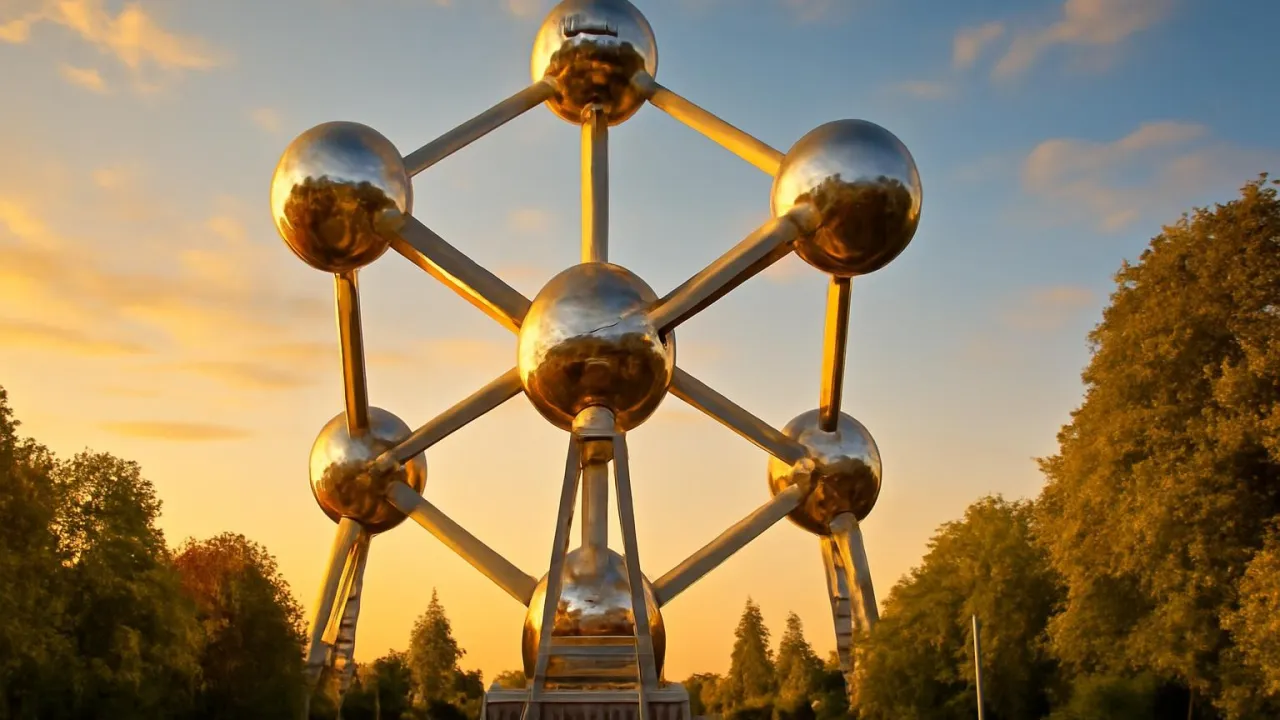
Have you ever seen a building shaped like a science model?
1
A Giant Silver Atom
The Atomium shines with nine giant spheres. Long tubes connect the spheres together, making a cool shape. People love to see its bright metal sparkle in the sun.
2
Walking Inside Science
Visitors can walk through tunnels between the spheres. Some tunnels have stairs, while others have for easy travel. The highest sphere gives amazing of Brussels city.
3
A Science Wonder
The Atomium was built for a world fair in 1958. Its shape copies an iron atom, but it is 165 billion times bigger! This makes learning about atoms super fun.
Each sphere of the Atomium is 59 feet wide—big enough for a classroom inside!
✨ Word Sparks (Grade 3 Glossary)
Tap 🔊 to hear
crystal lattice
A repeating pattern of atoms
observation deck
A high place to look around
stainless steel
A shiny, strong metal that does not rust
🪝
Imagine climbing through a building shaped like a giant atom—what would you find inside?
1
A Shiny Science Sculpture
The Atomium looks like a cluster of silver balls joined by long tubes. Each ball is called a sphere and is made from shiny . Together, they form a giant model of an iron atom’s crystal structure. The Atomium stands tall above the city, catching the sunlight.
2
Exploring the Spheres
Visitors can travel between the nine spheres using escalators and stairs inside the tubes. Some spheres hold science exhibits and fun activities for kids and families. The top sphere is an with a panoramic view of Brussels. Walking through the Atomium feels like exploring inside a science experiment.
3
How Does It Stand?
Strong steel columns support the spheres and tubes, keeping the Atomium steady. The design copies the way atoms connect in a , making it both artistic and scientific. Engineers used careful plans to balance the heavy spheres high in the air. The structure’s stability shows how science and art can work together.
4
A Monument to Progress
The Atomium was built for Expo ’58, a world’s fair celebrating new ideas. It became a symbol of hope and progress in Belgium and around the world. Today, the Atomium welcomes visitors from many countries every year. Its unique shape inspires people to learn more about science and engineering.
The Atomium’s tubes contain the longest escalator ever built in Europe at the time!
✨ Word Sparks (Grade 4 Glossary)
Tap 🔊 to hear
cubic crystal lattice
A box-shaped pattern atoms make in some solids
panoramic
A wide, sweeping view of a place
engineer
A person who designs and builds things
🪝
What if you could shrink and walk through the inside of an atom—how would it look and feel?
1
A Marvel of Modern Architecture
The Atomium’s nine gleaming spheres, linked by diagonal tubes, create a striking silhouette against the Brussels sky. Designed by André Waterkeyn for Expo ’58, the structure represents an iron atom magnified 165 billion times. Each sphere is made from stainless steel and measures 59 feet in diameter, large enough to house exhibits and event spaces. The Atomium’s futuristic design captures the spirit of scientific discovery and optimism after World War II.
2
Inside the Iron Atom
Visitors enter the Atomium through the lowest sphere and travel between levels using a combination of escalators, stairs, and even a vertical elevator. The connecting tubes, some over 100 feet long, allow people to move between the spheres just like electrons might travel between parts of an atom. Interactive science exhibits and windows fill the spheres, making the experience both educational and exciting. The top sphere offers breathtaking views of Brussels and the surrounding countryside.
3
Engineering the Impossible
Building the Atomium required advanced engineering to balance the heavy spheres and tubes. The structure’s frame is made of steel, while the spheres are covered in stainless steel panels that resist rust and weathering. had to calculate how to distribute the weight so the Atomium would remain stable and safe for visitors. Its design is based on the of iron, showing the power of combining art, science, and technology.
4
A Symbol for the Future
When it opened in 1958, the Atomium symbolized hope for a future shaped by science and cooperation. It quickly became a beloved landmark for Belgium and a popular attraction for tourists worldwide. The Atomium continues to inspire curiosity about atoms, molecules, and the wonders of engineering. Its bold form reminds us that big dreams and creative ideas can become real, lasting monuments.
1. What material covers the Atomium’s spheres to keep them shiny and strong?
2. Why did the Atomium become a symbol of hope in 1958?
🤯 Mind-Blowing Fact • Grade 5
The Atomium’s nine spheres could fit nearly 3,000 people inside at once!
✨ Word Sparks (Grade 5 Glossary)
Tap 🔊 to hear
load distribution
How weight spreads out in a building
cladding
The protective outer layer of a structure
Expo
A big world fair for new ideas
🪝
If you could magnify an atom until it became a building, what secrets of science and engineering would you discover inside?
1
The Atomium: Science Turned Monument
Rising 335 feet above Brussels, the Atomium is a unique architectural marvel designed for the 1958 World’s Fair, ’58. Its nine interconnected spheres, each 59 feet in diameter, represent the atomic structure of iron magnified 165 billion times. The monument’s bold modernist design was conceived by engineer André Waterkeyn, who aimed to celebrate scientific progress and the peaceful use of atomic energy. The Atomium’s gleaming stainless steel exterior reflects both the optimism and technical ambition of postwar Europe.
2
Engineering a Giant Crystal Lattice
Constructing the Atomium required innovative engineering to support the enormous weight of the spheres and tubes. The entire framework is composed of steel, with each sphere weighing approximately 250,000 kilograms. The tubes, some stretching 100 feet, are angled precisely to mimic the cubic crystal lattice of iron atoms. Engineers calculated complex to ensure the structure’s stability, employing deep foundations and internal supports to withstand high winds and crowds of visitors.
3
Exploring the Interior: Science in Motion
Inside, visitors travel between spheres using Europe’s longest escalator at the time—115 feet in length—as well as stairs and a central elevator. The spheres contain interactive science exhibits, event halls, and even a sphere dedicated to overnight stays for school groups. Panoramic windows in the upper spheres offer sweeping views of Brussels and its surroundings, while the lower spheres immerse visitors in the wonders of atomic theory and engineering innovation.
4
From Expo Wonder to National Icon
Originally intended as a temporary structure, the Atomium quickly became a symbol of Belgium’s forward-thinking spirit and was preserved as a national landmark. Over the decades, it has undergone several renovations, including the replacement of its original aluminum with durable stainless steel in 2006. The Atomium’s distinctive silhouette is now recognized worldwide, attracting over 600,000 visitors annually and serving as a venue for scientific and cultural events.
5
Legacy of Science, Art, and Imagination
The Atomium stands as a testament to the power of imagination, blending scientific principles with artistic vision on a monumental scale. Its design not only demonstrates the geometry of a cubic crystal lattice but also invites people of all ages to explore the mysteries of atoms and molecules. As both a scientific model and a work of art, the Atomium continues to inspire curiosity, creativity, and international collaboration. Its enduring presence reminds us that even the smallest building blocks of matter can spark the biggest dreams.