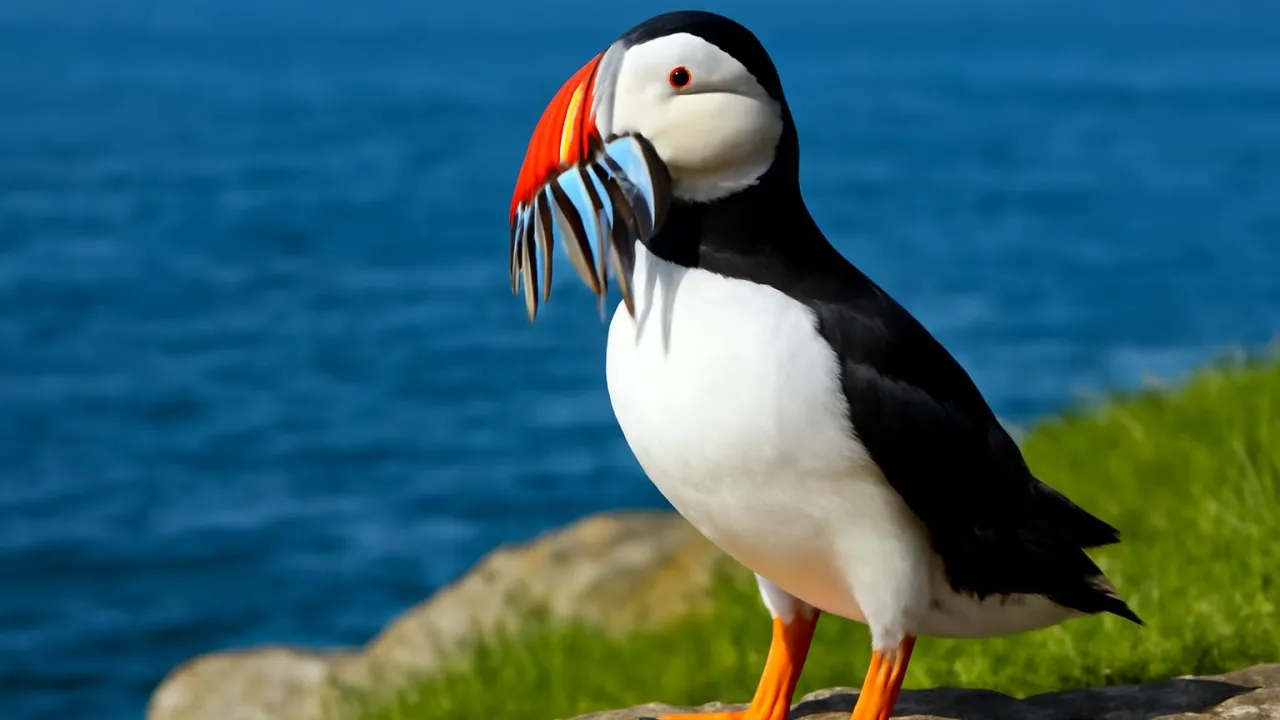
Puffins can flap their wings underwater up to 400 times per minute!
✨ Word Sparks (Grade 2 Glossary)
Tap 🔊 to hear
burrow
A hole dug for a home
chick
A baby bird
flippers
Flat parts for swimming
🪝
Have you ever seen a bird that swims like a fish?
1
Puffin’s Colorful Beak
The Atlantic puffin has a bright, striped beak that stands out. Its beak is red, yellow, and blue, making it look like a clown. The beak helps puffins carry lots of fish at once. Puffins use their beaks to bring food to their .
2
Where Puffins Live
Puffins live on rocky islands by the cold North Atlantic Ocean. They dig in grassy cliffs to make their nests. In spring, puffins come back to land to lay eggs. The rest of the year, they stay out at sea.
3
Swimming and Diving
Puffins are amazing swimmers and divers, using their wings like underwater. They chase little fish and catch them quickly. Puffins can hold many fish in their beaks at once. They bring food back to their in the nest.
Puffins can dive deeper than a basketball hoop is tall!
✨ Word Sparks (Grade 3 Glossary)
Tap 🔊 to hear
adaptation
A special body part for survival
colony
A big group living together
predator
An animal that hunts others
🪝
Did you know some birds can fly underwater?
1
A Beak Built for Fish
The Atlantic puffin’s colorful beak isn’t just for show—it’s a clever tool. Puffins can catch and hold up to ten small fish at once. Their rough tongues press fish against spines on the roof of their beaks. This lets them bring more food to their hungry chicks.
2
Life on Rocky Cliffs
Puffins nest on steep, grassy cliffs along the cold North Atlantic coast. They dig burrows using their sharp beaks and feet to keep eggs safe from . Each spring, puffins return to the same nesting spots. After chicks hatch, families spend winter far out at sea.
3
Masters of Air and Sea
Puffins are strong fliers, flapping their wings up to 400 times a minute. Underwater, they use their wings like flippers to chase fish. Their waterproof feathers keep them warm and dry while diving. Puffins can dive as deep as 200 feet to catch food.
4
Survival in a Changing World
Puffins face challenges like shrinking fish populations and climate change. Some islands protect puffin colonies to help them survive. Scientists study puffins to learn about ocean health. Puffins are important because they show how healthy the sea is.
Puffins always return to the same burrow, even after spending months at sea!
✨ Word Sparks (Grade 4 Glossary)
Tap 🔊 to hear
site fidelity
Returning to the same place every year
ecosystem
A community of living things and their home
conservation
Protecting animals and nature
🪝
Imagine catching ten slippery fish in your mouth at once—could you do it?
1
A Beak Like No Other
The Atlantic puffin’s beak is more than just colorful—it’s an engineering marvel designed for survival. The beak’s unique ridges and spines allow puffins to grip multiple fish without dropping any, even while catching more. During the breeding season, the beak’s bright colors help puffins attract mates and communicate with each other. After breeding, the beak’s colors fade until the next year.
2
Life on the Edge
Atlantic puffins nest in large colonies on remote, windswept cliffs and grassy islands in the North Atlantic. Puffins dig burrows up to three feet deep, providing safe shelter for their single egg and chick. These burrows help protect puffin families from predators like gulls and foxes. Each spring, puffins return to the exact same burrow they used before, showing strong .
3
Flight, Diving, and Feeding Habits
Puffins are powerful fliers, beating their wings rapidly to stay airborne over rough seas and cliffs. Underwater, their wings act like flippers, propelling them through the ocean as they hunt for fish, sand eels, and shrimp. Puffins can dive up to 200 feet deep and stay underwater for over 20 seconds while searching for food. Their waterproof feathers and strong muscles make them expert hunters both above and below water.
4
Puffins and Their Place in the World
Atlantic puffins play a vital role in their , serving as both predator and prey within the marine food web. They help control fish populations and provide food for animals like gulls and larger seabirds. Puffins face threats from overfishing, climate change, and pollution, which can reduce their food supply and nesting success. efforts, such as protected islands and habitat restoration, aim to help puffin populations recover and thrive.
1. Why do puffins dig deep burrows for their nests?
2. What helps puffins grip many fish at once?
🤯 Mind-Blowing Fact • Grade 5
A puffin’s wings can move faster than a hummingbird’s—up to 400 times per minute!
✨ Word Sparks (Grade 5 Glossary)
Tap 🔊 to hear
keratin
A hard material in beaks and nails
incubation
Keeping eggs warm until they hatch
IUCN Red List
A list of animals needing protection
🪝
How does a bird smaller than a football survive wild storms and icy seas?
1
Taxonomy and Physical Marvels
The Atlantic puffin, Fratercula arctica, belongs to the auk family and is renowned for its striking appearance and specialized anatomy. Its triangular, vividly colored beak contains plates that brighten during the breeding season, then shed to reveal a duller beak in winter. Puffins measure about 10 inches (25 cm) tall and weigh roughly 17 ounces (500 grams), making them compact yet robust seabirds. Their short wings, only about 6 inches (15 cm) long, are adapted for both rapid flight and underwater propulsion. Puffins’ orange feet and expressive eyes add to their clown-like look, which helps with species recognition during the crowded breeding season.
2
Life Cycle and Nesting Behavior
Puffins breed on remote, grassy cliffs and rocky islands scattered across the North Atlantic, from Maine to Norway. Each spring, adults return with remarkable fidelity to the same nesting burrow, some of which have been reused for over 20 years. A single white egg is laid deep in the burrow, where both parents share duties for about 40 days. After hatching, the chick, called a puffling, is fed several times daily with beakfuls of fish. Fledging occurs after 6–8 weeks, when the young puffin leaves its burrow at night and heads straight to sea, not returning to land for several years.
3
Adaptations for Extreme Environments
Puffins are superbly adapted to harsh oceanic conditions, with dense, waterproof feathers that insulate them from frigid waters averaging 40–50°F (4–10°C). Their wings beat up to 400 times per minute in flight, reaching speeds up to 55 mph (88 km/h). Underwater, they use their wings like flippers, diving as deep as 200 feet (60 meters) and holding their breath for up to 30 seconds. The beak’s specialized spines and rough tongue allow puffins to grip and transport up to a dozen small fish crosswise without losing any. These adaptations enable puffins to exploit rich fish shoals that other birds cannot reach.
4
Ecosystem Roles and Conservation Status
Atlantic puffins are both predators and prey, feeding primarily on sand eels, herring, and capelin, while being hunted by gulls, skuas, and foxes. Their presence indicates healthy marine environments, as declining puffin numbers often signal trouble in the food web. Overfishing, oil spills, and climate change have caused puffin populations to fall sharply in some regions, especially around Iceland and the UK. Conservationists have restored puffin colonies by translocating chicks and protecting nesting islands from invasive predators. Today, the Atlantic puffin is listed as Vulnerable on the , highlighting the urgent need for ongoing protection.
5
Amazing Numbers and Human Connections
An adult puffin can carry up to 12 fish in its beak at once, and during a single breeding season, a pair may deliver over 2,500 fish to their chick. Puffins spend about eight months each year at sea, sometimes traveling thousands of miles between feeding and nesting grounds. They have inspired legends and folklore in coastal communities for centuries, often called 'sea parrots' or 'clowns of the sea' due to their appearance. Citizen science projects now help track puffin populations, giving people a chance to support conservation efforts. Learning about puffins helps us understand the delicate balance of ocean ecosystems and why every species matters.