📏 Size & WeightUp to 8.5 ft (2.6 m) long • 1.8 ft (55 cm) wide • ~110 lbs (50 kg)
🦴 Diet & FossilsHerbivore & Detritivore • Scottish Trackways & French 3D Head Fossils
⚡ Survival SuperpowerLargest land invertebrate ever, rippling across forest floors on dozens of legs
🤯 Mind-Blowing Fact • Grade 1
Arthropleura left giant parallel footprints in ancient sand that look just like tire tracks from a tractor!
✨ Word Sparks (Grade 1 Glossary)
Tap 🔊 to hear
Millipede
A many-legged bug that eats dead plants
Segment
One of many repeating parts of a body
Trackway
A trail of footprints preserved in stone
🪝
What if a friendly forest bug grew as long as a small car?
1
Rustle in the Ferns
Scritch, scratch, rustle! Giant green ferns shake on the warm swamp floor. Out crawls Arthropleura! It looked like a super-sized as long as a sofa.
2
Lots of Marching Legs
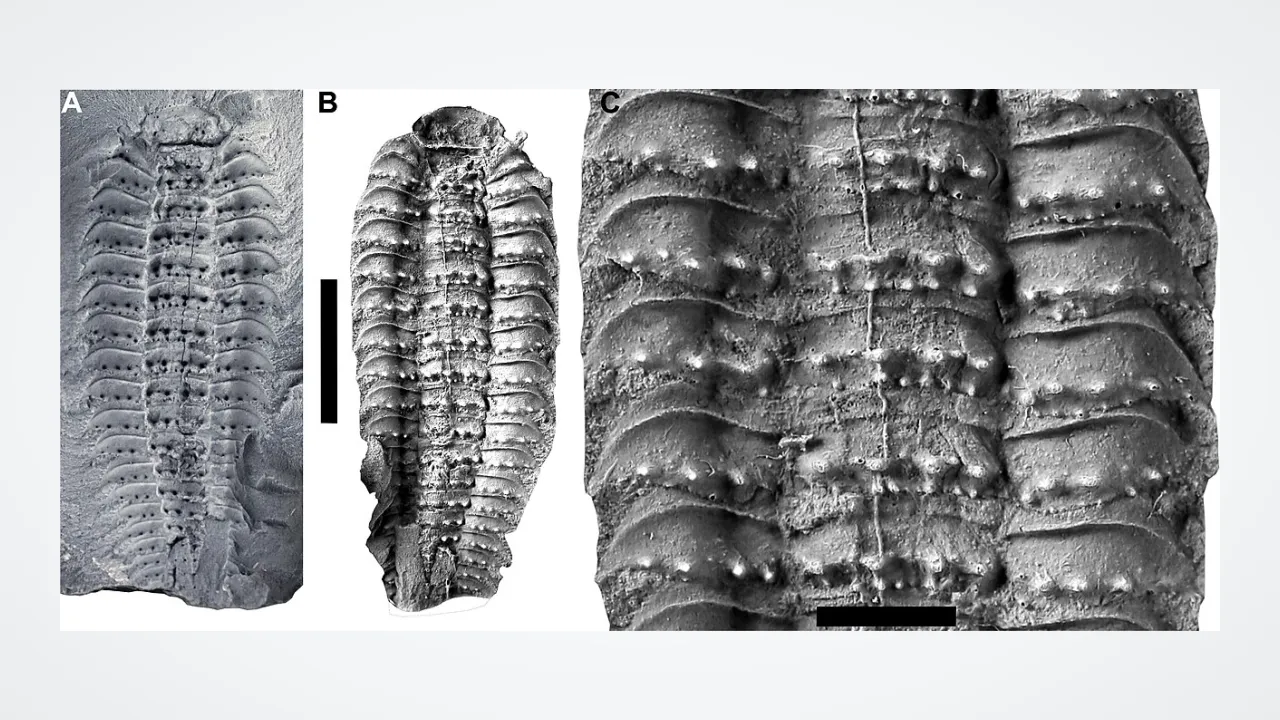
About thirty wide armor plates covered its flat back. Dozens of little legs moved underneath like tiny waves! Two eyes on short stalks peeked out ahead.
3
A Gentle Plant Eater
Even though it looked huge, Arthropleura was peaceful! It munched soft rotten logs, fern leaves, and fallen seeds. Few hunters dared to bother this armored giant.
1. What did giant Arthropleura like to eat on the forest floor?
2. What did Arthropleura's fossilized footprints look like?
🤯 Mind-Blowing Fact • Grade 2
In 2024, X-ray scans solved a 170-year-old mystery by showing that Arthropleura stood midway on the family tree between millipedes and centipedes!
✨ Word Sparks (Grade 2 Glossary)
Tap 🔊 to hear
Invertebrate
An animal that has no backbone inside
Antennae
Feelers on a bug's head for sensing
Woodland
Land covered with spaced-out trees and plants
🪝
How could a relative of tiny garden millipedes grow wider than a welcome mat?
1
Giant of the Coal Forests
Step into a warm forest 310 million years ago, where mossy trees towered a hundred feet overhead. Crawling steadily across fallen bark is Arthropleura, the biggest land bug that ever walked on Earth! It stretched over eight feet long and nearly two feet wide.
2
Extra Oxygen and Open Paths
Ancient air held much more oxygen than today's air, which helped bugs breathe and grow large. Surprise fossil tracks in England and Scotland show Arthropleura also strolled through open coastal where its wide body would not get stuck between tight tree trunks!
3
Mystery of the Missing Head Solved
For over a hundred years, scientists only found body shells without heads. Recently, X-ray scans of young fossils revealed a round head with seven-segment and stalked eyes like a crab!
1. Why were open woodlands easier for adult Arthropleura to walk through than super-crowded swamps?
2. What surprising feature did scientists discover on Arthropleura's head using X-ray scans?
🤯 Mind-Blowing Fact • Grade 3
The largest Arthropleura fossil ever found was discovered completely by accident when a sandstone block cracked open on a beach in northern England!
✨ Word Sparks (Grade 3 Glossary)
Tap 🔊 to hear
Detritivore
Animal that feeds on dead leaves and decaying plants
Myriapod
Group of many-legged bugs including millipedes and centipedes
Spore
Tiny seed-like cell made by ferns and mosses
🪝
Why did paleontologists spend more than 150 years searching for the head of Earth's biggest land invertebrate?
1
Empty Molts Left Behind
Imagine walking along a Carboniferous riverbank in northern England and spotting a shed bug shell as big as a kayak! In 2018, a falling cliff boulder in Northumberland revealed just such a fossil belonging to Arthropleura. Measuring about 2.6 meters (8.5 feet) long and weighing roughly fifty kilograms in life, it dwarfed every other land invertebrate.
2
Why Heads Were Missing
Most large Arthropleura fossils are not dead animals—they are empty exoskeletons left behind after molting. Because Arthropleura crawled forward out of a split at the front of its old shell, the delicate head capsule detached or broke apart while the tough back plates stayed connected.
3
X-Rays Reveal a Hybrid Face
In 2024, researchers used micro-CT X-rays to peer inside rock nodules from Montceau-les-Mines, France, containing tiny complete juveniles. The scans unveiled millipede-like body segments paired with centipede-like jaw parts and curious stalked eyes, hinting that juveniles may have spent time near shallow water.
4
A High-Energy Diet
Fossilized gut contents and droppings packed with nutritious clubmoss and seed-fern fragments show Arthropleura fueled its massive body on calorie-rich plant litter across Carboniferous and Early Permian lowlands.
1. Why were almost all giant Arthropleura fossils found without heads for over a century?
2. What nutritious plant foods helped power Arthropleura's fifty-kilogram body?
🤯 Mind-Blowing Fact • Grade 4
Each wide armor plate on Arthropleura's back actually covered two pairs of walking legs underneath, giving a thirty-segment adult more than a hundred individual feet!
✨ Word Sparks (Grade 4 Glossary)
Tap 🔊 to hear
Tergite
A hardened armor plate covering one back segment
Diplosegmentation
Having two pairs of legs under single body segments
Tomography
3D X-ray scanning that sees inside solid rock
🪝
Did sky-high Carboniferous oxygen alone create an eight-foot millipede cousin, or was something else at work?
1
Rethinking the Oxygen Hypothesis
Picture coastal plains stretching across equatorial Euramerica 325 million years ago. Gliding over rippled sandbars on roughly sixty jointed legs is Arthropleura, a 2.6-meter myriapod whose overlapping dorsal plates——spread more than half a meter wide. For decades, textbooks credited Arthropleura's gigantism solely to Late Carboniferous atmospheric oxygen peaking above thirty percent. Then in 2021, a massive Northumberland fossil dated to 326 million years ago proved Arthropleura reached maximum size when oxygen sat near twenty-three percent, barely higher than today's twenty-one percent!
2
Predator-Free Lowlands and Rich Forage
If extra oxygen wasn't the sole driver, what enabled such giant scale? During the Early-to-Mid Carboniferous, large terrestrial vertebrate predators were still rare, leaving open coastal woodlands as low-risk corridors. Abundant, nutrient-dense lycopsid spores and decaying plant litter supplied ample calories without forcing Arthropleura to climb or sprint.
3
Trackway Biomechanics on the Isle of Arran
Famous Diplichnites trackways preserved in sandstone on Scotland's Isle of Arran capture the animal's gait in stone. Each wide covered two pairs of legs—a classic millipede trait called —allowing rhythmic metachronal waves of footsteps to distribute its fifty-kilogram weight evenly across soft sediment.
4
Synchrotron Scans End a Taxonomic Puzzle
In 2024, synchrotron micro- of siderite nodules from Montceau-les-Mines reconstructed juvenile Arthropleura heads in micron-level detail, uniting millipede trunk anatomy with centipede-style mouthparts and lateral stalked eyes before arid Permian climates and agile tetrapod predators ended its fifty-five-million-year reign.
1. Why did the 326-million-year-old Northumberland Arthropleura fossil surprise scientists studying giant bugs?
2. How did having dozens of legs moving in smooth waves help a heavy Arthropleura walk over soft sand?
🤯 Mind-Blowing Fact • Grade 5
Trackway fossils in Nova Scotia and Scotland are so detailed that paleontologists can even tell when an Arthropleura slowed down to turn a corner or brushed against a horsetail stem!
✨ Word Sparks (Grade 5 Glossary)
Tap 🔊 to hear
Exuviae
Cast-off outer shells shed by molting arthropods
Ichnology
Scientific study of fossilized tracks, burrows, and traces
Hyperoxic
Having significantly higher oxygen levels than normal air
🪝
How did synchrotron X-rays and a fallen British cliff block overturn a century of assumptions about Earth's largest terrestrial invertebrate?
1
Fifty-Five Million Years of Myriapod Dominance
Across equatorial Euramerica from the Viséan Stage of the Early Carboniferous to the Sakmarian Stage of the Early Permian (roughly 345 to 290 million years ago), a flattened, trilobed myriapod named Arthropleura patrolled lowland floodplains and coastal forests. Reaching 2.63 meters in length, 55 centimeters in width, and an estimated mass of 50 kilograms, Arthropleura stands unchallenged as the largest terrestrial invertebrate in Earth's history.
2
Testing Atmospheric Oxygen Versus Ecological Release
Classic physiological models attributed Paleozoic arthropod gigantism almost exclusively to Late Carboniferous air (30–35% O2) boosting passive diffusion through tracheal tubes. However, the 2021 description by Neil Davies and colleagues of an articulated 75-centimeter-long exuvial segment from Serpukhovian sandstones in Northumberland, England—scaling to a 2.6-meter adult—demonstrated that maximum size evolved millions of years before coal-swamp oxygen peaks, when atmospheric O2 hovered near 23%. Ecological release in predator-sparse alluvial woodlands, paired with calorie-rich lycopsid spore cones and pteridosperm detritus, played an equally decisive role.
3
Ichnology and Locomotor Mechanics
Trace fossils classified as Diplichnites cuithensis—most famously exposed on Scotland's Isle of Arran and in Nova Scotia's Joggins Cliffs—record parallel rows of footprints nearly half a meter apart. Stride spacing confirms diplosegmentation across twenty-eight to thirty-two paratergal plates, dispersing ground pressure while navigating open, seasonally dry river channels rather than impenetrable peat mires.
4
Cracking the 170-Year Cephalic Mystery
Because large fossils represent shed from which animals exited anteriorly, adult heads disarticulated and vanished. In 2024, Mickaël Lhéritier and colleagues used synchrotron X-ray micro-CT on siderite concretions from Montceau-les-Mines, France, revealing intact 40-millimeter juveniles. Their heads combined seven-segmented antennae, centipede-like mandibles and maxillae without venom claws (forcipules), and lateral stalked eyes—placing Arthropleura as a stem-group millipede (Diplopoda) with semi-aquatic juvenile traits.
5
Permian Aridification and Extinction
As Pangaea assembled in the Early Permian, equatorial rainforests fragmented into dry seasonal scrublands while large carnivorous synapsids and amphibians proliferated, driving giant arthropleurids to extinction around 290 million years ago.