2. What did Argentinosaurus spend its days eating?
🤯 Mind-Blowing Fact • Grade 2
A rancher in Argentina originally thought the five-foot-long lower leg bone of Argentinosaurus was a giant petrified tree trunk!
✨ Word Sparks (Grade 2 Glossary)
Tap 🔊 to hear
petrified
wood or bone turned slowly into solid stone
pillar
a thick, straight column that holds heavy weight
herbivore
an animal that eats only plants
🪝
How did a rancher mistake a giant dinosaur bone for a giant tree trunk?
1
Mistaken for a Tree Trunk!
One sunny day in Argentina, a rancher spotted something huge sticking out of the dirt. He thought it was a giant log of stone wood! Scientists soon realized it was actually a leg bone from a record-breaking dinosaur.
2
As Long as Three School Buses
Parked bumper to bumper, three yellow school buses would barely match the length of one Argentinosaurus! Its -like legs carried as much weight as twelve African elephants combined.
3
Air Pockets Inside Its Bones
How could it lift that thirty-foot neck without tipping over? Nature filled its neck and back bones with honeycomb air pockets, keeping its skeleton super strong yet surprisingly light!
1. What did the rancher first think the huge Argentinosaurus bone was?
2. What helped keep the giant neck of Argentinosaurus light enough to lift?
🤯 Mind-Blowing Fact • Grade 3
From hatching out of an eight-inch egg to reaching full adult size, Argentinosaurus grew roughly 10,000 times heavier!
✨ Word Sparks (Grade 3 Glossary)
Tap 🔊 to hear
sauropod
a giant four-legged dinosaur with a long neck
vertebra
one single bone segment in a backbone
titanosaur
the last and largest group of long-necked dinosaurs
🪝
How does a baby dinosaur weighing ten pounds grow into an eighty-ton land titan?
1
Thunder Over Patagonia
Dust rises in golden clouds across Late Cretaceous South America as a herd of colossal marches between conifer groves. Stretching roughly 115 feet from nose to tail, Argentinosaurus towered over every neighbor, its name meaning 'silver lizard' in honor of Argentina.
2
Unearthing Five-Foot Backbones
After rancher Guillermo Heredia reported a giant bone on his farm in 1987, paleontologists José Bonaparte and Rodolfo Coria led a careful dig. When they freed a single dorsal from the rock, it stood over five feet tall—nearly as tall as a grown adult!
3
Fueling a Living Skyscraper
Argentinosaurus did not waste precious time chewing its food. Peg-shaped teeth at the front of its jaws stripped whole branches clean like a garden rake, sending hundreds of pounds of tough needles and ferns straight down its throat each day.
4
Growing Fast to Stay Safe
Hatching from eggs no wider than eight inches, tiny babies faced hungry predators on every side. To survive, young grew at astonishing speeds, multiplying their hatched weight more than ten thousand times before reaching adulthood!
1. Why is Argentinosaurus called the 'silver lizard'?
2. How did Argentinosaurus eat enough plants to fuel its massive body?
🤯 Mind-Blowing Fact • Grade 4
Computer walking models show that despite weighing around 75 tons, Argentinosaurus could stroll steadily at about five miles per hour thanks to massive hip muscles and cushioned heel pads!
✨ Word Sparks (Grade 4 Glossary)
Tap 🔊 to hear
buoyancy
upward push of water that helps things float
ferment
break down tough food using helpful gut microbes
canopy
the high leafy roof formed by tall trees
🪝
How close did Argentinosaurus push the absolute physical limits of how big a walking land animal can get?
1
Living Bridges of Muscle and Bone
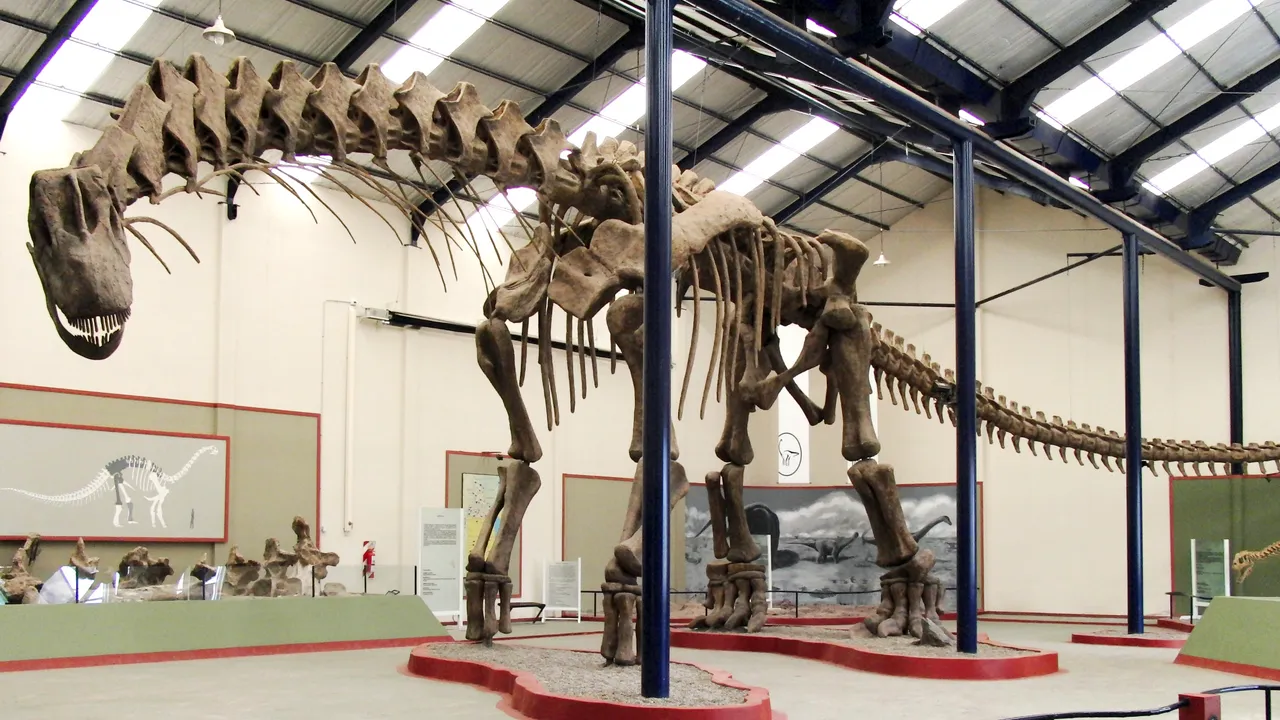
Stand beneath a reconstructed skeleton of Argentinosaurus huinculensis and you feel as though you have walked under a suspension bridge. Ninety-four million years ago across the semi-arid floodplains of Patagonia's Huincul Formation, adults stretched nearly 35 meters long and tipped the scales between 70 and 80 tons—rivaling the mass of a modern commercial jetliner.
2
Engineering Against Gravity
At sea, water buoys up blue whales, but on land gravity pulls relentlessly on every bone and blood vessel. Argentinosaurus beat gravity with bird-like air sacs connected to its lungs that invaded its huge five-foot vertebrae, carving out lightweight struts. Below, solid pillar-like limb bones locked vertically beneath the hips and shoulders, while thick fleshy heel pads cushioned each thunderous step.
3
Stand-Still Canopy Harvesting
Moving seventy-five tons burns enormous energy, so Argentinosaurus conserved motion by parking its body in one spot and sweeping its long neck in wide arcs through Monkey Puzzle conifers. Inside its barrel-sized gut, trillions of microbes fermented tough plant fibers for days, releasing steady heat and nutrition.
4
Facing Pack-Hunting Giants
Even in a land patrolled by Mapusaurus—a forty-foot meat-eater whose fossils occur in groups—a healthy adult Argentinosaurus was practically a walking fortress, vulnerable mainly during youth, illness, or old age.
1. How did Argentinosaurus save energy while gathering hundreds of pounds of plants each day?
2. Why is supporting 75 tons harder for Argentinosaurus than for an ocean whale?
🤯 Mind-Blowing Fact • Grade 5
In 2013, scientists laser-scanned an entire Argentinosaurus skeleton and used a supercomputer to teach a virtual model how to walk for the first time in 94 million years!
✨ Word Sparks (Grade 5 Glossary)
Tap 🔊 to hear
terrestrial
living and walking on dry land
volumetric
measuring total three-dimensional space an object fills
mastication
the process of chewing food with teeth
🪝
How can paleontologists reconstruct the walk and weight of an eighty-ton giant when fewer than fifteen percent of its bones survived?
1
From Ranch Discovery to Scientific Sensation
When sheep rancher Guillermo Heredia stumbled across an immense mineralized shaft protruding from reddish sandstone near Plaza Huincul in Neuquén Province in 1987, nobody suspected it belonged to a contender for Earth's heaviest animal. Excavated and formally named Argentinosaurus huinculensis in 1993 by José Bonaparte and Rodolfo Coria, the specimen yielded six monumental dorsal vertebrae, a fused sacrum, ribs, and a 1.55-meter fibula.
2
Scaling Up From Fragmentary Giants
Because no skull or complete neck of Argentinosaurus has yet been recovered, researchers compare its preserved vertebrae—one measuring an astounding 1.59 meters (5.2 feet) high—and an incomplete femur estimated at 2.5 meters long against more complete cousin titanosaurs such as Patagotitan and Dreadnoughtus. 3D laser scans consistently place Argentinosaurus near 33 to 35 meters in length and 65 to 80 metric tons in body mass.
3
Digital Biomechanics and First Steps
In 2013, paleontologist Bill Sellers and colleagues laser-scanned a full 40-meter museum skeletal mount and fed 3D muscle attachments into a supercomputer. Using machine-learning algorithms to coordinate virtual tendons and joints without snapping bone, the simulation proved Argentinosaurus could walk comfortably at roughly two meters per second (about 4.5 miles per hour).
4
Physiological Secrets of Sauropod Gigantism
Reaching such extreme mass required an evolutionary toolkit unmatched by any land mammal. Avian-style unidirectional lungs pumped oxygen efficiently while pneumatic diverticula hollowed out vertebrae; lack of kept the skull tiny so the neck could lengthen; and laying clutches of small eggs bypassed the biological limits of live birth.
5
Architect of the Huincul Ecosystem
Like living bulldozers, herds of Argentinosaurus reshaped Patagonian landscapes ninety-four million years ago—opening sunny forest glades, dispersing conifer seeds in massive dung piles, and anchoring a food web shared with giant carcharodontosaurid theropods like Mapusaurus.