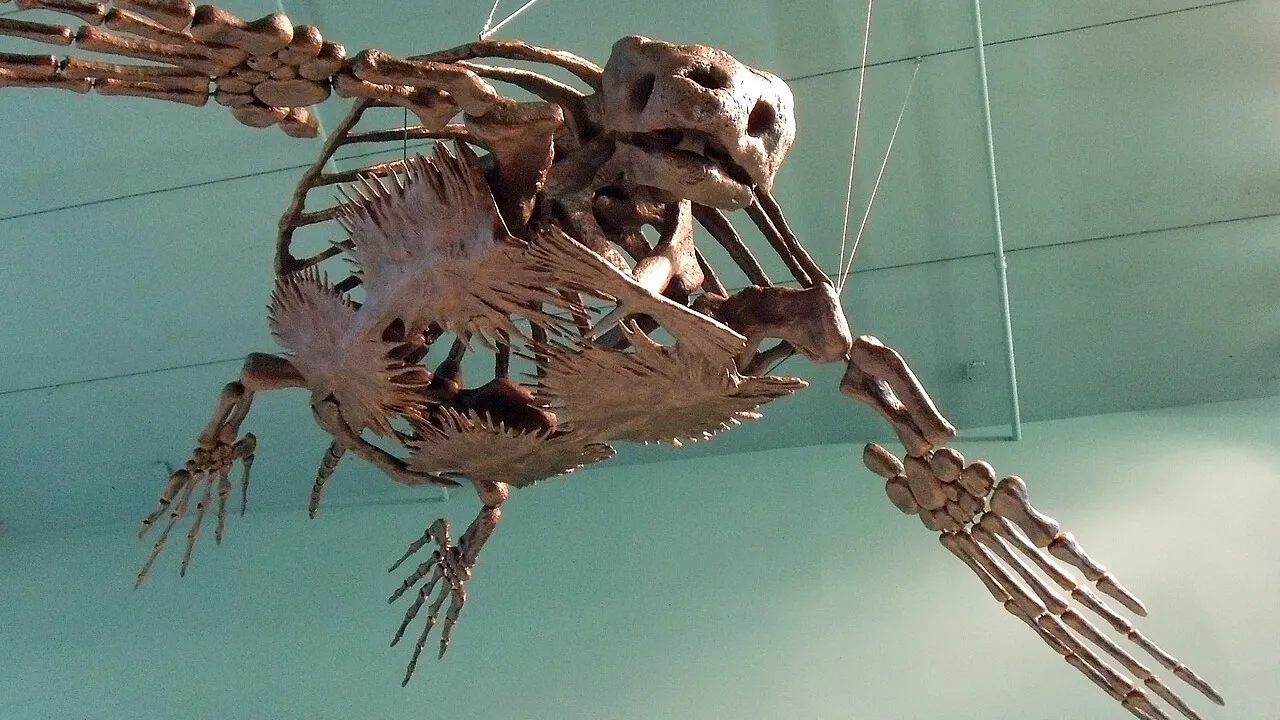
1. What covered Archelon's back instead of a solid heavy shell?
2. How did Archelon eat without any teeth?
🤯 Mind-Blowing Fact • Grade 2
Scientists estimate the largest famous Archelon fossil found in South Dakota lived to be about one hundred years old!
✨ Word Sparks (Grade 2 Glossary)
Tap 🔊 to hear
prairies
Wide, flat grasslands with very few trees
seaway
A broad ocean passage dividing dry land
afloat
Floating safely without sinking down
🪝
Why are giant sea turtle skeletons buried under dry prairies in South Dakota?
1
An Ocean Across America
Imagine sailing a boat right over South Dakota and Kansas! Seventy-five million years ago, a warm ocean called the Western Interior split North America in two. Gliding peacefully across that seaway was Archelon, whose name means 'ruling turtle.'
2
Light Shell, Giant Flippers
Weighing more than two tons, Archelon needed a smart way to stay . Open spaces sat between the bony ribs of its shell, covered by thick, rubbery skin much like today's leatherback sea turtle. Enormous front paddles rowed it effortlessly across open water.
3
Resting on the Muddy Bottom
Fossil hunters think Archelon sometimes sank down to nap in soft seafloor mud, tucking its head safely while holding its breath for hours!
1. Why can paleontologists dig up Archelon bones in South Dakota today?
2. Which living animal has a leathery shell most like Archelon's?
🤯 Mind-Blowing Fact • Grade 3
The largest complete Archelon specimen ever found—nicknamed 'Brigitta' and displayed in Vienna—weighed over 4,800 pounds in life!
✨ Word Sparks (Grade 3 Glossary)
Tap 🔊 to hear
carapace
The protective upper shell of a turtle
fontanelles
Lightening gaps between bones in a shell
mosasaurs
Giant prehistoric ocean-going lizard predators
🪝
How did a lightweight rib-frame shell help a two-ton turtle soar across prehistoric seas?
1
Giant of the Pierre Shale
Picture warm waves lapping across the heart of North America during the Late Cretaceous Period. Beneath the glittering surface of the Western Interior Seaway cruised Archelon ischyros, stretching fifteen feet from hooked beak to tail and spanning sixteen feet across its front flippers!
2
Engineering a Lighter Carapace
If a fifteen-foot turtle carried a solid dome of heavy bone like a land tortoise, swimming thousands of miles would exhaust its muscles. Instead, Archelon's —its upper shell—worked like a sturdy kite frame. Wide gaps called separated its broadened ribs, covered by dense, leathery hide and a ridge running down its spine.
3
Crushing Beak of the Open Sea
Archelon sported a strongly hooked upper beak shaped almost like an eagle's bill. This powerful jaw let it snip slippery jellyfish at the surface or crack the coiled shells of swimming ammonites and squid.
4
Sharing Waters with Sea Monsters
Even a car-sized turtle needed to stay alert! Giant like Tylosaurus and twenty-foot sharks patrolled the same seaway, meaning speed from those massive front flippers was Archelon's best defense.
1. Why did Archelon's upper shell have wide open gaps between its ribs?
2. Why couldn't Archelon pull its head and flippers inside its shell to hide?
🤯 Mind-Blowing Fact • Grade 4
Wait—let's look closely at Brigitta, Vienna's famous Archelon skeleton: her missing right back flipper had healed cleanly in life after surviving an ancient shark or mosasaur bite!
✨ Word Sparks (Grade 4 Glossary)
Tap 🔊 to hear
plastron
The flat lower shell covering a turtle's belly
latticework
Crisscrossing framework with open spaces between bars
keels
Raised ridges that guide smooth water flow
🪝
Why did paleontologists once think modern leatherback turtles were Archelon's grandchildren—until new fossils changed the family tree?
1
Pelagic Titan of the Interior Seaway
Soaring above dark mud bottoms of the Late Cretaceous Western Interior Seaway 75 million years ago, Archelon ischyros represented the pinnacle of prehistoric turtle gigantism. Measuring 4.6 meters long with a nearly five-meter foreflipper wingspan, this two-ton mariner first came to light in 1895 when paleontologist George Reber Wieland excavated a magnificent skeleton from South Dakota's Pierre Shale along the Cheyenne River.
2
Skeletal Weight-Saving Mechanics
Both its dorsal carapace and ventral —the star-shaped belly shield—replaced solid bony plates with a of struts and open fenestrae wrapped in thick dermal leather. By shedding hundreds of pounds of dense bone while maintaining hydrodynamic stiffness via dorsal , Archelon conserved energy for trans-oceanic cruising powered by hypertrophied pectoral muscles.
3
Raptor-Like Beak and Pelagic Diet
Look at an Archelon skull from the side and its narrow, sharply down-turned premaxillary beak resembles a giant bird of prey! Broad crushing surfaces inside the mouth suggest Archelon wasn't restricted to soft medusae (jellyfish); it also sheared buoyant nautiloids, ammonites, and drifting crustaceans near the ocean surface.
4
Cousins, Not Direct Ancestors
Because living leatherback turtles (Dermochelys) also carry a leathery shell and grow huge, scientists long thought Archelon was their direct ancestor. Evolutionary anatomy proves Archelon belonged to Protostegidae, an extinct cousin branch that independently evolved giant size and reduced shell bone before vanishing at the end of the Cretaceous!
1. How is Archelon related to today's giant leatherback sea turtle?
2. What does the healed missing flipper on Vienna's 'Brigitta' skeleton tell scientists?
🤯 Mind-Blowing Fact • Grade 5
In 2022, paleontologists in Spain discovered Leviathanochelys, a gigantic European cousin nearly twelve feet long, proving giant sea turtles patrolled both sides of the ancient Atlantic!
✨ Word Sparks (Grade 5 Glossary)
Tap 🔊 to hear
gigantothermy
Staying warm simply by having a huge body
histology
Studying microscopic tissue rings inside bones
rhamphotheca
Tough keratin outer covering over a beak
🪝
How did bone histology, gigantothermy, and skeletal fenestration allow Archelon to thrive across Late Cretaceous seas?
1
Discovery in the Pierre Shale
In 1895, Yale paleontologist George Reber Wieland unearthed a colossal marine chelonian eroding from dark Campanian mudstones of the Pierre Shale in South Dakota. Naming it Archelon ischyros—Greek for 'mighty ruling turtle'—Wieland revealed an oceanic giant spanning 4.6 meters in length and 4.9 meters across its forelimbs, later surpassed slightly in completeness by 'Brigitta,' a 2.2-metric-ton skeleton excavated in the 1970s and housed in Vienna's Natural History Museum.
2
Fenestrated Shell Architecture
To achieve subaqueous flight without sinking under excessive skeletal mass, Archelon carried extreme dermal bone reduction. Its carapace lacked solid peripheral plates, consisting instead of rib-like costal bars separated by expansive fontanelles and topped by rowed neural keels that channeled laminar water flow. Underneath, four star-shaped plastral bones braced a vast pectoral girdle powering wing-like humeral strokes.
3
Gigantothermy and Growth Rates
Microscopic bone of protostegid flippers reveals rapid vascularized growth rings resembling warm-blooded marine mammals rather than slow-growing pond turtles. Because a multi-ton body has a low surface-area-to-volume ratio, Archelon practiced —retaining muscle-generated heat inside its bulky core to cruise cool depths and migrate across wide latitudes.
4
Cranial Mechanics and Trophic Ecology
Archelon's elongated, narrow skull terminated in a formidable hooked (keratinous beak sheath). While broad palatal triturating surfaces could crush thin-shelled pelagic ammonoids and squid, biomechanical studies of its slender lower jaw indicate it also specialized in shearing gelatinous macrozooplankton like giant scyphozoan medusae.
5
Benthic Brumation and Extinction
Several Pierre Shale specimens were entombed fully articulated in fine offshore mud, prompting hypotheses that Archelon periodically rested on muddy seabeds in low-oxygen torpor, though surviving healed bite trauma on flippers shows mosasaurs and lamniform sharks posed constant hazards. Despite dominating Cretaceous oceans globally—rivaled only by Spain's newly discovered Leviathanochelys—all protostegids perished during the end-Cretaceous extinction 66 million years ago.