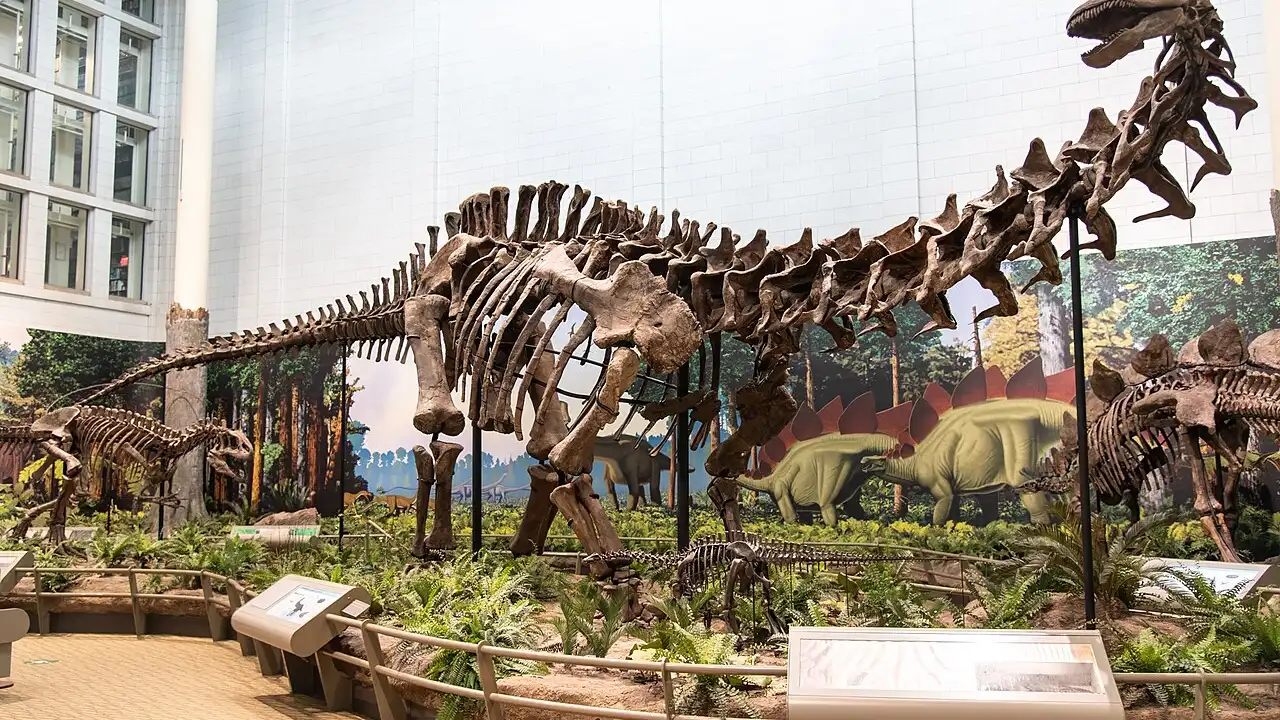
1. How did Apatosaurus use the skinny tip of its long tail?
2. What kind of teeth did Apatosaurus have at the front of its mouth?
🤯 Mind-Blowing Fact • Grade 2
For nearly a hundred years, famous museums displayed Apatosaurus skeletons wearing the wrong boxy skull until scientists solved the mix-up in the 1970s!
✨ Word Sparks (Grade 2 Glossary)
Tap 🔊 to hear
snout
an animal's nose, mouth, and front jaw
sleek
smooth, narrow, and streamlined in shape
browse
to nibble leaves and shoots from plants
🪝
How did museum builders accidentally put the wrong head on Apatosaurus for nearly a hundred years?
1
The Case of the Mixed-Up Skull
Imagine building a giant dinosaur skeleton, only to find the skull is missing! Over a hundred years ago, museums guessed and gave Apatosaurus a short, boxy head from another dinosaur. In the 1970s, scientists finally proved it actually had a long, , horse-like !
2
Built Like a Heavyweight Wrestler
Compared with its slender cousins, Apatosaurus was extra wide and muscular. Heavy bony ribs hung beneath its thick neck, giving it tremendous strength as it browsed riverside ferns.
3
Guarding the Herd
When fierce Allosaurus lurked nearby, adult Apatosaurus stood shoulder to shoulder and cracked their fifty-foot whip tails to protect youngsters!
1. What mistake did museums make with Apatosaurus skeletons for decades?
2. How did Apatosaurus's body compare with many of its long-necked cousins?
🤯 Mind-Blowing Fact • Grade 3
Apatosaurus means 'deceptive lizard' because the V-shaped bones beneath its tail looked almost identical to the tail bones of giant ocean reptiles!
✨ Word Sparks (Grade 3 Glossary)
Tap 🔊 to hear
deceptive
tricky or looking like something else
horizontal
level and parallel to the flat ground
taper
to grow gradually thinner toward one end
🪝
Why did a scientist name this twenty-ton land giant the 'deceptive lizard'?
1
Tricked by Tail Bones
When paleontologist Othniel Charles Marsh examined giant fossil bones from Colorado in 1877, the V-shaped bones under the tail looked surprisingly like bones from sea-swimming mosasaurs! Because those bones nearly tricked him, Marsh named the dinosaur Apatosaurus, Greek for ' lizard.'
2
A Neck Built for Shoving Matches
Most long-necked sauropods evolved lightweight, slender necks, but Apatosaurus went the opposite way. Thick, downward-pointing ribs reinforced its wide neck vertebrae, leading scientists to suspect rival adults swung their heavy necks in shoving contests much like modern bull giraffes!
3
Fern Lawnmower of the Jurassic
Stretching up to seventy-five feet long across the Late Jurassic floodplains, Apatosaurus held its neck mostly . Pencil-shaped teeth clustered solely at the front of its jaws stripped horsetails, seed ferns, and low conifer branches.
4
Thumb Claws and Whip Tails
Stout front legs ended in a single large curved thumb claw useful for gripping ground or tree trunks, while eighty-two tail vertebrae tapered into a flexible bullwhip.
1. Why did Othniel Charles Marsh name Apatosaurus the 'deceptive lizard'?
2. Why do scientists think Apatosaurus had unusually thick, downward-pointing neck ribs?
🤯 Mind-Blowing Fact • Grade 4
Growth rings inside Apatosaurus leg bones prove it gained over 10,000 pounds in a single year during its teenage growth spurt!
✨ Word Sparks (Grade 4 Glossary)
Tap 🔊 to hear
savanna
open plain with scattered trees and dry seasons
cervical
relating to the bones of the neck
deterrence
discouraging an attacker before a fight starts
🪝
How did Apatosaurus share crowded Jurassic river valleys with half a dozen other giant plant-eaters without running out of food?
1
Sharing the Morrison Floodplain
Visit western North America 152 million years ago and you enter a dotted with ginkgoes, tree ferns, and seasonal rivers—crowded with giant sauropods! Apatosaurus, Diplodocus, Camarasaurus, and Brachiosaurus all roamed the same Morrison Formation valleys, yet subtle differences in skull and neck design let each giant dine at its own preferred level.
2
Low-Sweeping Stripper Jaws
While high-shouldered Brachiosaurus plucked treetops and broad-toothed Camarasaurus crushed woody branches, Apatosaurus swept its muscular neck side to side a few feet above the ground. Narrow, peg-like teeth worn flat at steep angles show it raked soft ferns and horsetails along riverbanks without chewing.
3
Combat Necks and Whip Physics
In 2015, paleontologists Mike Taylor and Matt Wedel analyzed the extraordinarily stout, V-bottomed vertebrae of Apatosaurus. Heavy knobs and roughened bone surfaces looked engineered to cushion violent downward and sideways blows—strong evidence of neck-slamming rivalry! At the opposite end, computer physics models show waves traveling down its eighty-two-bone tail accelerated into a thunderous whip crack for herd communication or predator .
4
Rapid Growth From Tiny Hatchling
Bone-ring studies reveal young Apatosaurus rocketed from dog-sized hatchlings to twenty-ton adults in roughly fifteen years, quickly outgrowing the jaws of prowling Allosaurus packs.
1. How could Apatosaurus, Camarasaurus, and Brachiosaurus live side by side without starving one another?
2. How long did it take a hatchling Apatosaurus to grow into a twenty-ton adult?
🤯 Mind-Blowing Fact • Grade 5
Microscopic scratches on Apatosaurus's peg-shaped front teeth prove it gripped stems and raked leaves off sideways near ground level rather than chewing!
✨ Word Sparks (Grade 5 Glossary)
Tap 🔊 to hear
niche partitioning
coexisting species dividing food resources to avoid competition
intraspecific
happening between members of the very same species
pollex
the innermost digit or thumb on a hand
🪝
How did solving a century-old museum skull error and CT-scanning giant neck vertebrae reveal the true powerhouse lifestyle of Apatosaurus?
1
Bone Wars Discovery and the Hundred-Year Skull Mix-Up
Unearthed from the Morrison Formation foothills of Morrison, Colorado, in 1877 and named Apatosaurus ajax by Yale paleontologist Othniel Charles Marsh, this iconic diplodocid endured one of science's longest cases of mistaken identity. Because early skeletons lacked attached heads, museums from Pittsburgh to New York mounted robust, short-snouted Camarasaurus-style skulls onto Apatosaurus necks until paleontologists John McIntosh and David Berman proved in 1978 that a long, low, peg-toothed skull found metres from a Utah skeleton was its authentic head.
2
Anatomy of a Heavyweight Diplodocid
Stretching 21 to 23 meters (70 to 75 feet) long and weighing roughly 18 to 25 metric tons, Apatosaurus was dramatically bulkier than its lithe relative Diplodocus. Stout limb columns ended in broad, cushioned hind feet bearing three curved claws and semi-tubular metacarpals on the forefeet sporting a single enlarged (thumb) claw.
3
The Neck-Combat Hypothesis
Why did Apatosaurus possess such bizarrely thick cervical vertebrae flanked by heavy, ventrally projecting cervical ribs that actually added weight to its neck? Biomechanical studies by Taylor, Wedel, and Naish demonstrated that these bifurcated spines and robust bony clubs housed massive soft-tissue cushions and muscles tailored to deliver and absorb forceful ventral-lateral strikes—mirroring combat in bull elephant seals and giraffes.
4
Whip-Tail Acoustics and Niche Partitioning
Behind its hips stretched up to 82 caudal vertebrae tapering into a rod-thin whiplash tip. Aerodynamic modeling indicates rapid base swings sent high-velocity waves down that tail capable of cracking well above 200 decibels. Meanwhile, microscopic enamel wear scratches on its procumbent peg teeth confirm unilateral branch-stripping of low equisetalean horsetails and ferns.
5
Accelerated Ontogeny as Predator Defense
Histological growth curves constructed from limb-bone thin sections reveal peak mass gains exceeding five metric tons per year during adolescence—an evolutionary sprint past the size threshold vulnerable to Morrison apex predators Allosaurus and Torvosaurus.