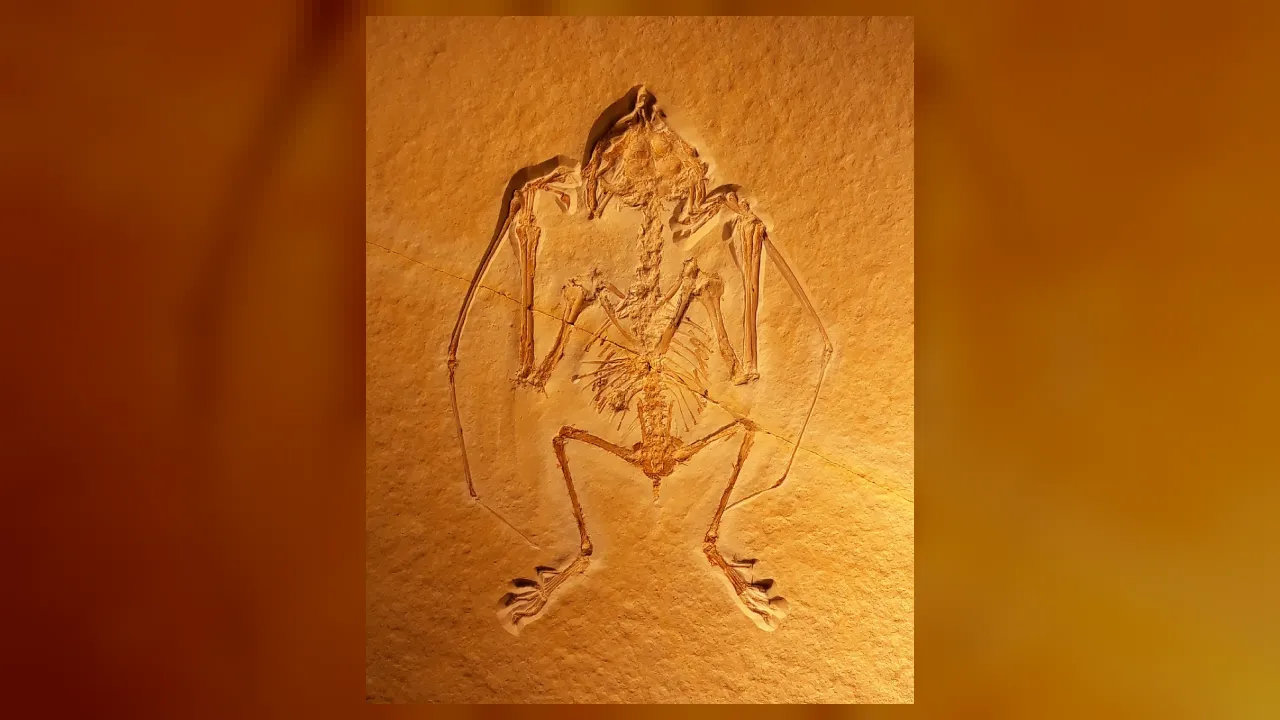
Stiff whisker-like bristles grew around Anurognathus's wide mouth to help guide flying insects straight into its jaws in dim light!
✨ Word Sparks (Grade 2 Glossary)
Tap 🔊 to hear
Muffle
To make a sound much softer
Camouflage
Colors or patterns blending into surroundings
Nightjar
Wide-mouthed twilight bird that catches moths
🪝
How did a tiny pterosaur fly silently in the dark millions of years before bats or nightjar birds existed?
1
Frog Jaw, Stubby Tail
Peek into a quiet coastal forest in Germany 150 million years ago! Clinging flat against rough bark rests tiny Anurognathus. Its scientific name means frog jaw or tailless jaw because its skull was wider than it was long, and its stubby tail lacked the long rod seen on neighbor Rhamphorhynchus!
2
Whisper-Quiet Wings
Fine fossil slabs revealed velvety fuzz covering Anurognathus's body and even soft tufts dotting its twenty-inch wings! Just like an owl's soft feathers today, that fuzz muffled wind noise so moths never heard it coming.
3
Turning on a Dime
Without a long stiff tail holding it straight, Anurognathus flipped, banked, and zigzagged through dark branches like a tiny superhero!
1. Why did soft fuzz growing across Anurognathus's wing skin help it hunt?
2. How did having a short stubby tail instead of a long stiff tail help Anurognathus?
🤯 Mind-Blowing Fact • Grade 3
Ultraviolet light scans of the second Anurognathus specimen revealed tiny cushioned pads on the soles of its feet and hands for gripping rough tree branches!
✨ Word Sparks (Grade 3 Glossary)
Tap 🔊 to hear
Ultraviolet
Invisible light waves making fossils glow brightly
Gape
How wide an open mouth stretches
Insectivore
Animal that feeds mainly on insects
🪝
What amazing hidden details popped out under ultraviolet light on a second Anurognathus fossil found in Germany?
1
Rare Treasure of Solnhofen
When paleontologist Ludwig Döderlein first described Anurognathus ammoni in 1923 from Germany's Solnhofen Limestone, only one crushed skeleton existed! For nearly eighty years, scientists had to study faint bone impressions in stone to imagine this nine-centimeter Jurassic insect hunter.
2
Glowing Under UV Light
Then a second, beautifully articulated juvenile skeleton turned up from Eichstätt, Germany, and was studied by S. Christopher Bennett in 2007! Shining light onto the slab made fossilized soft tissues glow vividly—revealing ankle webs, fuzzy wing tufts, whisker-like jaw bristles, and even bumpy footpads for gripping tree bark!
3
Built Like a Reptilian Nightjar
Modern whip-poor-wills and frogmouth birds share Anurognathus's exact toolkit: enormous forward-looking eyes for low light, sensory mouth bristles, camouflage fuzz, and a short wide that gulps insects whole.
4
Folded Flat Against Bark
During bright daylight, Anurognathus folded its wings neatly against its sides and crouched motionless on branches, invisible to hungry predators!
1. How did paleontologist S. Christopher Bennett reveal hidden soft tissues on the second Anurognathus fossil in 2007?
2. Which modern bird group shares the closest ecological lifestyle and head shape with Anurognathus?
🤯 Mind-Blowing Fact • Grade 4
Unlike other Solnhofen pterosaurs, Anurognathus had a flexible joint halfway along its wing finger that let it fold or curve its wingtips mid-flight for razor-sharp turns!
✨ Word Sparks (Grade 4 Glossary)
Tap 🔊 to hear
Hawking
Catching flying insects directly in mid-air
Turbulence
Swirling air currents that create wind noise
Rictal Bristle
Stiff whisker-like filament beside the mouth
🪝
Why did Anurognathus shorten its tail independently of giant Cretaceous pterosaurs—and how did its folding wing joint boost agility?
1
Aerial Acrobat of the Jurassic Dusk
Picture the conifer-clad islands bordering Germany's Solnhofen lagoons 150 million years ago as dusk settles. Launching silently from a shaded bough is Anurognathus ammoni—a forty-gram, nine-centimeter pterosaur spanning 50 centimeters (20 inches) across broad, maneuverable wings. Named by Ludwig Döderlein in 1923 after geologist Ludwig von Ammon, it represents one of the most specialized insect- vertebrates ever to evolve.
2
Skeletal Frame of a Living Bug Net
Unlike virtually every other pterosaur with an elongated beak, Anurognathus compressed its skull into a frog-like semicircle wider than long! Slender needle-like bony bars framed immense forward-angled eye sockets containing wide scleral rings tuned for crepuscular vision. Spaced along its semicircular jaws sat short, sharp peg teeth surrounded by stiff rictal-style pycnofiber bristles that funneled moths, lacewings, and beetles inward.
3
Convergent Tail Loss and Movable Wing Joints
Even though Anurognathus belonged to an ancient early-branching pterosaur lineage, it independently shortened its tail to a tiny mobile stub—increasing aerodynamic instability so it could bank and roll instantaneously! Furthermore, S. Christopher Bennett's 2007 UV study showed it lacked a stiffened fourth-finger knuckle joint, letting the outer wing flex smoothly during tight forest turns.
4
Acoustic Stealth
Short, tufted pycnofibers spaced across the upper wing membrane broke up micro- just like the velvety dorsal plumage of modern barn owls—silencing wingbeats during twilight pursuits.
1. How did reducing its tail to a tiny stub help Anurognathus hunt flying insects?
2. How did short fuzzy tufts across Anurognathus's upper wing surface work like an owl's wing?
🤯 Mind-Blowing Fact • Grade 5
Anurognathus could hinge its wide frog-like jaws open to nearly a 90-degree right angle, turning its whole head into a flying funnel for catching Jurassic insects!
✨ Word Sparks (Grade 5 Glossary)
Tap 🔊 to hear
Brachycephalic
Having a short, unusually wide skull shape
Stereoscopic
3D depth vision from two overlapping eyes
Caprimulgiform
Bird order including nightjars and frogmouths
🪝
How did Anurognathus pioneer bat-and-caprimulgiform twilight insectivory 95 million years before the first echolocating bats?
1
Cryptic Phantom of the Solnhofen Archipelago
One hundred fifty million years ago during the Tithonian stage of the Late Jurassic, arid scrubland islands bordering Bavaria's Solnhofen lagoons teemed with neuropteran lacewings, beetles, and orthopterans. Hawking through that twilight air was Anurognathus ammoni, described by Ludwig Döderlein in 1923 from a single crushed impression and revolutionized in 2007 when S. Christopher Bennett analyzed a pristine, UV-fluorescent juvenile specimen from near Eichstätt.
2
Brachycephalic Skull and Binocular Scotopic Vision
Measuring merely 9 centimeters from snout to tail tip and weighing ~40 grams across a 50-centimeter wingspan, Anurognathus inverted typical pterosaur cranial proportions. Its (short, broad) cranium formed a wide, semicircular gape framed by paper-thin triradiate jugal and premaxillary struts, reducing skull mass to mere grams while allowing nearly 90-degree jaw opening! Huge anterolaterally oriented orbits with wide scleral apertures conferred depth perception in dim crepuscular light.
3
Phylogenetic Placement and Tail Reduction
Because Döderlein noticed its abbreviated, pygostyle-like caudal series, paleontologists long puzzled over whether Anurognathidae belonged with short-tailed pterodactyloids or basal 'rhamphorhynchoids.' Modern cladistic analyses—bolstered by Asian cousins Jeholopterus, Dendrorhynchoides, and Sinomacrops—demonstrate anurognathids were specialized short-tailed monofenestratans or caelidracones that shortened their tails and fifth toes for extreme aerial agility.
4
Integumentary Stealth and Wing Flexion
Ultraviolet fluorescence microscopy on the Eichstätt specimen revealed remarkable soft-tissue specializations: rugose plantar pads for clinging flat against tree bark by day, sensory pycnofiber bristles ringing the oral margin, and rows of short epidermal tufts across the dorsal actinopatagium that dampened boundary-layer vortex noise—convergent with nocturnal Strigiformes (owls) and (nightjars and frogmouths).
5
Legacy of a Mesozoic Nightjar
Nearly a hundred million years before Eocene bats conquered night skies, Anurognathus perfected silent, visually guided twilight insectivory.