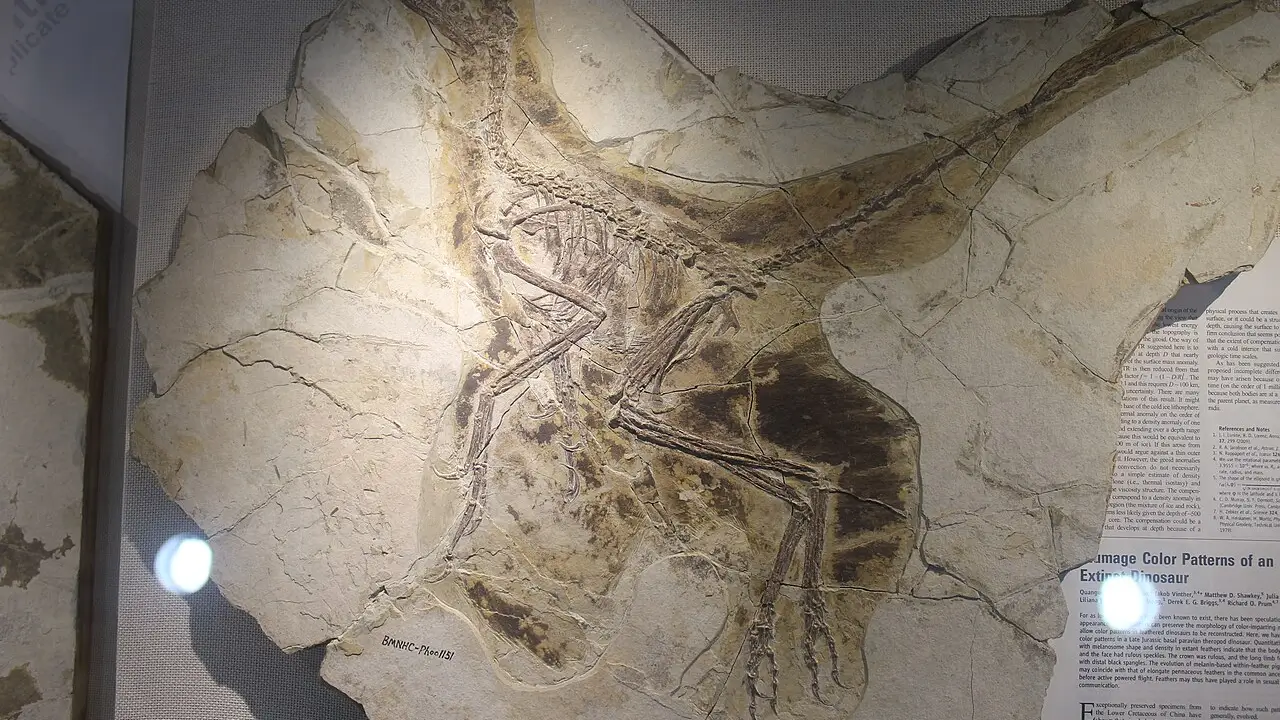
⚡ Survival SuperpowerFirst dinosaur ever reconstructed in full head-to-tail feather color
🤯 Mind-Blowing Fact • Grade 1
Anchiornis was the very first dinosaur in history to have its entire body's real colors solved by science!
✨ Word Sparks (Grade 1 Glossary)
Tap 🔊 to hear
crown
A tall tuft of feathers atop the head
speckled
Dotted with small spots of bright color
striped
Marked with neat bands of light and dark
🪝
What did the very first dinosaur ever painted in its real fossil colors look like?
1
Bright Red Crown!
Chirp, rustle! On a mossy branch perches a pigeon-sized dinosaur. Look at its fancy feathers! Anchiornis wore a fluffy reddish-orange , cheeks, and black-and-white wings!
2
Fluffy Down to Its Toes
Long feathers covered its arms, its legs, and even its feet—like fuzzy winter boots! Its name means near bird.
3
Older Than Archaeopteryx
Anchiornis lived in China ten million years before Archaeopteryx fluttered in Germany!
1. What colors were the fancy feathers of Anchiornis?
2. What does the name Anchiornis mean?
🤯 Mind-Blowing Fact • Grade 2
Fossilized stomach pellets show Anchiornis coughed up indigestible lizard bones and fish scales just like modern owls do!
✨ Word Sparks (Grade 2 Glossary)
Tap 🔊 to hear
pigment
Natural substance giving color to feathers, hair, or skin
pellet
Small ball of undigested bones coughed up by birds
microscope
Scientific tool that magnifies tiny details thousands of times
🪝
How did scientists map twenty-nine feather patches to reveal Anchiornis's true woodpecker-like colors?
1
Color Detective Story
Imagine opening a dinosaur book as a kid and wondering if artists just guessed every color! In 2010, scientists changed that forever using an Anchiornis fossil from China. By checking twenty-nine tiny feather samples under an electron , they unlocked the first head-to-tail color map of any dinosaur!
2
Woodpecker Style With Four Wings
Round grains gave Anchiornis a bright rusty-red head crest and cheek spots, while rod-shaped grains painted its body dark gray and barred its four wings in bold black-and-white stripes.
3
Tiny Jurassic Hunter
No heavier than a soda can, this 160-million-year-old tree climber caught lizards and fish, coughing up hard bones in owl-like !
1. What modern bird habit did fossilized pellets reveal in Anchiornis?
2. How old are the Late Jurassic rocks where Anchiornis lived?
🤯 Mind-Blowing Fact • Grade 3
Over two hundred beautifully feathered specimens of Anchiornis have been discovered in China's Tiaojishan Formation!
✨ Word Sparks (Grade 3 Glossary)
Tap 🔊 to hear
pheomelanin
Roundish pigment packets producing reddish-brown and ginger colors
ornithologist
A scientist who specializes in studying birds
symmetric
Matching equally in width on both sides
🪝
Why did Anchiornis have long feathers growing all the way down to its toes?
1
Ten Million Years Before Archaeopteryx
Cool mountain mist drifts through ginkgo and fern forests in northeastern China 160 million years ago during the early Late Jurassic. Hopping nimbly along a mossy limb is Anchiornis huxleyi, named in 2009 to honor Thomas Henry Huxley, the scientist who first linked birds to dinosaurs. Weighing barely half a pound, Anchiornis settled an old puzzle by proving feathered bird-like dinosaurs existed millions of years BEFORE Archaeopteryx!
2
Reading Melanosome Shapes
In 2010, paleontologists Quanguo Li, Jakob Vinther, and Richard Prum sampled twenty-nine spots across an Anchiornis fossil. Sausage-shaped eumelanin packets revealed charcoal-gray body down and black wing tips, blank zones showed crisp white wing stripes, and meatball-shaped packets painted a flaming rufous-red crown and speckled face!
3
Feathered 'Snowshoe' Feet
Long feathers sprouted not only on its arms and lower legs, but right down onto its toes like modern golden eagles—creating four-winged gliding lift, though feather vanes meant it glided gentler distances than later flyers.
4
Laser Body Outlines
High-tech laser scans in 2017 even revealed soft-tissue outlines of drumstick-like legs and padded bird-like toes!
1. How did scientists tell reddish-brown feathers apart from black feathers in Anchiornis?
2. Why did Anchiornis's discovery solve a major timeline puzzle in evolution?
🤯 Mind-Blowing Fact • Grade 4
Laser-Stimulated Fluorescence revealed a stretchy triangle of skin called a propatagium along the front of Anchiornis's elbow—the exact aerodynamic wing-leading edge living birds need for lift!
✨ Word Sparks (Grade 4 Glossary)
Tap 🔊 to hear
fluorescence
Glowing brightly when invisible chemical traces absorb laser light
propatagium
Elastic skin web stretching from shoulder to wrist on wings
temporal paradox
Apparent puzzle when fossils of relatives seem younger than descendants
🪝
What happened when scientists shone high-powered blue lasers onto an Anchiornis fossil in the dark?
1
Closing the 'Temporal Paradox'
Picture the forested volcanic lakeshores of China's Oxfordian-stage Tiaojishan Formation 160 million years ago. Darting after salamanders and dragonflies is a thirty-four-centimeter paravian weighing barely 150 grams: Anchiornis huxleyi. For decades, skeptics of bird-dinosaur evolution pointed to a '': famous feathered raptors like Microraptor were 120 million years old, younger than 150-million-year-old Archaeopteryx. When Xing Xu's team dated Anchiornis to 160 million years ago, that paradox evaporated overnight.
2
Symmetric Multi-Layered Wings
Unlike Archaeopteryx and Microraptor, whose single row of primary flight feathers had stiff asymmetric vanes, Anchiornis carried shorter, symmetric feathers arranged in overlapping tiers along both its arms and hind limbs. These layered coverts created a smooth, continuous airfoil for short woodland glides before stiff single-feathered wings evolved.
3
2010 Color Map and 2017 Laser Glow
After Jakob Vinther and Quanguo Li mapped its gray body, boldly spangled black-and-white limbs, and rufous crest via melanosome geometry in 2010, paleontologist Michael Pittman's team illuminated another specimen using Laser-Stimulated (LSF) in 2017. Invisible chemical traces in the rock glowed neon under laser light, revealing bird-like wing skin membranes, slender 'drumstick' shins, and cushioned toe pads!
4
Owl-Like Digestion
Six specimens preserving compacted gastric pellets of lizard skeletons and ganoid fish scales show Anchiornis already digested meals with two-chambered, bird-like efficiency.
1. How did Anchiornis's wing feathers differ structurally from those of later Microraptor and modern birds?
2. What soft tissues glowed visibly when researchers scanned Anchiornis with Laser-Stimulated Fluorescence in 2017?
🤯 Mind-Blowing Fact • Grade 5
Anchiornis had disordered, open-vaned contour feathers that shed water less readily than modern ducks, showing that fluffiness and vivid color display evolved millions of years before sleek waterproof feathers!
✨ Word Sparks (Grade 5 Glossary)
Tap 🔊 to hear
covert
Shorter overlapping feather smoothing airflow over wing bases
regurgitation
Bringing undigested bones or scales cleanly back up the throat
gizzard
Muscular second stomach chamber that grinds food and compacts bones
🪝
How did Anchiornis huxleyi pioneer paleocolor reconstruction, laser soft-tissue imaging, and the origin of avian wing architecture?
1
Resolving the Paravian Timeline
Recovered from Oxfordian-stage lacustrine shales of the Tiaojishan Formation (~160 MYA) in western Liaoning, China, Anchiornis huxleyi was named by Xing Xu and colleagues in 2009 to honor Thomas Henry Huxley's nineteenth-century insights into dinosaur-bird evolution. Measuring thirty-four to forty centimeters long and weighing 110 to 250 grams, Anchiornis predates Solnhofen's Archaeopteryx by roughly ten million years—decisively refuting the once-cited 'temporal paradox' by placing four-winged paravians firmly in the early Late Jurassic.
2
The First Whole-Body Dinosaur Color Map
In February 2010, Quanguo Li, Ke-Qin Gao, Jakob Vinther, Matthew Shawkey, and Richard Prum published a landmark Science study analyzing melanosome morphology across twenty-nine discrete plumage sites on specimen BMNHC PH828. Applying discriminant-function statistics calibrated against extant birds, rod-like eumelanosomes and spheroidal pheomelanosomes reconstructed a striking woodpecker-like palette: dark-gray contour plumage, boldly contrasting black-and-white spangled fore- and hind-limb remiges, facial rufous speckles, and an erect reddish-brown crown crest.
3
Multi-Tiered Wing Assembly and LSF Contours
Detailed plumage studies by Nicholas Longrich (2012) showed Anchiornis lacked stiff asymmetric primary vanes; instead, multiple overlapping rows of slender, symmetric remiges and elongated laminated together to generate passive aerodynamic lift. In 2017, Michael Pittman and Xiaoli Wang applied high-flux Laser-Stimulated Fluorescence (LSF) to illuminate geochemical soft-tissue halos invisible under white light, revealing a modern avian-like propatagial leading-edge membrane alongside reticulate plantar footpads.
4
Gastric Pellets and Two-Part Stomachs
In 2018, Xiaoli Zheng and colleagues documented six Anchiornis specimens containing compact oval gastric pellets packed with articulated lizard bones and etched ptycholepid fish scales—demonstrating a muscular and oral identical to extant raptorial birds.
5
Anchor of Anchiornithidae
Sitting right near the evolutionary split of Avialae, Troodontidae, and Dromaeosauridae, Anchiornis captures the exact anatomical workshop from which true avian flight emerged.