1. How did an ammonite push itself through the ocean?
2. What helped an ammonite's heavy coiled shell float effortlessly in water?
🤯 Mind-Blowing Fact • Grade 2
In Alberta, Canada, fossilized ammonite shells crushed deep underground turned into 'ammolite'—a dazzling rainbow gemstone glowing red, green, and blue!
✨ Word Sparks (Grade 2 Glossary)
Tap 🔊 to hear
jet propulsion
Moving forward by squirting liquid backward
cephalopod
Tentacled ocean group including squid and octopuses
iridescent
Shimmering with shifting rainbow colors
🪝
Why did people once call coiled ammonite fossils 'snakestones'?
1
Legends of Coiled Stone
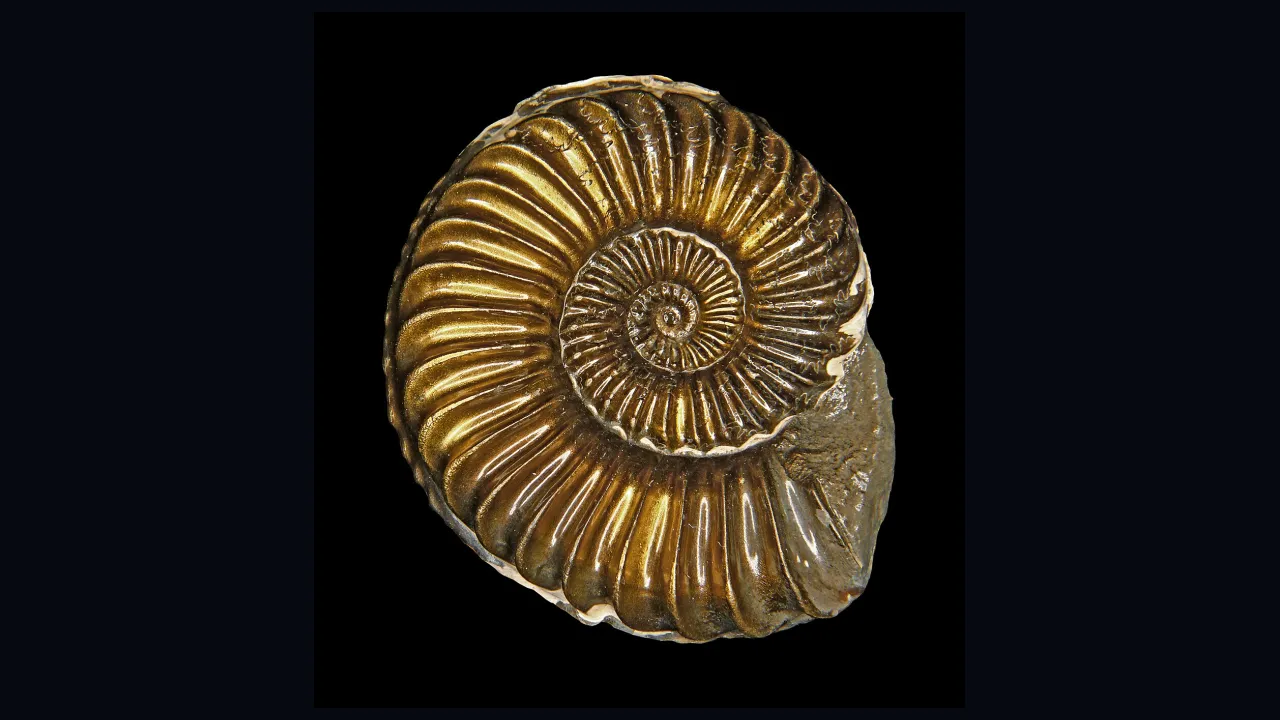
Pick up a ribbed spiral fossil along an English beach, and it looks remarkably like a coiled ram's horn or a sleeping snake! Ancient Romans named them 'ammonites' after Ammon, an Egyptian god pictured with curly ram's horns, while medieval villagers called them 'snakestones.'
2
Living in the Front Room Only
Even though an ammonite's shell had dozens of chambers, the soft squid-like animal lived only inside the newest, widest room at the open front! Whenever it outgrew that space, it built a wider shell ring ahead and sealed off a brand-new float chamber behind it.
3
Closer to Squid Than Nautiluses!
Although ammonites look like today's chambered nautilus, fossil beaks and tentacles show they were actually closer cousins to modern octopuses and squid!
1. Which living sea creatures are actually the closest cousins to extinct ammonites?
2. Where inside its coiled shell did the soft ammonite body actually live?
🤯 Mind-Blowing Fact • Grade 3
Paperclip-shaped Diplomoceras ammonites near Antarctica lived for up to 200 years, adding one new rib to their four-foot shells each year!
✨ Word Sparks (Grade 3 Glossary)
Tap 🔊 to hear
siphuncle
Living tube adjusting water and gas in shells
suture lines
Fern-like folded seams reinforcing chamber walls
heteromorph
Ammonite with an uncoiled or unusual shell shape
🪝
Why did some ammonites uncoil their shells into giant paperclips, hooks, and ice-cream cones?
1
Submarine Plumbing: The Siphuncle
How did an ammonite control dozens of sealed float chambers behind its back? Running along the outer rim of every chamber wall—called a septum—stretched a living tissue tube named the ! By pumping salty water out through that tube so gas diffused inward, the ammonite hovered weightlessly without flapping a fin.
2
Fern-Leaf Wall Patterns
Where each inner wall met the outer shell, ammonites grew wavy, interlocking folds called that looked like delicate frost ferns! Those puzzle-piece folds braced thin shells against crushing deep-water pressure and hungry mosasaur bites.
3
Rule-Breakers: Heteromorph Ammonites!
Not every ammonite grew a flat spiral! During the Cretaceous Period, '' ('different-shaped') ammonites uncoiled into six-foot straight spears (Baculites), spiral wizard hats (Turrilites), hanging paperclips (Diplomoceras), and tangled knots (Nipponites)—floating gently while snagging drifting zooplankton!
4
Why Nautiluses Survived 66 MYA
When the dinosaur-ending asteroid darkened skies 66 million years ago, surface plankton died off—starving tiny floating baby ammonites while deep-water nautilus babies hatched with big yolk supplies and survived!
1. What job did the wavy, fern-like suture lines inside an ammonite shell perform?
2. Why did chambered nautiluses survive the asteroid impact 66 million years ago when ammonites vanished?
🤯 Mind-Blowing Fact • Grade 4
Germany's record-breaking Parapuzosia seppenradensis ammonite shell—measuring 6.4 feet wide—would have weighed over 3,000 pounds in life if its chambers hadn't been buoyed by gas!
✨ Word Sparks (Grade 4 Glossary)
Tap 🔊 to hear
radula
Ribbon of tiny rasping teeth inside mollusks
aptychi
Paired jaw plates doubling as shell trapdoors
biostratigraphic
Dating rock layers using fast-evolving fossil species
🪝
How did X-ray beams find microscopic snail-shell snacks inside an ammonite's mouth—and solve why mosasaurs left bullet-hole marks?
1
340 Million Years of Spiral Innovation
Branching from straight-shelled bactritid nautiloids during the Early Devonian (~409 MYA), Ammonoidea conquered global oceans for 343 million years—surviving three catastrophic mass extinctions (Late Devonian, End-Permian, and End-Triassic) and rebounding faster than almost any marine clade! From dime-sized swimmers to Germany's colossal two-meter Parapuzosia seppenradensis, ammonites serve geologists as the Mesozoic Era's gold-standard timekeepers.
2
Synchrotron Scans Reveal Planktonic Diets
Because soft cephalopod tentacles rarely fossilize, ammonite diets remained mysterious until Pascal Kruta and colleagues aimed synchrotron X-ray microtomography at Cretaceous Baculites jaws! Instead of crushing giant crabs, its delicate comb-like teeth enclosed crushed larval snails and tiny pelagic isopods—showing many ammonites strained mid-water zooplankton, linking microscopic algae blooms to giant marine reptiles!
3
Aptychus Trapdoors and Ballast Physics
Paired calcitic plates found inside body chambers—called —functioned both as lower jaw scoops and as protective armored trapdoors sealing the shell opening when pulled shut! Meanwhile, a ventral siphuncle lining the outer whorl regulated osmotic fluid removal across fractal ammonitic septa.
4
Limpet Tricks vs. Mosasaur Bites
Rows of neat circular holes punched across ammonite shells were long blamed on mosasaur teeth; careful study revealed some were home scars etched by hitchhiking limpet snails, while true aligned puncture tracks record thrilling escapes from Tylosaurus and Placenticeras-hunting mosasaurs!
1. What did synchrotron X-ray scans of preserved ammonite jaws reveal they ate?
2. What clever double duty did paired plates called aptychi perform for an ammonite?
🤯 Mind-Blowing Fact • Grade 5
Three-dimensional physics models of tangled, knot-shaped Nipponites shells revealed that every twist purposefully balanced buoyancy and weight so the ammonite rotated gently in currents like a living chandelier!
✨ Word Sparks (Grade 5 Glossary)
Tap 🔊 to hear
phragmocone
The chambered, buoyancy-controlling portion of cephalopod shells
aragonite
Pearly calcium mineral forming iridescent ammonite shells
r-selection
Producing thousands of tiny offspring at once
🪝
Why did fractal septa, ventral siphuncles, and r-selected hatchlings propel ammonoids through three mass extinctions—yet doom them after Chicxulub?
1
Coleoid Sisterhood and Evolutionary Longevity
Despite superficial conch convergence with extant ectocochleate Nautilus, phylogenetic analyses of radular dentition (seven teeth per row rather than thirteen), embryonic protoconch size, and rare soft-body compressions from Germany's Devonian Hunsrück Slate and Jurassic Solnhofen Limestone unite Subclass Ammonoidea with Coleoidea (octopuses, squid, cuttlefish, and belemnites) inside clade Neocephalopoda! Originating in Emsian seas (~409 MYA), ammonoids repeatedly re-radiated from handfuls of surviving genera after the Kellwasser, End-Permian, and End-Triassic crises.
2
Suture Evolution: Goniatitic, Ceratitic, and Ammonitic
Across three hundred million years, septa traced a textbook trend toward fractal complexity: simple wavy Paleozoic goniatitic sutures gave way to Triassic ceratitic saddles and finely dendritic Mesozoic ammonitic sutures. Finite-element structural modeling and fluid-retention experiments show complex fluting distributed hydrostatic stress across ultra-thin aragonitic shells AND stored capillary cameral liquid along septal margins for rapid buoyancy fine-tuning via the marginal ventral siphuncle!
3
Hydrostatics of Heteromorph Conchs
Three-dimensional hydrostatic simulations by David Peterman and Kathleen Ritterbush overturned nineteenth-century dismissals of uncoiled Cretaceous heteromorphs—such as orthoconic Baculites, helical Turrilites, and meandering Nipponites—as 'evolutionary dead ends.' Separating centers of buoyancy and mass stabilized vertical or hover postures at minimal metabolic cost while plucking epipelagic zooplankton.
4
Nacreous Aragonite and Ammolite
Ammonites constructed shells from microscopic hexagonal platelets of (nacre, or mother-of-pearl). In Alberta's Bearpaw Formation, tectonic heat and bentonite clay preserved unrecrystallized aragonite nanostructures whose optical interference diffracts dazzling gem-quality ammolite colors!
5
Reproductive Strategy and the K-Pg Extinction
Ammonoids practiced extreme —releasing thousands of one-millimeter planktonic ammonitella hatchlings bound to sunlit surface food webs—whereas nautilids invested in few, centimeter-scale benthic eggs rich in yolk (K-selection). When Chicxulub impact aerosols shut down photosynthesis AND surface ocean acidification dissolved microscopic aragonitic shells 66 million years ago (save brief Danian survivor pockets), ammonoids vanished forever while deep-water nautilids endured.