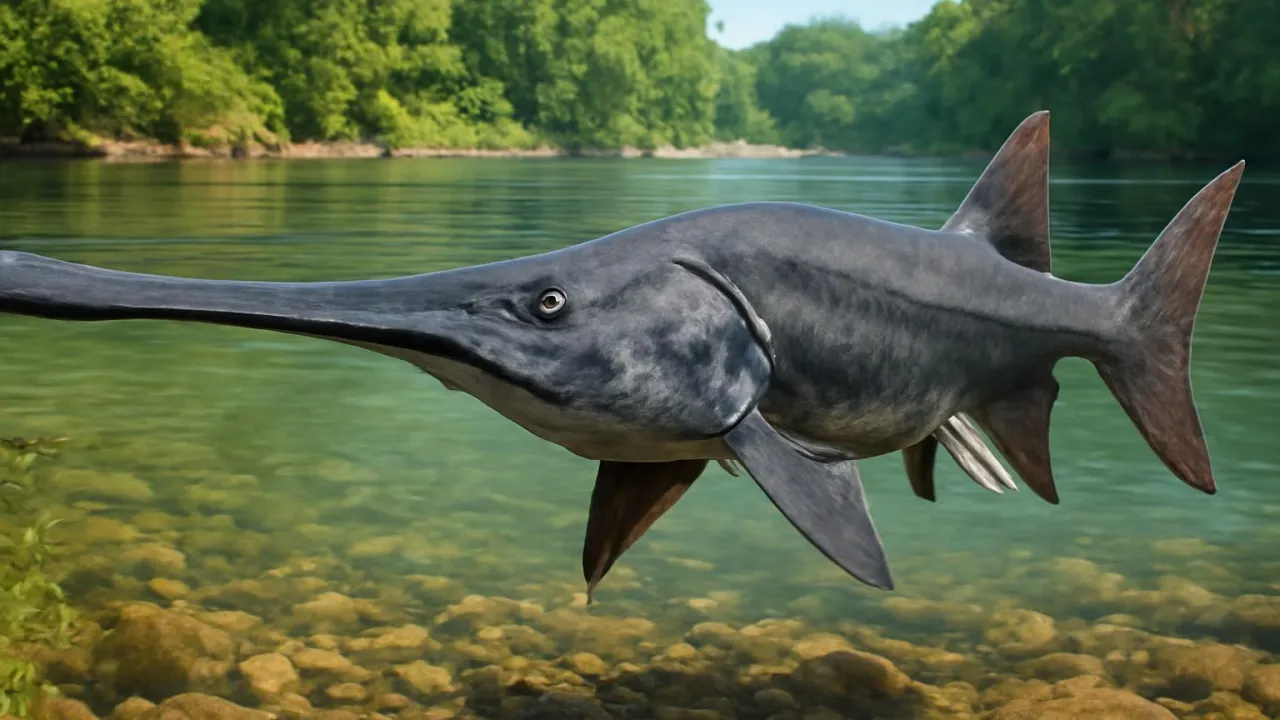
1. What does the paddlefish use its long nose for?
2. Where do paddlefish live?
🤯 Mind-Blowing Fact • Grade 2
The paddlefish’s nose can sense electric signals that are too small for humans to feel!
✨ Word Sparks (Grade 2 Glossary)
Tap 🔊 to hear
filter
To catch tiny things by letting water pass
electric signals
Tiny energy messages animals can sense
freshwater
Water from rivers and lakes, not salty
🪝
Have you ever seen a fish with a nose like a long paddle?
1
A Special Paddle Nose
The American paddlefish has a long paddle-shaped nose that helps it find food. This nose senses tiny in the water. It uses this to catch small animals called plankton. The paddle is flat and wide, making it easy to sense its surroundings.
2
Where It Lives and Grows
Paddlefish live in large rivers across the central United States. They prefer slow-moving water with lots of plankton to eat. Young paddlefish grow quickly and swim near the river bottom. Adults can grow very large, sometimes reaching seven feet long.
3
How It Eats
This fish feeds by opening its mouth wide and filtering water for plankton. Water flows through its gills, trapping tiny animals to eat. It does not have teeth but uses its gills like a sieve. This feeding style helps it get enough food without chasing prey.
Paddlefish use their paddle snouts to detect electric fields from plankton hidden in murky water.
✨ Word Sparks (Grade 3 Glossary)
Tap 🔊 to hear
adaptation
A body change that helps survival
filter feeder
An animal that eats by straining water
plankton
Tiny plants and animals in water
🪝
How does the paddlefish’s long nose help it survive in murky rivers?
1
Unique Paddle-Shaped Snout
The American paddlefish has a long, flat snout that looks like a paddle. This snout is covered with special sensors that detect weak electric signals. These signals help the fish find in murky water where vision is poor. This is vital for its survival.
2
Habitat and Life Cycle
Paddlefish live in freshwater rivers and reservoirs in the central United States. They spawn in flowing water during spring, releasing eggs and sperm into the current. Young paddlefish grow quickly and feed on tiny . Adults can grow to more than seven feet and weigh over 60 pounds.
3
Feeding by Filter-Feeding
This fish is a that swims with its mouth open to strain from the water. Water passes through gill rakers that trap tiny animals and plants. The paddlefish does not have teeth but relies on this method to get nutrients. This feeding strategy helps it thrive in its ecosystem.
4
Camouflage and Protection
Its dark gray body helps it blend into river waters, avoiding predators. The paddlefish’s slow movements and large size also deter many threats. Its paddle snout is not used for defense but for sensing food. These help it survive in a complex food web.
1. What does the paddlefish’s paddle snout detect?
2. Why does the paddlefish’s body color help it?
🤯 Mind-Blowing Fact • Grade 4
Paddlefish help keep river ecosystems healthy by controlling plankton and linking food webs.
✨ Word Sparks (Grade 4 Glossary)
Tap 🔊 to hear
electroreceptors
Sensors that detect tiny electric signals
filter feeder
An animal that eats by straining water
ecosystem
A community of plants and animals living together
🪝
How does the American paddlefish’s paddle snout help it play an important role in river ecosystems?
1
Sensing Food in Murky Rivers
The paddlefish’s long paddle snout is covered with that detect tiny electric fields produced by plankton. This allows the fish to find food even when the water is muddy and visibility is low. By feeding on plankton, the paddlefish helps control their populations, maintaining balance in the .
2
Role in Food Webs and Ecosystems
As a , the paddlefish consumes large amounts of plankton, which are primary producers or primary consumers in aquatic food webs. This feeding helps transfer energy from microscopic organisms to larger predators, including humans. The paddlefish also serves as prey for some large fish and birds, linking many species in its habitat.
3
Distribution and Human Impact
American paddlefish are native to large river systems like the Mississippi and Missouri Rivers. Dams and pollution have affected their migration and spawning habits, causing population declines. Conservation efforts focus on habitat restoration and breeding programs to protect this ancient species for future generations.
4
Cause and Effect of Adaptations
Because paddlefish rely on electroreception to find food, their paddle snout evolved to maximize sensory surface area. This adaptation causes them to be highly efficient in turbid waters. However, changes in river flow or water quality can disrupt their feeding and reproduction, showing how sensitive they are to environmental changes.
1. How does the paddlefish’s snout help the river ecosystem?
2. What human activity harms paddlefish populations?
🤯 Mind-Blowing Fact • Grade 5
The paddlefish’s paddle snout has over 100,000 electroreceptors, making it one of nature’s most sensitive biological sensors.
✨ Word Sparks (Grade 5 Glossary)
Tap 🔊 to hear
electroreception
Ability to sense tiny electric fields in water
rostrum
The long paddle-shaped nose of the fish
filter feeding
Eating by straining tiny food from water
🪝
What makes the American paddlefish’s paddle snout a remarkable evolutionary and ecological tool in freshwater rivers?
1
Taxonomy and Scientific Classification
The American paddlefish, scientifically named Polyodon spathula, belongs to the family Polyodontidae. It is a primitive ray-finned fish, closely related to sturgeons. This species is one of the few surviving members of an ancient lineage dating back over 125 million years. Its unique morphology reflects evolutionary adaptations to in freshwater ecosystems.
2
Physiological Mechanics of the Paddle Snout
The paddlefish’s elongated , or paddle snout, contains thousands of electroreceptors called ampullae of Lorenzini. These specialized sensory organs detect weak bioelectric fields generated by plankton and other aquatic organisms. This allows the paddlefish to locate food efficiently in turbid, low-visibility waters. The snout’s large surface area maximizes sensory input, enhancing feeding success.
3
Conservation Status and Human Influence
American paddlefish populations have declined due to habitat fragmentation, pollution, and overfishing. Dams disrupt their spawning migrations, reducing reproductive success. Conservation programs include habitat restoration, captive breeding, and regulated fishing to protect this species. Understanding their ecological role helps prioritize efforts to maintain biodiversity in North American river systems.
4
Ecological Role and Quantitative Comparisons
As a filter feeder, the paddlefish consumes vast quantities of plankton daily, filtering up to several hundred gallons of water per hour. Adults can reach lengths of seven feet and weigh over 60 pounds, making them among the largest freshwater fish in North America. Their feeding behavior supports aquatic food webs by transferring energy from microscopic plankton to larger predators.
5
Evolutionary Significance and Historical Context
The American paddlefish represents an evolutionary relic from the Jurassic period, surviving major extinction events. Its morphology has remained relatively unchanged, highlighting successful adaptation strategies. Early Native American cultures valued paddlefish for their meat and roe, which is sometimes used as a substitute for caviar. Scientific study of this species provides insights into ancient fish evolution and freshwater ecology.