1. How many rows of tall spines ran down the neck of Amargasaurus?
2. Where did Amargasaurus find most of its leafy snacks?
🤯 Mind-Blowing Fact • Grade 2
CT scans of Amargasaurus's inner ear balance canals proved it naturally carried its snout tilted downward, browsing plants just two to three feet off the ground!
✨ Word Sparks (Grade 2 Glossary)
Tap 🔊 to hear
parallel
running side by side at the same distance
display
showing off colors or shapes to communicate
horsetail
an ancient reed-like plant growing near water
🪝
Why did this pint-sized long-necked dinosaur grow two giant rows of spikes along its neck?
1
Double Trouble on Its Neck
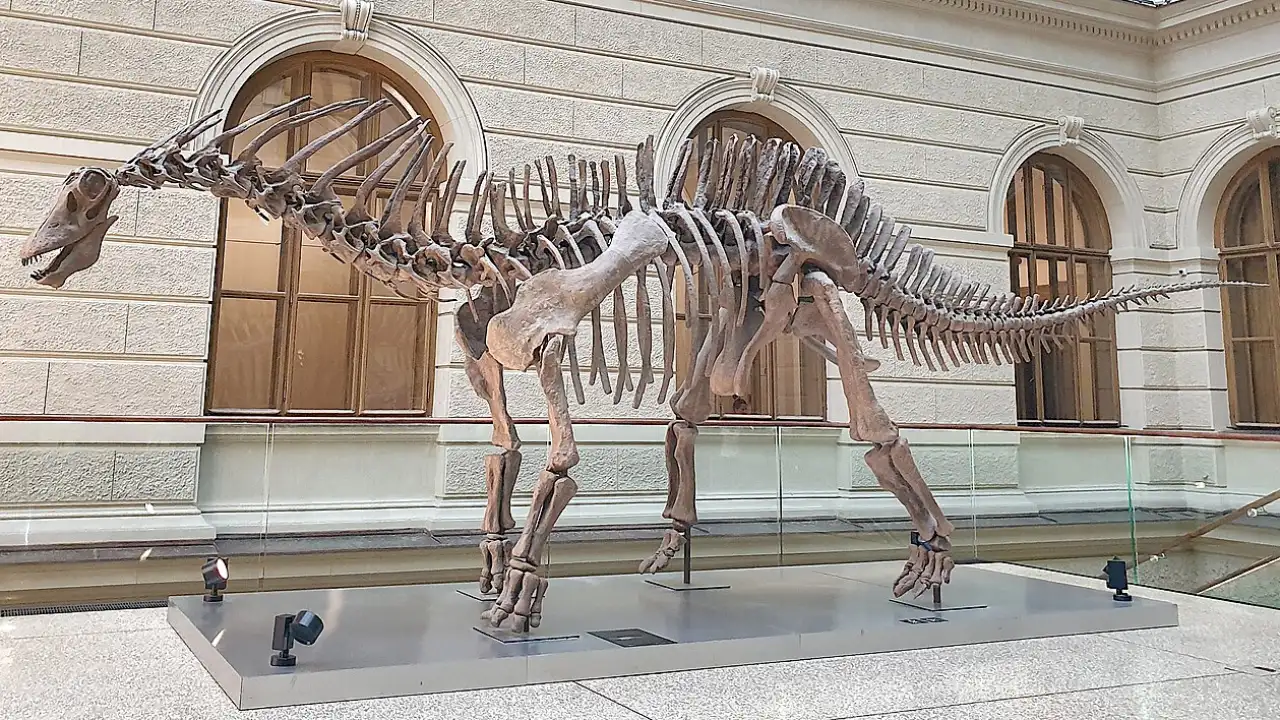
Step into an ancient forest in Argentina and spot the flashiest dinosaur around! Rising from the neck of Amargasaurus were two rows of curved bony rods up to twenty-four inches tall, connected by twin curtains of tough skin.
2
Show-Off Sails and Rattling Tips
Why carry such fancy headgear? Scientists think Amargasaurus flushed bright blood into its twin sails to show off to friends and rivals, while pointy tips helped warn hungry predators away from its neck!
3
A Pint-Sized Sauropod
At thirty feet long and less than three tons, Amargasaurus weighed no more than a rhino, keeping its snout low to crop riverside .
1. About how much did an adult Amargasaurus weigh?
2. What did inner-ear scans reveal about how Amargasaurus held its head?
🤯 Mind-Blowing Fact • Grade 3
Because twin skin sails ran side by side down its neck with a hollow trough in between, bending its neck sideways must have rippled those colorful sails like giant fans!
✨ Word Sparks (Grade 3 Glossary)
Tap 🔊 to hear
ligament
tough tissue band connecting bones or supporting skin
braincase
the bony box protecting an animal's brain
trough
a narrow channel sitting between two high ridges
🪝
Were the twin rows of two-foot rods on Amargasaurus's neck bare horns or double skin sails?
1
Unearthed Along La Amarga Creek
In 1984, paleontologist Guillermo Rougier uncovered an extraordinary skeleton along a dry canyon called La Amarga in Patagonia, Argentina. Twenty-two connected vertebrae stretched from the tail right up to the —and sprouting from the neck were twin rows of sweeping two-foot-tall spines!
2
Spikes or Sails? Microscopes Decide!
For thirty years, scientists debated whether those split neck bones poked out as bare horns or held up skin sails. In 2022, researchers examined microscopic bone fibers on the spines and found unmistakable anchor marks where elastic stretched twin webs of living skin from bone to bone!
3
Short Neck by Sauropod Standards
Amargasaurus belonged to a quirky sauropod family called dicraeosaurids that actually evolved shorter necks over time. Its neck measured less than eight feet long—shorter than its back and tail!
4
Built-In Balance Sensor
X-ray scans of the semicircular canals in its inner ear revealed Amargasaurus held its muzzle angled downward, grazing ferns about thirty inches above the ground.
1. What did the 2022 microscopic bone study reveal about Amargasaurus's tall neck spines?
2. How was the neck of Amargasaurus unusual compared with giant sauropods?
🤯 Mind-Blowing Fact • Grade 4
When Amargasaurus lowered its head to graze ferns near the ground, geometry tilted its backward-slanted neck spines straight up toward the sky like a bristling fence!
✨ Word Sparks (Grade 4 Glossary)
Tap 🔊 to hear
bifurcation
splitting at the top into two separate branches
vestibular
inner-ear system sensing head tilt and balance
understory
shady layer of low plants beneath forest trees
🪝
Why did one branch of long-necked dinosaurs shrink in size, shorten their necks, and sprout extravagant double neck sails?
1
Breaking the Giant Sauropod Mold
Most sauropods chased ever-greater heights, yet 125 million years ago in Early Cretaceous Patagonia, Amargasaurus cazaui thrived by breaking every rule. Measuring roughly nine to ten meters long and weighing just 2.6 metric tons, this dicraeosaurid stood low among conifer understories while flaunting the boldest neck ornament in dinosaur history.
2
Solving the Horn-Versus-Sail Debate
Each cervical vertebra split at the top—a feature called —into two slender cylindrical spines angling steeply backward, peaking at sixty centimeters over the middle neck before merging into a single row along the back. For decades artists painted them covered in hard horn sheaths like antelope horns. However, a 2022 osteohistological study led by Ignacio Cerda discovered dense networks of Sharpey's fibers—microscopic mineralized collagen strands—proving strong ligaments tethered dual parallel skin sails between consecutive spines!
3
Inner-Ear Posture Reconstruction
CT-scanning the holotype's well-preserved braincase allowed paleoneurologists Paulina Carabajal and colleagues to reconstruct its inner-ear labyrinth. Aligning the horizontal semicircular canal level with the horizon positioned the snout pointing steeply downward, holding the jaws roughly eighty centimeters above the ground while keeping the backward-swept neck spines angled threateningly upward!
4
Visual Signals in Dense Woodlands
Too stiff-necked to turn sharply, Amargasaurus likely used its twin sails for bold visual courtship displays and making its compact body look twice as tall to Early Cretaceous predators.
1. What happened to the angle of Amargasaurus's backward-curving neck spines whenever it dipped its snout down to graze?
2. What microscopic evidence convinced researchers in 2022 that skin sails stretched between the neck spines?
🤯 Mind-Blowing Fact • Grade 5
Unlike nearly all other long-necked sauropods whose backbones were hollowed out by air sacs, Amargasaurus and its dicraeosaurid cousins lost most of those air pockets because their shorter, 2.6-ton bodies didn't need extreme weight reduction!
✨ Word Sparks (Grade 5 Glossary)
Tap 🔊 to hear
Sharpey's fibers
microscopic bone threads anchoring tendons and skin ligaments
dicraeosaurid
short-necked sauropod family with tall split back spines
tomography
3D X-ray imaging peering non-destructively inside fossils
🪝
How did synchrotron-grade histology and inner-ear CT tomography decode the posture and soft-tissue sails of South America's most flamboyant sauropod?
1
Discovery in the La Amarga Formation
Excavated in February 1984 during José Bonaparte's eighth paleontological expedition to Patagonia and formally named Amargasaurus cazaui by Leonardo Salgado and Bonaparte in 1991, holotype MACN-N 15 remains one of the most complete Cretaceous sauropod skeletons ever recovered. Twenty-two articulated presacral vertebrae connected directly to the braincase and pelvis, accompanied by complete fore- and hindlimbs from Barremian–Aptian riverine sandstones (~129–122 MYA).
2
Extreme Dicraeosaurid Dwarfism and Bifurcation
Measuring just 9 to 10 meters long and roughly 2.6 metric tons, Amargasaurus epitomized Dicraeosauridae—a diplodocoid lineage that evolved secondary body-size reduction and shortened, thirteen-vertebra necks lacking extensive lateral pleurocoels. Compensating for lost stature, its neural spines bifurcated dramatically from the third cervical backward, soaring 60 centimeters above the eighth cervical vertebra in two parallel, circular-cross-section shafts spaced 7 centimeters apart.
3
Osteohistology Settles the Keratin-Sheath Hypothesis
Long reconstructed with exposed keratinous horn sheaths because of faint surface striations, Amargasaurus spines underwent thin-section paleohistological analysis in 2022 by Ignacio Cerda and colleagues. Instead of the heavily vascularized cortex required to nourish growing horn sheaths, the shafts exhibited dense along their anterior and posterior margins—unequivocal proof of an interspinous ligamentous lattice supporting twin parallel dermal sails.
4
Neuroanatomy and Low-Browsing Ecology
In 2014, CT of the braincase by Ariana Paulina Carabajal mapped the flocculus, olfactory bulbs, and semicircular canals. Orienting the lateral semicircular canal horizontally placed the muzzle 65 degrees below horizontal in neutral alert posture, positioning its narrow peg-toothed jaws ~0.8 meters above ground while elevating its dual sails into a formidable visual crest.
5
Multi-Modal Signaling in Gondwanan Forests
Restricted lateral neck flexion meant twin sails could not have evolved primarily as weapons; instead, vascularized dual membranes—separated by a median resonant trough—served intra-specific courtship signaling, species recognition, and visual intimidation against abelisaurid and carcharodontosaurid theropods.