🎵 INSTRUMENTS
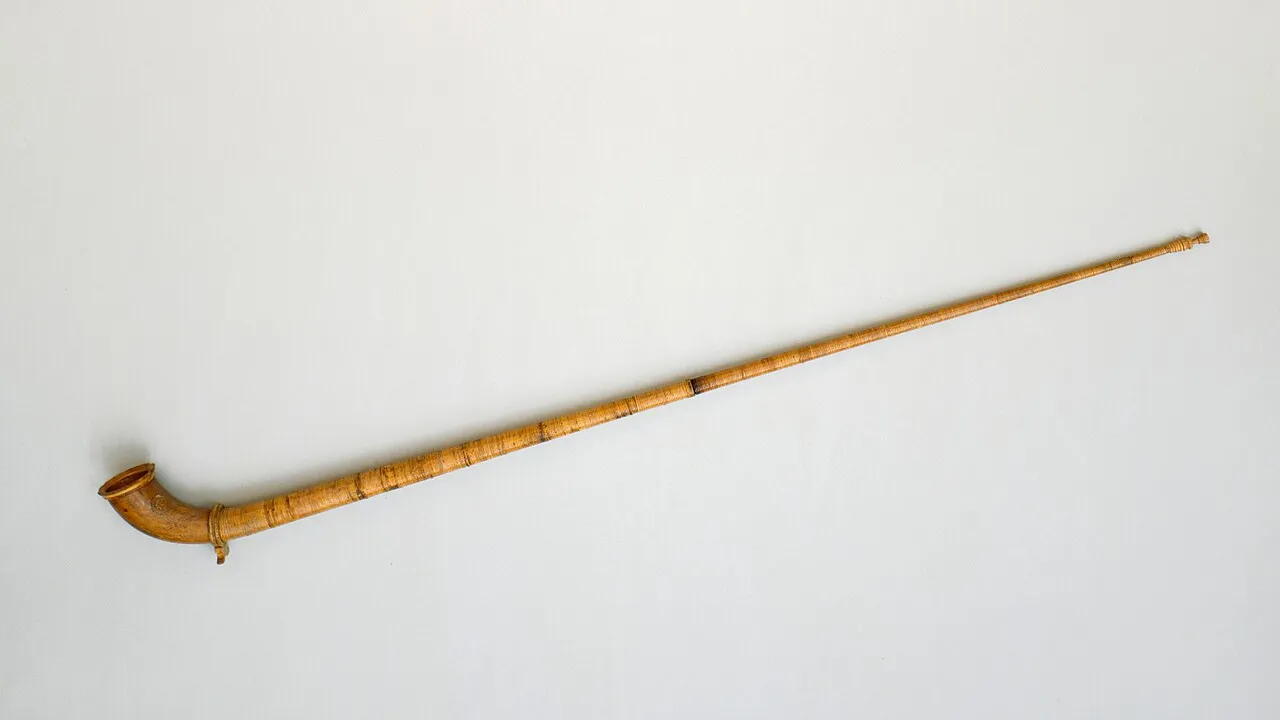
🎶 Wooden Conical Natural Labrosone Aerophone (Hornbostel-Sachs 423.121)
VA Music, Fine Arts & Sound Physics SOL 5.5
Alphorn
Twelve-Foot Wooden Voice of Mountain Valleys
Grade 2 • Developing • 104 words
🎶 Instrument Family & OriginNatural horn family; centuries-old pastoral tradition of the Swiss, Austrian, German, and French Alps (recorded 1555)
🪵 Materials & RangeCarved mountain spruce wrapped in rattan or birch bark; 11 to 13 ft (3.4–4.0 m) long, spanning 12–16 natural harmonics
🔊 How Sound Is MadeBuzzing lips in a turned hardwood cup mouthpiece send warm standing waves down a long conical timber tube
⚡ Signature Sound SparkProjects soothing, horn-like wooden melodies up to six miles across silent Alpine peaks and valleys
🤯 Mind-Blowing Fact • Grade 1
On a calm day high in the Swiss Alps, an alphorn's deep song can be heard up to six miles away in the next valley!
✨ Word Sparks (Grade 1 Glossary)
Tap 🔊 to hear
spruce
Tall evergreen tree with light, singing wood
valley
Low green land between tall mountains
carve
Shape smooth pieces out of solid wood
🪝
Have you ever seen a wooden horn longer than two grown-ups?
1
A Horn Made of Tree!
Hoooo-laaa-hooo! A deep, gentle song echoes from peak to snowy peak! Look at that giant wooden pipe resting on the grass! It stretches twelve feet across the meadow.
2
Carved From Mountain Spruce
This huge horn is not made of shiny metal at all. Makers it out of light wood. Its curved bell turns up like a big smile.
3
Calling Across the Hills
A player stands tall and buzzes into a small wood cup. No buttons sit on the long trunk. Its warm notes float for miles!
1. What material is a traditional twelve-foot alphorn carved from?
2. Where does the upturned bell end of an alphorn rest while someone plays?
🤯 Mind-Blowing Fact • Grade 2
Modern twelve-foot alphorns unscrew into three neat wooden sections so musicians can carry them up mountain trails in a backpack!
✨ Word Sparks (Grade 2 Glossary)
Tap 🔊 to hear
herder
Person caring for grazing mountain cows
rattan
Strong woven vine strips wrapping wooden tubes
hollow
Empty on the inside like a pipe
🪝
Why does a wooden alphorn play just like a brass instrument even though it has zero metal?
1
Brass Cousins Dressed in Wood!
Stand on a breezy Swiss hillside and listen as a velvety golden chord rolls off snow-capped cliffs! Even though an alphorn is carved completely from spruce wood and wrapped in strips, musicians group it with brass instruments because buzzing lips create the sound.
2
Nature's Curved Saplings
Centuries ago, mountain searched steep slopes for young pine trees whose bases curved naturally under heavy winter snow! They sliced the trunk in half lengthwise, hollowed both sides with chisels, and bound the halves tightly back together.
3
Calming Cows and Greeting Neighbors
At sunset, cowherds blew peaceful alphorn melodies to call grazing cows home for milking and send evening greetings to distant mountain villages!
1. Why do instrument scientists group the wooden alphorn with brass horns instead of woodwinds?
2. Why did old-time mountain makers look for trees growing on steep snowy slopes?
🤯 Mind-Blowing Fact • Grade 3
After hearing an alphorn echo across Switzerland in 1868, composer Johannes Brahms jotted the melody on a postcard and wove it straight into the finale of his First Symphony!
✨ Word Sparks (Grade 3 Glossary)
Tap 🔊 to hear
alphorn-fa
Dreamy eleventh overtone sitting between standard keys
gouge
Curved chisel tool scooping out smooth wood
pastoral
Connected to peaceful countryside meadows and shepherds
🪝
How can an alphorn play whole melodies without valves when a short bugle only plays five notes?
1
Three Times Longer Than a Bugle!
If you have ever heard a four-foot bugle, you know a short valveless tube only unlocks five spread-out notes. Now stretch that conical pipe to twelve feet—nearly four meters—and something magical happens inside the air column!
2
Twelve to Sixteen Natural Overtones
Because an alphorn's wooden bore is so long, its standing waves divide into tiny segments high in the harmonic series. Skilled players reach from deep bass rumbles all the way up to the twelfth or sixteenth overtone, where natural notes sit close enough together to form flowing melodies!
3
Mystery of the 'Alphorn-Fa'
Listen closely to its eleventh harmonic and your ears may perk up in surprise! That natural mountain note—nicknamed —lands right between F and F-sharp on a piano, giving Alpine folk tunes a dreamy, ancient shimmer.
4
Crafted by Master Woodworkers
Each half of slow-grown spruce is gouged to seven millimeters thin, glued airtight, and wrapped in weatherproof birch bark or rattan.
1. Why can a valveless alphorn play smoother scale-like melodies than a short valveless bugle?
2. What makes the famous note called *alphorn-fa* sound so unusual to modern ears?
🤯 Mind-Blowing Fact • Grade 4
At the annual Nendaz International Alphorn Festival in Switzerland, more than one hundred alphorn players stand in a giant mountain semicircle to sound thunderous wooden chords together!
✨ Word Sparks (Grade 4 Glossary)
Tap 🔊 to hear
motif
Short musical phrase carrying a clear meaning
refraction
Gentle bending of waves across air layers
growth rings
Yearly wood layers showing how trees grew
🪝
Why did Swiss naturalist Conrad Gessner marvel at this wooden giant back in 1555—and how did it nearly vanish?
1
Five Centuries of Alpine Communication
In 1555, Swiss scholar Conrad Gessner climbed Mount Pilatus and recorded the earliest detailed description of an eleven-foot wooden Lituus alpinus blown by mountain herdsmen. Across isolated valleys from Savoy to Bavaria, specific horn functioned like a long-distance telegraph—warning neighbors of approaching storms, summoning villagers to evening prayer, and soothing restless dairy herds during twilight milking.
2
Saved From Extinction in 1827
By the early 1800s, village cheese cooperatives reduced the need for lone high-pasture herders, and the alphorn nearly vanished! Determined to rescue Switzerland's sonic heritage, Bernese governor Niklaus von Mülinen commissioned master builder Franz Anton Zetter to craft standardized horns and organized historic folk festivals at Unspunnen, sparking a joyful revival that thrives today.
3
Acoustics of Slow-Grown High-Altitude Spruce
Why choose high-elevation Norway spruce (Picea abies)? Short Alpine summers produce tight, uniform annual with high stiffness-to-weight ratios—the exact same acoustic timber prized for Stradivarius violin tops! Turning a dry hardwood mouthpiece of boxwood or plum wood prevents moisture swelling while transmitting crisp lip vibrations into the four-meter conical bore.
4
Valley Refraction and Long-Range Carry
Cool evening air settling into mountain basins bends sound waves gently downward through temperature , carrying the alphorn's mellow 150-to-600 Hz partials cleanly across five to ten kilometers of open sky.
1. Why do alphorn makers prize spruce trees that grew slowly high up in cold mountains?
2. How does cool evening mountain air help an alphorn carry up to six miles across a valley?
🤯 Mind-Blowing Fact • Grade 5
Written relative to C, the alphorn's natural eleventh harmonic lands at 551 cents—just one-hundredth of a semitone away from the exact mathematical midpoint between F (500 cents) and F-sharp (600 cents)!
✨ Word Sparks (Grade 5 Glossary)
Tap 🔊 to hear
labrosone
Any wind instrument sounded by buzzing lips
damping
Absorbing high vibrations to mellow out tone
trembita
Long Carpathian wooden mountain horn cousin
🪝
How can a four-meter timber cone rival symphony brass in projection—and even experiment with carbon-fiber physics?
1
Organological Classification: Labrosones Beyond Metal
In the Hornbostel-Sachs taxonomy, instruments are classified by their primary vibrating medium rather than construction material. Designated 423.121—an end-blown conical natural without mouthpiece-independent valves—the alphorn proves that 'brass acoustics' depend solely on lip-reed aeroacoustics coupled to a resonant waveguide. Standard Swiss instruments pitched in F-sharp (3.40 m) or F (3.60 m) produce a fundamental f1 near 92.5 Hz or 87.3 Hz, though performers routinely utilize partials 2 through 16 (spanning ~175 Hz to 1,400 Hz).
2
Bore Geometry and Wall-Damping Timbre
Internally, a hand-gouged or CNC-milled spruce alphorn expands from a 16-to-19-millimeter hardwood cup mouthpiece along a gentle parabolic-conical profile whose walls measure 6 to 8 millimeters thick, culminating in an upturned 20-centimeter bell. Compared with thin 0.5-millimeter sheet brass, fibrous wood walls exhibit slightly higher internal viscothermal at frequencies above 2,000 Hz, filtering out metallic sizzle to leave a remarkably pure, horn-like fundamental and low-partial glow.
3
Harmonic Series Topology: Partials 7, 11, and 13
Operating high in the natural overtone series unlocks diatonic steps from Partial 8 upward, yet exposes three famous non-tempered harmonics relative to an equal-tempered scale built on C: Partial 7 (B-flat, 31 cents flat), Partial 11 (alphorn-fa, 551 cents above C—almost dead center between F at 500 cents and F-sharp at 600 cents), and Partial 13 (A-flat/A, 41 cents flat of A). Rather than 'correcting' these intervals, Alpine composers celebrate their shimmering acoustic authenticity.
4
Classical Concertos and Carbon-Fiber Innovation
Leopold Mozart's 1755 Sinfonia Pastorella and Jean Daetwyler's 20th-century concertos brought the alphorn onto symphonic stages, while modern Swiss engineers have even developed telescoping 800-gram carbon-fiber alphorns swap-tunable into all twelve keys.
5
Global Timber Cousins
Parallel wooden —including the Carpathian , Romanian bucium, and Swedish birch-bark näverlur—confirm that mountain cultures across Europe independently harnessed long-tube harmonic acoustics for long-range communication.