2. Which famous predator shared the Late Cretaceous Southwest with Alamosaurus?
🤯 Mind-Blowing Fact • Grade 2
Alamosaurus was the ONLY long-necked dinosaur living in North America at the very end of the Age of Dinosaurs!
✨ Word Sparks (Grade 2 Glossary)
Tap 🔊 to hear
ancestor
an earlier family member from long ago
pterosaur
a flying reptile from the dinosaur age
palm
a warm-weather tree crowned with fan leaves
🪝
How did giant long-necked dinosaurs return to North America after vanishing for thirty million years?
1
A Giant Southern Visitor
For over thirty million years, not a single long-necked sauropod walked across North America! Then, around seventy million years ago, of Alamosaurus trekked north from South America to reclaim warm southwestern plains.
2
Not Named for the Famous Fort!
People often guess this Texas giant was named for the Alamo in San Antonio. Actually, scientist Charles Gilmore named its first fossils in 1922 after New Mexico's Ojo Alamo Trading Post!
3
Sharing Skies With Giant Flyers
Stretching nearly one hundred feet long, Alamosaurus munched tall and conifers while airplane-sized soared overhead.
1. Where did the ancestors of Alamosaurus likely travel from to reach North America?
2. How many other long-necked dinosaur species lived alongside Alamosaurus in end-Cretaceous North America?
🤯 Mind-Blowing Fact • Grade 3
Huge neck vertebrae found in Big Bend National Park suggest full-grown Alamosaurus matched South America's super-giants at nearly 100 feet long!
✨ Word Sparks (Grade 3 Glossary)
Tap 🔊 to hear
delta
fan-shaped wetland where a river meets sea
land bridge
strip of dry land connecting two continents
hide
the thick, tough skin of a large animal
🪝
What happens when a forty-ton South American titanosaur moves into T. rex territory?
1
Ending the Sauropod Gap
Picture Big Bend, Texas, sixty-seven million years ago: warm river wind past palm groves as a hundred-foot Alamosaurus shakes the ground! After earlier North American sauropods died out, North America went thirty million years without long-necked giants—until Alamosaurus arrived from the south.
2
New Mexico Roots, Texas Giants
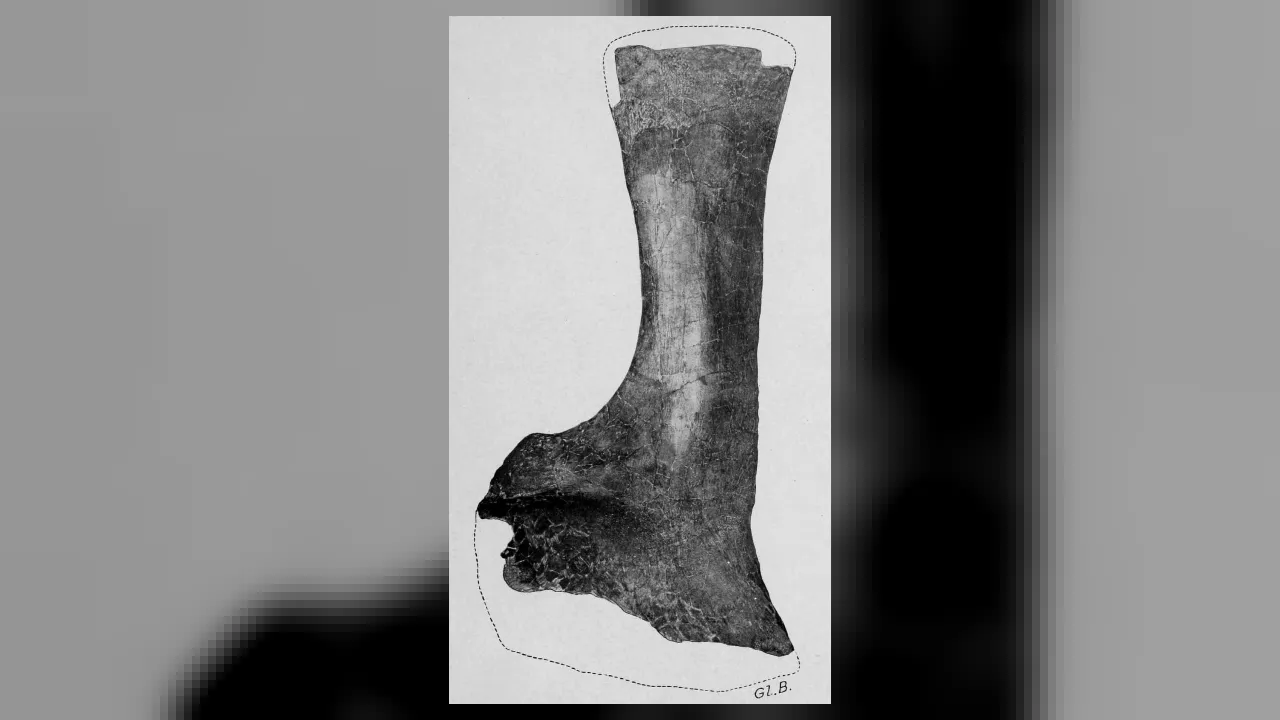
Smithsonian paleontologist Charles Gilmore named Alamosaurus sanjuanensis in 1922 from a shoulder blade and tail bones found near New Mexico's Ojo Alamo ('Cottonwood Spring'). Decades later, enormous neck and leg bones from Texas and Utah revealed it weighed forty tons or more!
3
Armored Skin and Wide Steps
Like its South American cousin Saltasaurus, Alamosaurus belonged to the titanosaur group and carried rounded bony armor lumps embedded in its thick .
4
Showdown With Tyrannosaurus
Young Alamosaurus had to watch out for hungry Tyrannosaurus rex, yet a full-grown forty-five-ton adult towered far out of danger's reach—surviving right until the asteroid ended the Cretaceous Period!
1. Why is the period before Alamosaurus arrived in North America called a 'sauropod gap'?
2. What defensive protection helped shield Alamosaurus besides its huge adult size?
🤯 Mind-Blowing Fact • Grade 4
Until giant neck and leg bones were studied in 2011, scientists underestimated Alamosaurus by nearly half—not realizing older museum skeletons were merely teenagers!
✨ Word Sparks (Grade 4 Glossary)
Tap 🔊 to hear
hiatus
a long pause or gap in a record
incubate
keep eggs warm so embryos grow inside
subadult
a teenage animal not yet fully grown
🪝
Why did giant Alamosaurus herds rule the sunny American Southwest while duck-billed dinosaurs dominated the cooler North?
1
Mystery of the Sauropod Hiatus
Around one hundred million years ago, North America's native sauropods vanished, opening what paleontologists call the 'North American sauropod .' For more than thirty million years, duck-bills and horned ceratopsians monopolized plant-eating jobs—until tectonic uplift created volcanic island stepping-stones linking South and North America around seventy million years ago.
2
Reclaiming Warm Southern Plains
Across that bridge marched ancestors of Alamosaurus sanjuanensis, spreading rapidly across semi-arid floodplains in New Mexico, Texas, and Utah. Oddly, Alamosaurus fossils never turn up farther north in Montana's Hell Creek beds! Climate studies suggest these sun-loving titanosaurs preferred warm, frost-free southern basins where open woodlands favored high canopy browsing and warm soil incubated buried clutches of eggs.
3
Discovering True Super-Titan Proportions
For decades, museums restored Alamosaurus at sixty-five feet based on skeletons. Then in 2011, paleontologist Denver Fowler and Robert Sullivan described gigantic cervical vertebrae and limb fragments from New Mexico and Big Bend rivaling Puertasaurus and Argentinosaurus in scale—proving fully mature individuals stretched nearly thirty meters and weighed forty to fifty tons!
4
Witness to the Final Day
Fossils positioned just meters below the iridium-rich asteroid clay layer confirm Alamosaurus thundered across the Southwest right until the Mesozoic Era's final sunset.
1. Why were Alamosaurus herds common in Texas and New Mexico but absent from northern states like Montana?
2. Why did scientists dramatically increase size estimates for Alamosaurus in 2011?
🤯 Mind-Blowing Fact • Grade 5
Alamosaurus, Tyrannosaurus rex, and the airplane-sized flying reptile Quetzalcoatlus all inhabited Big Bend, Texas, at the exact same time 66 million years ago—forming one of the most spectacular giant ecosystems in Earth's history!
✨ Word Sparks (Grade 5 Glossary)
Tap 🔊 to hear
biogeography
how geography and continents shape where species live
Maastrichtian
the very final geologic stage of the Cretaceous
faunal realm
a region defined by its distinct animal community
🪝
How did intercontinental plate tectonics, southern climate provinces, and giant Big Bend fossils crown Alamosaurus as North America's ultimate dinosaur heavyweight?
1
Smithsonian Discovery at Ojo Alamo
In June 1921, Smithsonian paleontologist John Bernard Reeside Jr. collected a massive sauropod scapula and ischium from badlands in New Mexico's San Juan Basin. Describing the find in 1922 as Alamosaurus sanjuanensis after the nearby Ojo Alamo Trading Post (Spanish for 'Cottonwood Spring'), Charles Whitney Gilmore stunned colleagues who doubted giant sauropods had survived into North America's latest Cretaceous.
2
Biogeography of the Great Cretaceous Interchange
Following the mid-Cretaceous extinction of native North American somphospondylans like Sauroposeidon, Laramidia experienced a ~35-million-year sauropod hiatus. Phylogenetic analyses nest Alamosaurus deeply within Lithostrotia alongside South American saltasaurids and lognkosaurs, demonstrating dispersal northward across an emerging proto-Central American island arc during Campanian– sea-level regressions (~70 MYA).
3
Provincialism Across Late Maastrichtian Laramidia
Remarkably, Late Cretaceous North America split into distinct : humid northern coastal plains (Montana and the Dakotas) teemed with Triceratops and Edmontosaurus, while semi-arid southern inland basins (Texas's Javelina Formation, New Mexico's Ojo Alamo, and Utah's North Horn) formed the 'Alamosaurus fauna,' where forty-ton titanosaurs shared skies with the giant azhdarchid pterosaur Quetzalcoatlus northropi and southern populations of Tyrannosaurus rex.
4
Super-Giant Adult Skeletal Evidence
For decades, mounted skeletons such as Texas Memorial Museum's juvenile-to-subadult composite suggested lengths around 20 meters. However, isolated adult cervical vertebrae and a monumental tibia/femur assemblage described by Fowler and Sullivan (2011) and Lehman and Coulson scale directly to Patagotitan and Puertasaurus—indicating fully mature Alamosaurus reached 28 to 30+ meters and 38 to 50+ metric tons.
5
Thriving Right to the K–Pg Boundary
Equipped with bulbous dermal osteoderms, camellate air-filled vertebrae, and non-chewing peg dentition, Alamosaurus flourished across southwestern river plains until the Chicxulub asteroid impact 66 million years ago—closing the 140-million-year reign of sauropods at peak gigantic form.