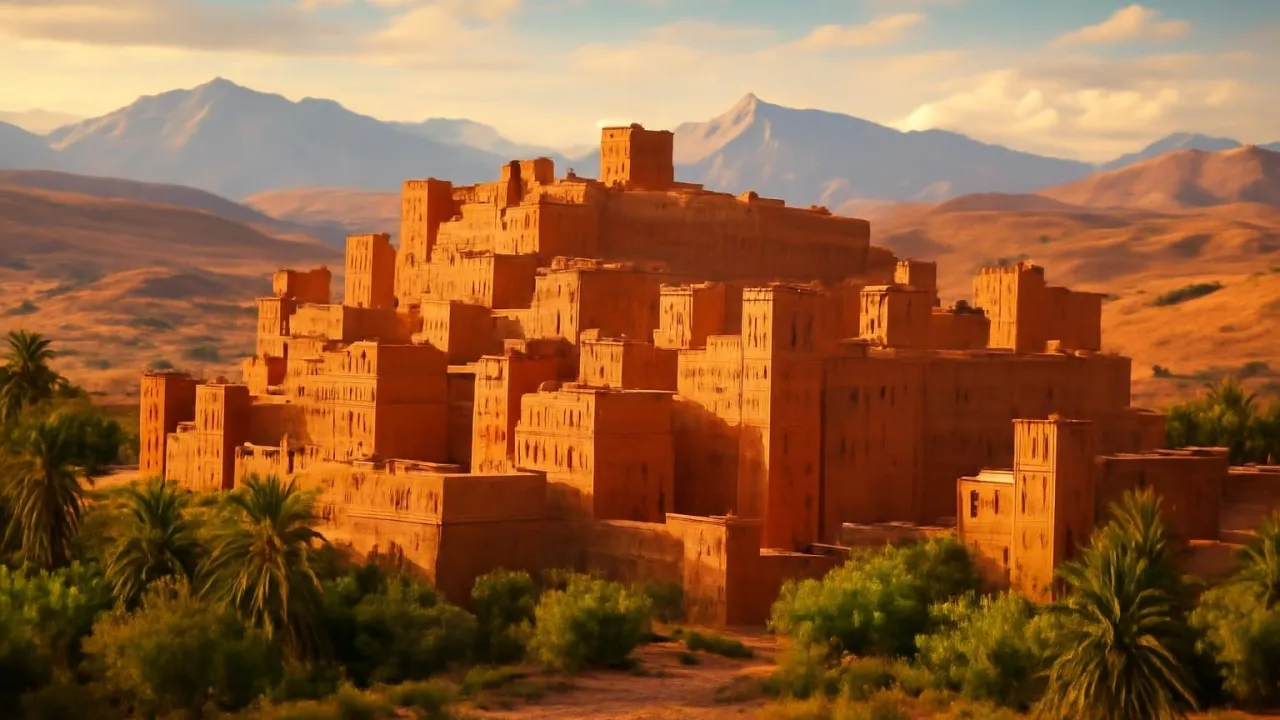
Ait Benhaddou’s walls are made from mud and straw. People mix them together and press them into . The sun bakes the bricks hard and strong. These walls keep the hot desert wind outside.
2
A Place Full of Towers
Tall towers stand at every corner of the kasbah. People once watched for travelers from these towers. Today, visitors walk the sandy streets and climb the towers. From the top, you can see the whole .
3
Old Stories in the Walls
Families lived safely inside these walls for hundreds of years. The kasbah protected them from sandstorms and strangers. Now, it is a famous place for movies and . It still stands strong in the desert sun.
The kasbah’s largest tower rises over 60 feet (18 meters) high!
✨ Word Sparks (Grade 3 Glossary)
Tap 🔊 to hear
adobe
Sun-dried bricks made of mud
erode
Slowly wear away or break down
ksar
A walled village or fortress
🪝
How do ancient mud towers survive fierce desert winds for centuries?
1
Earth and Straw Construction
The kasbah’s thick walls are made from a mixture of earth, straw, and water. Builders shape this mixture into bricks, called , and let them dry in the hot sun. These bricks are stacked to create tall, sturdy towers and walls. The straw inside the adobe helps prevent cracks from forming.
2
Defending the Valley
Ait Benhaddou was built as a , or fortified village, to protect families and traders. The high towers allowed people to spot travelers or danger from far away. Narrow, winding streets made it hard for strangers to find their way. The thick walls also block out desert heat and sand.
3
A Living Museum
Today, Ait Benhaddou is a UNESCO World Heritage Site. Visitors come from all over the world to see its unique architecture and history. Some families still live in the kasbah, keeping ancient traditions alive. The site is also famous for appearing in many movies and TV shows.
4
Nature’s Challenge
Wind and rain can slowly the mud walls over time. People must repair the regularly to keep the kasbah strong. The valley’s palm trees and river help protect the village from harsh weather. This teamwork between people and nature keeps Ait Benhaddou standing.
2. What helps protect Ait Benhaddou from harsh weather?
🤯 Mind-Blowing Fact • Grade 4
Ait Benhaddou has appeared in over 20 famous films, including 'Gladiator' and 'Prince of Persia'!
✨ Word Sparks (Grade 4 Glossary)
Tap 🔊 to hear
rammed earth
Earth pressed into walls for building
crenellation
Notched tops of castle walls
preservation
Keeping something safe and lasting
🪝
What secrets do the sunbaked walls of Ait Benhaddou hold from centuries past?
1
Engineering with Earth
Ait Benhaddou was constructed using a traditional technique called , where a mixture of clay, sand, straw, and water is compressed into wooden molds. This method creates thick, insulating walls that keep the interiors cool during scorching desert days and warm at night. The towers and are designed to withstand both fierce desert winds and the rare but heavy rains. Over centuries, regular maintenance with fresh layers of mud has helped the kasbah survive the harsh climate.
2
A Strategic Stronghold
The kasbah’s location on a hill beside the Ounila River made it a key stop for traders crossing the Atlas Mountains. Its high towers provided excellent views for spotting travelers and potential threats. The winding, narrow passageways inside the walls made it difficult for invaders to enter or navigate. This defensive design allowed families and merchants to live and trade safely within the ksar for generations.
3
A Cultural Crossroads
Ait Benhaddou has been home to Berber, Arab, and Saharan cultures, each leaving their mark on its architecture and traditions. Decorative geometric patterns carved into the towers reflect the artistic styles of these peoples. Today, the kasbah is a UNESCO World Heritage Site, drawing visitors who want to experience its history and beauty. It also serves as a symbol of Morocco’s rich cultural heritage.
4
Preservation and Challenges
Although the kasbah’s design is well-suited to the desert, erosion from wind and rain remains a constant threat. Local families and teams regularly repair the adobe walls using traditional methods. Modern tourism brings both opportunities and challenges, as increased visitors can cause wear but also help fund restoration. Through teamwork and respect for tradition, Ait Benhaddou continues to stand strong in the desert sun.
2. Why do people repair the kasbah with fresh mud?
🤯 Mind-Blowing Fact • Grade 5
Ait Benhaddou’s walls, some over 1,000 years old, are made entirely from sun-dried earth and straw—no cement or steel!
✨ Word Sparks (Grade 5 Glossary)
Tap 🔊 to hear
thermal mass
Material that stores and releases heat
crenellated
Walls with notched tops for defense
stewardship
Caring for and protecting something important
🪝
If you could walk through Ait Benhaddou at sunrise, what ancient echoes might you hear in its winding alleys?
1
Mastering Mud: The Science of Earthen Architecture
Ait Benhaddou’s formidable walls and towers are crafted from adobe—a composite of local earth, straw, and water—using both rammed earth and sun-dried brick techniques. The physics of adobe construction relies on the of thick walls, which absorb heat during the day and release it slowly at night, creating natural temperature regulation. Builders used wooden beams, called 'tataoui,' to reinforce ceilings and distribute weight evenly across the structure. The kasbah’s parapets and buttressed towers were engineered to resist both the erosive force of desert winds and the occasional deluge from mountain rains. Regular maintenance, involving the application of new mud plaster, is essential to counteract erosion and preserve structural integrity.
2
Ait Benhaddou’s Strategic Geography
Located along the ancient caravan route between Marrakech and the Sahara, Ait Benhaddou served as both a defensive stronghold and a bustling trading post. Its position on a hill above the Ounila River enabled residents to monitor approaching travelers and control access to the valley. The kasbah’s labyrinth of narrow passageways, high-walled courtyards, and concealed granaries provided security against raids and sandstorms alike. The site’s architecture reflects a blend of Berber, Arab, and sub-Saharan influences, showcasing the region’s historical role as a crossroads of cultures and commerce.
3
Cultural Legacy and Global Recognition
Ait Benhaddou is recognized as a UNESCO World Heritage Site for its outstanding example of pre-Saharan earthen architecture and its preservation of traditional ksar life. The site’s intricate geometric decorations, carved into facades and wooden doors, symbolize the artistic heritage of the local Amazigh (Berber) people. Over the centuries, the kasbah has witnessed the passage of traders, warriors, and storytellers, each contributing to its rich tapestry of legends. Today, it remains a living monument, with a handful of families still maintaining ancestral homes within its walls.
4
Challenges of Preservation in a Changing World
The survival of Ait Benhaddou depends on ongoing collaboration between local residents, Moroccan authorities, and international conservation experts. Erosion, seismic activity, and the pressures of modern tourism all threaten the integrity of the site. Restoration efforts focus on traditional materials and techniques, ensuring that repairs blend seamlessly with the original construction. Sustainable tourism initiatives aim to balance visitor access with the need to protect fragile adobe surfaces and traditional lifestyles. These efforts highlight the importance of cultural and adaptive engineering in safeguarding world heritage landmarks.
5
A Living Landmark in Film and Imagination
Ait Benhaddou’s dramatic silhouette and authentic architecture have made it a favorite location for major films and television series, including 'Lawrence of Arabia,' 'Gladiator,' and 'Game of Thrones.' This global exposure has brought new economic opportunities to the region, while also raising awareness about the challenges of conserving earthen monuments. As you wander its alleys, you might imagine the echoes of ancient traders, the laughter of children, and the timeless strength of walls shaped by sun, wind, and human ingenuity. Ait Benhaddou stands as a testament to the enduring relationship between people, place, and the environment.