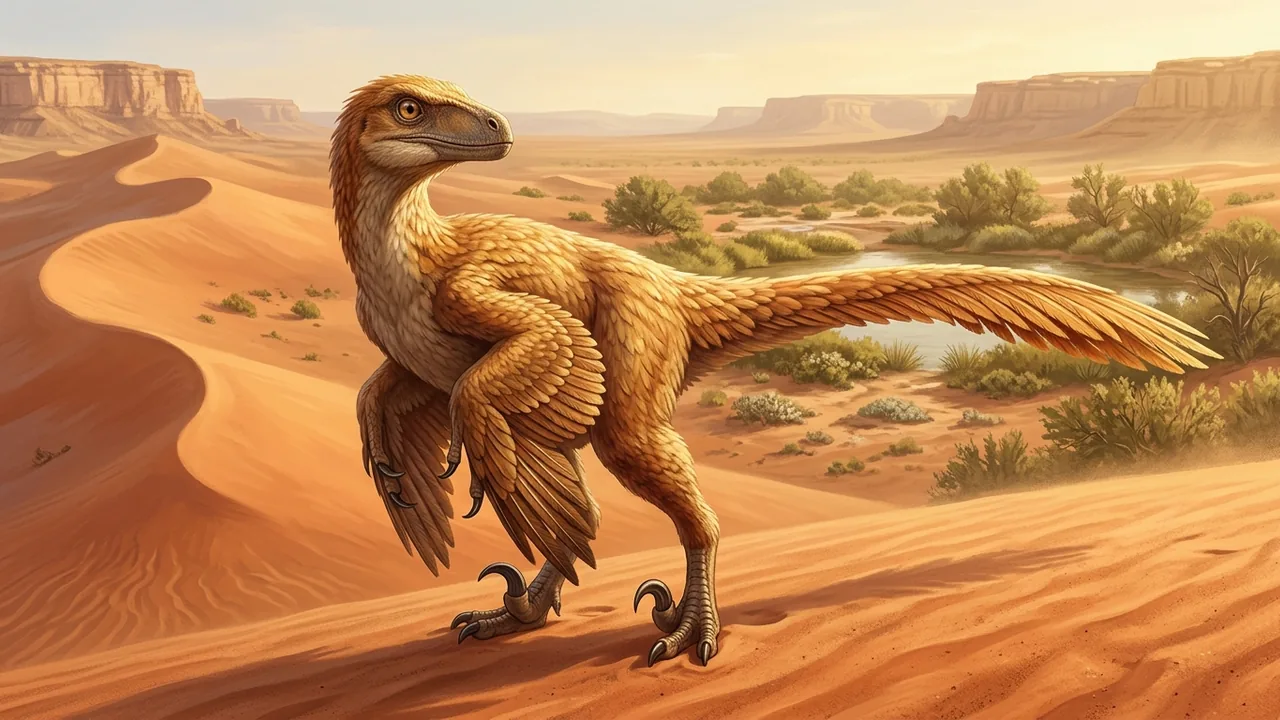
Meet the Legend: Cladistics of a Desert Maniraptoran
Within modern vertebrate paleontology, Velociraptor mongoliensis stands as a textbook bridge linking non-avian theropod dinosaurs directly to living birds. Nested inside Dromaeosauridae, a derived family of paravian maniraptorans, an adult Velociraptor measured roughly 2.07 meters (6.8 feet) in total length, stood barely 0.5 meters tall at the hip socket, and carried a lean body mass of 15 to 20 kilograms (33 to 45 pounds).
Popular adventure cinema famously inflated raptors to human height and stripped them down to leathery scales, borrowing proportions from North America's bulkier Early Cretaceous relative Deinonychus. Authentic fossil and comparative osteology reveal a remarkably avian hunter instead. Pneumatic air sacs hollowed its cervical and dorsal vertebrae like those of modern eagles, while an elastic wishbone, or furcula, braced its shoulder girdle during vigorous arm movements.
In 2007, paleontologists Alan Turner, Peter Makovicky, and Mark Norell examined specimen IGM 100/981 and documented six evenly spaced follicular papillae, known as quill knobs, along the posterior margin of the forearm . Because quill knobs develop only where strong ligaments anchor stiff flight-style shafts against bending forces, scientists proved Velociraptor sported fourteen large pennaceous secondary wing feathers alongside full contour plumage and a broad tail fan.
Although adult individuals weighed far too much relative to forelimb span for powered flight, retaining full avian-grade plumage demonstrates that complex vaned wings evolved first among terrestrial paravians for courtship display, brooding thermal control, and high-speed aerodynamic maneuvering long before birds mastered open skies above ancient continents!
Lost World Habitat: Djadochta Dunes & Stratigraphy
Reconstructing Velociraptor's lost ecosystem begins with the Upper Cretaceous of the Djadochta Formation (Campanian stage, roughly 75 to 71 million years ago) and the slightly younger Barun Goyot Formation across Mongolia's Gobi Basin. At famous outcrops such as Bayanzag, nicknamed the Flaming Cliffs, and the pale buff bluffs of Tugrikin Shireh, thick sedimentary sequences preserve sweeping cross-bedded quartz sandstones deposited by prevailing desert winds.
Interleaved between windblown dune sets lie thin lenses of mudstone and calcium-rich caliche paleosols, recording seasonal streams, shallow interdune ponds, and brief monsoonal downpours in an otherwise semiarid continental interior. Because Djadochta strata lack volcanic ash beds needed for direct argon-argon radiometric dating, geologists correlate magnetic polarity reversals and fossil mammal assemblages to pin down their Campanian age with precision.
Harsh daily temperature swings between scorching midday sand and chilly desert nights favored habits among local wildlife. Sparse drought-tolerant conifers, horsetails, and low flowering shrubs clustered around groundwater seeps, supporting club-tailed ankylosaurids like Pinacosaurus, brooding oviraptorids like Citipati, hopping multituberculate mammals, iguanian lizards, and abundant herds of Protoceratops andrewsi.
Compared against humid coastal floodplains in Late Cretaceous North America or Mongolia's wetter Nemegt river valleys, the dry Djadochta dune seas excluded multi-ton tyrannosaurids and giant hadrosaurs. That environmental filter allowed agile, heat-adapted mesopredators like Velociraptor to occupy the apex carnivore niche around isolated desert oases while navigating shifting walls of wind-sculpted orange sand throughout dry summers, sudden dust storms, and cool continental winters across inner Asia!
What's on the Prehistoric Menu? Predation & Scavenging
Cranial geometry and limb mechanics show Velociraptor thrived as a versatile desert mesopredator and opportunistic scavenger. Statistical comparisons of its scleral ring, the delicate circle of overlapping eye bones that supported the cornea, against modern birds and reptiles indicate a wide light-gathering pupil aperture tailored for and nocturnal hunting. Patrolling dunes between dusk and dawn minimized evaporative water loss while targeting active nocturnal mammals, scorpions, and lizards.
When tackling larger quarry such as juvenile oviraptorids or subadult Protoceratops, Velociraptor did not slash through thick hides like a saber blade. Instead, functional morphologists demonstrated Raptor Prey Restraint (RPR): Velociraptor hyperextended Pedal Digit II to sink its 6.5-centimeter curved sickle talon deep like a mountaineer's crampon hook, pinning prey beneath its full body weight while beating feathered wings anchored along each to maintain stability atop struggling targets.
Its narrow, slightly upturned snout carried 26 to 28 ziphodont teeth per jaw side with noticeably coarser serrations along the rear cutting edges, ideal for gripping prey and pulling flesh backward once subdued. Extraordinary gut-content even revealed an acid-etched azhdarchid pterosaur bone measuring over seven centimeters inside one Velociraptor ribcage, confirming bold scavenging across Gobi oases!
Because healthy adult azhdarchids stood taller than Velociraptor itself, discovering smoothed wing bones inside the raptor's digestive tract alongside healed rib injuries proves desert hunters eagerly exploited drought casualties whenever dry seasons made live oasis ambushes scarce, blending agile active predation with smart, energy-saving carrion foraging across the basin.
Superpowers: Endocasts, Wrist Folding & Tail Rods
High-resolution X-ray computed tomography (CT) scans of Velociraptor braincases reveal neuroanatomy finely tuned for athletic pursuit in dim desert light. Three-dimensional digital endocasts show expansive olfactory bulbs for tracking faint scents alongside an enlarged cerebellar flocculus, a specialized neural lobe coordinating rapid eye, head, and neck reflexes. That vestibulo-ocular circuitry kept Velociraptor's gaze locked steady onto zig-zagging lizards even while bounding across uneven sand ripples!
Its forelimbs and hind limbs reflected equally sophisticated evolutionary engineering. A crescent-shaped wrist bone called the semilunate carpal allowed its three-fingered hands, whose curved claws always faced inward rather than palms-down, to fold sideways neatly against its ribs, shielding long secondary plumes rooted along the from abrasive desert grit.
Unlike long-shinned cursorial ornithomimids built purely for 35-mph straight-line sprints, Velociraptor retained a relatively short, stout metatarsus that maximized mechanical gripping torque in its feet during prey restraint. Behind the hips, bundles of paper-thin ossified vertebral rods bridged up to ten caudal segments at once, locking most of the tail into a stiff dynamic stabilizer that pivoted smoothly at its muscular base!
Working together with broad tail-fan plumage and vigorous wing strokes, that rigid caudal beam let Velociraptor adjust body pitch, roll, and yaw mid-leap. Those precise balance refinements gave non-flying terrestrial raptors extraordinary agility on steep sand slopes while showcasing the exact biomechanical control toolkit that smaller paravian relatives adapted for powered avian flight across Mesozoic forest canopies, lakeshores, and sunny island shorelines.
Flight vs. Fight Arena: Evolutionary Trade-Offs
Every encounter between Velociraptor mongoliensis and Protoceratops andrewsi tested sharply contrasting evolutionary investments along the Flight versus Fight survival spectrum. Representing Team Apex Hunter, Velociraptor optimized low-mass offensive agility: hollow pneumatic bones reduced rotational inertia, eyesight favored twilight ambushes, and hinged Pedal Digit II talons delivered concentrated pinning pressure. Yet lightweight bones carried real fragility whenever an attacker tangled with a much heavier rival!
Quadrupedal Protoceratops embodied classic Team Fight defense on open desert flats. Weighing 60 to 80 kilograms, roughly four times an adult Velociraptor's mass, grown defenders braced low on four sturdy limbs, shielding vulnerable neck vessels behind an expanded parietal-squamosal frill while anchoring massive adductor jaw muscles to power a narrow, bone-shearing beak.
That exact ecological duel became immortalized in stone at Tugrikin Shireh in 1971. Detailed of the world-famous Fighting Dinosaurs fossil reveals Velociraptor's left sickle claw driven deep toward the herbivore's throat region while Protoceratops clamped its beak vise-tight across the raptor's right forearm beneath collapsing dune sand.
Neither animal could pull free once a rain-drenched sand slope liquefied and buried them together in seconds. Across evolutionary history, this remarkable fossil snapshot demonstrates why solitary mesopredators rarely gambled against healthy, alert adult defenders unless surprise, moonless darkness, steep dune terrain, or severe seasonal hunger tilted the mechanical odds decisively toward speed, stealth, and raptorial agility in the ancient Gobi arena, making every oasis standoff a high-stakes test of survival physics and split-second instincts!
Fossil Detective Secrets: Flaming Cliffs Taphonomy
Why do Upper Cretaceous basins in southern Mongolia preserve wafer-thin raptor skulls in full three-dimensional detail when most river-channel fossils flatten or scatter apart? The secret lies in catastrophic desert recorded across Djadochta . Whereas dry windblown dunes build angled cross-beds grain by grain, intense seasonal rainstorms occasionally saturated steep dune faces until heavy, waterlogged sand grainflows slumped downward like wet concrete.
Those sudden sediment avalanches entombed resting, brooding, and dueling dinosaurs instantaneously, sealing articulated skeletons away from surface scavengers and oxygen-driven bacterial decay. Ever since Central Asiatic Expeditions technician Peter Kaisen uncovered holotype skull AMNH 6515 at Bayanzag on August 11, 1923, formally named Velociraptor by Henry Fairfield Osborn in 1924, Gobi outcrops have revolutionized dinosaur science.
Today, ultraviolet laser fluorescence, synchrotron micro-CT braincase mapping, and high-magnification inspection of ligament scars along the forearm continue turning ancient stone into living biology. Even fossilized two-toed dromaeosaur trackways called Deinonychosaurichnus across East Asia confirm these hunters walked on Digits III and IV while holding their curved inner talons cleanly aloft above muddy flats!
Stripped of Hollywood monster exaggerations, Velociraptor endures as one of paleontology's finest detective triumphs. Every pneumatic bone, quill knob, inner-ear canal, and sand-cast footprint reveals a warm-blooded, swift, eagle-plumed predator of Cretaceous Asian dunes whose unmistakable avian blueprint still lives on in every hawk, falcon, owl, and songbird soaring gracefully through Earth's skies outside your classroom window today, inspiring future fossil explorers around the globe.