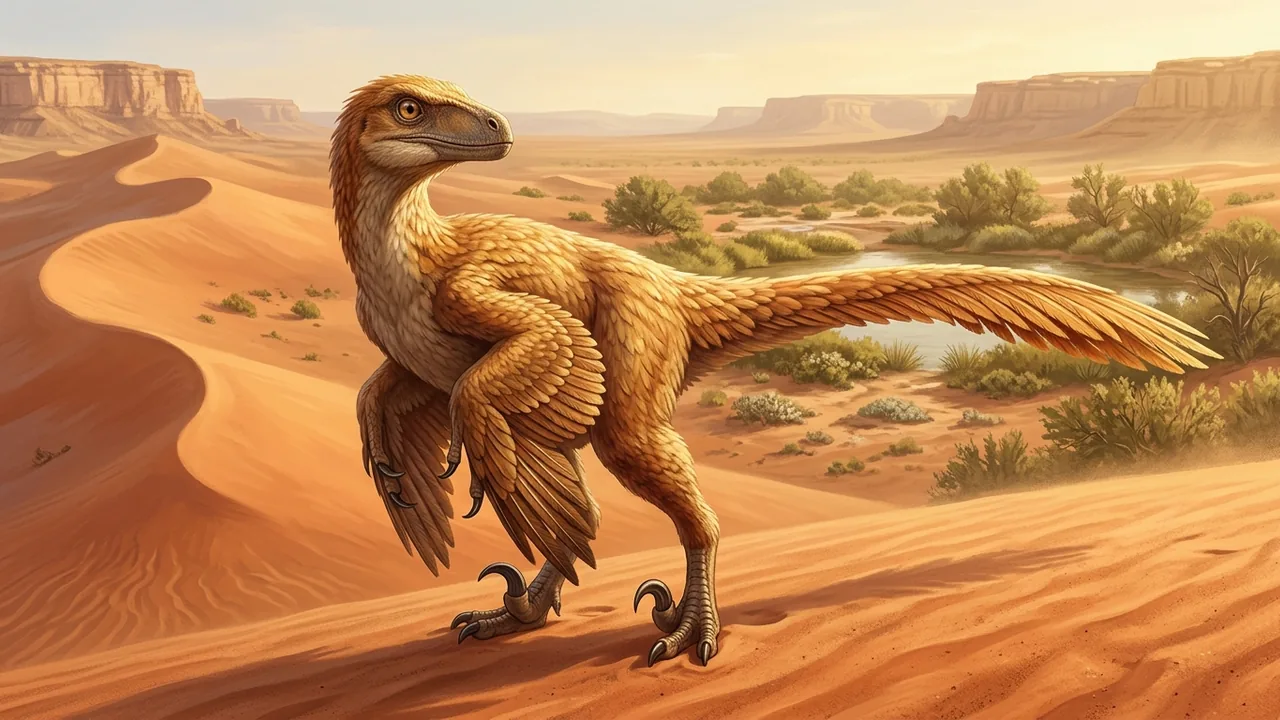
Meet the Legend: Turkey-Sized Bandit
Picture a swift no taller at the hip than a medium dog and weighing about as much as a plump wild turkey! That was the real Velociraptor, whose name means swift seizer. From snout to tail tip, it stretched six and a half feet, roughly as long as a broomstick plus a baseball bat.
Popular movies often show giant, scaly raptors taller than grown-ups. Real skeletons prove Velociraptor actually wore sandy-brown with long wing feathers on its arms, looking like an athletic desert hawk on two strong legs!
Lost World Habitat: Windswept Gobi Sands
Roughly 75 million years ago during the Late Cretaceous Period, Velociraptor roamed the ancient Gobi Desert in Mongolia. Towering hills of orange sand—each wind-carved as tall as a three-story school building—rippled across the wide horizon. Summers baked under blazing sunshine, while chilly nights cooled the rocky valleys quickly.
Warm protected Velociraptor from blowing grit and cold evening air. Thirsty animals gathered around shallow streams and green scrub bushes, where Velociraptor shared trails with armored ankylosaurs, crested Oviraptor parents, tiny mammals, and herds of sturdy, beak-faced Protoceratops.
What's on the Prehistoric Menu?
As an active , Velociraptor needed plenty of protein to fuel its speedy, warm-blooded body. During scorching afternoons it rested in shady bushes, then trotted out at dusk when desert lizards, beetles, and mouse-sized mammals scurried across cooling sand. Its narrow, slightly upturned snout held more than fifty small, backward-curved teeth lined with tiny saw edges.
Instead of chewing food, Velociraptor gripped slippery prey tightly with jaws and hands. When stalking bigger meals like young Protoceratops, it crouched quietly behind a low sand and launched a sudden ambush sprint!
Superpowers: Sickle Claws & Tail Steering
Velociraptor's most famous tool grew on the second toe of each hind foot: a curved, two-and-a-half-inch claw shaped like a hawk's talon! While running on its third and fourth toes, Velociraptor held that hooked claw raised cleanly off gritty desert sand so the point stayed razor-sharp.
Just as amazing was its sense of during high-speed chases. Thin bony rods locked its long tail into a stiff horizontal bar, acting like a tightrope walker's pole. Flapping its winged arm helped Velociraptor pivot sharply without ever tumbling over!
Flight vs. Fight Arena: Dune Rivals!
In the Gobi Desert arena, Velociraptor represented Team Apex Hunter, relying on stealth, speed, and agile footwork. Its main rival, sheep-sized Protoceratops, chose Team Fight! Though four-legged Protoceratops trotted much slower over soft sand, an adult weighed nearly four wild turkeys put together and carried a thick bony neck shield.
Velociraptor used quick leaps, feathered , and gripping claws to outmaneuver its sturdy neighbor. Meanwhile, brave Protoceratops spun in tight circles with a powerful, branch-snapping beak to defend its sandy nest from hungry visitors!
Fossil Detective Secrets of the Gobi
Desert storms created amazing time capsules for fossil detectives! When rain-soaked sand hills slumped suddenly, whole skeletons were buried deeply before scavengers could scatter the bones. In 1971, scientists in Mongolia uncovered the famous Fighting Dinosaurs specimen—a Velociraptor and a Protoceratops preserved together beneath a collapsed sand .
Decades later, museum researchers spotted six rowed quill bumps along a Velociraptor forearm bone. Those tiny anchor marks proved beyond doubt that real raptors wore magnificent bird-like as they raced across the prehistoric Gobi Desert!