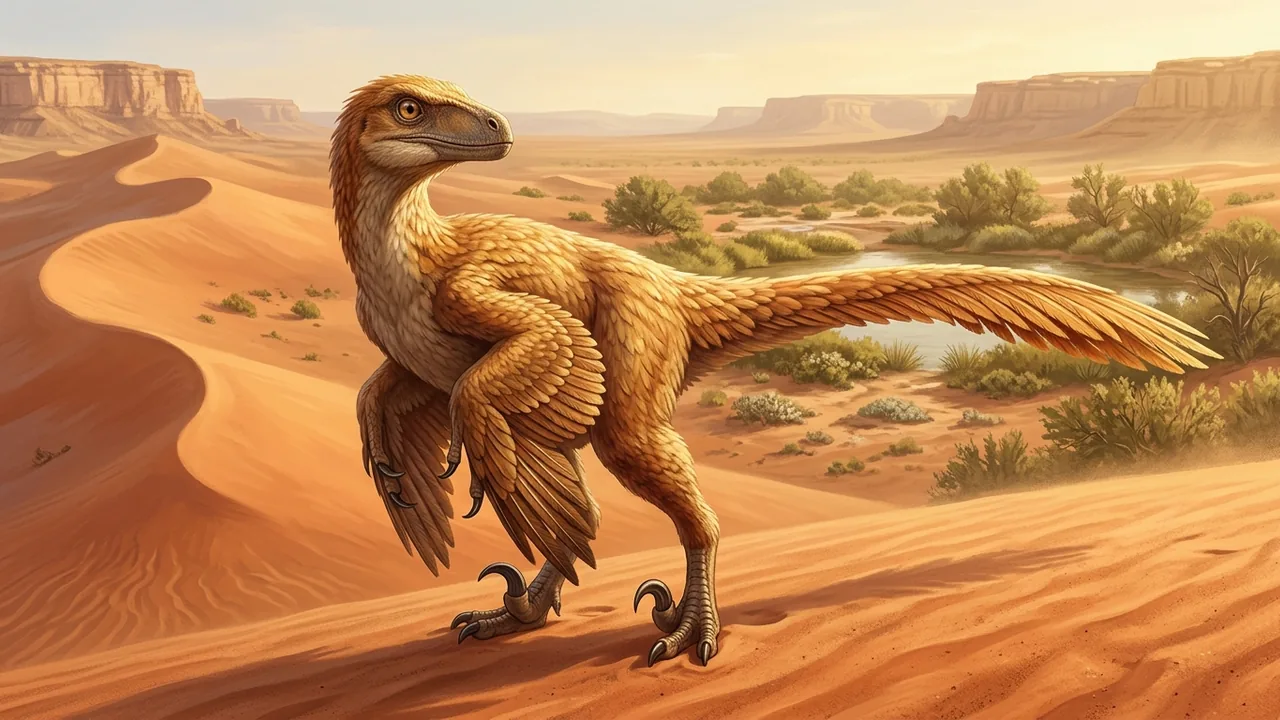
Meet the Legend: Feathered Desert Sprinter
When you hear the name Velociraptor—Latin for swift seizer—you might picture a human-sized scaly reptile from adventure films. Yet real fossil discoveries tell a far cooler story! Velociraptor mongoliensis stood under two feet tall at the hip, stretched six and a half feet from snout to tail tip, and weighed only 33 to 45 pounds, roughly matching a large wild turkey.
Every inch of its athletic skeleton showed clear bird-like features. Thick coat feathers served as a warm for chilly nights, long wing plumes lined its forearms, and a fan of feathers tipped its stiff tail.
Popular monster movies borrowed the size of larger North American cousins when designing giant screen villains. Today, every who studies Velociraptor marvels at how closely this nimble hunter resembled an eagle built for sprinting across sand!
Lost World Habitat: Oasis Life in Ancient Asia
During the Late Cretaceous Period about 75 to 71 million years ago, Velociraptor thrived in a dry desert across Mongolia and northern China. Windswept red sand dunes towered above rocky streambeds and hidden green oases. Rainfall arrived only in brief seasonal bursts, dust storms swept open basins, and temperatures swung sharply between scorching afternoons and cold, starry nights.
Surviving such tough conditions required specialized traits. Each feathered layer worked as a physical that blocked blazing midday sun and trapped body heat after dark, while shade-resting kept water loss low.
Even across oceans, dry Mesozoic basins recorded similar clues in stone. Just as ancient iron-rich red sandstones in Virginia's Culpeper Basin preserved older three-toed dinosaur footprints along muddy stream flats, Mongolia's red desert sandstones locked away footprints, nests, and skeletons from Velociraptor's sandy world!
What's on the Prehistoric Menu?
Every desert ecosystem depends on a connected powered by sunlight. Drought-hardy conifers, low shrubs, and streambank horsetails acted as producers near damp oases. Crunchy beetles, desert lizards, hopping furry mammals, and sheep-sized plant-eating Protoceratops munched on those plants or insects as primary and secondary consumers. Prowling at the top of that local food chain was Velociraptor!
Measurements of tiny bones framing its eyes reveal an important behavioral : Velociraptor was largely , hunting actively at dusk, night, and dawn. By stalking prey during cool darkness when desert lizards, mammals, and young herbivores left shelter, Velociraptor avoided overheating and conserved precious moisture.
Using quiet footfalls and keen night vision, it crept behind rippled sand ridges before launching sudden sprints. Nothing went wasted in this dry land, so Velociraptor also scavenged animals that perished during summer droughts.
Superpowers, Senses & Feathered Anatomy
Velociraptor packed remarkable survival equipment into a lightweight, hollow-boned frame. Each hind foot carried an enlarged second toe armed with a curved, 2.5-inch sickle claw held high off gritty sand while running. Rather than slashing wildly, Velociraptor used this structural like a modern hawk's talon—pinning quick prey firmly beneath its body weight while flapping feathered arms for steady balance.
Inside its narrow, upturned skull sat sharp sensory organs built for life. Wide eye sockets gathered faint starlight across dark dunes, oversized scent lobes detected hidden burrows, and sensitive inner ears picked up soft footsteps in dry brush.
Three long clawed fingers on each inward-facing hand helped grasp slippery lizards tightly. Meanwhile, thin bony rods stiffened its long tail into a straight rudder that swung left or right during lightning-fast turns!
Flight vs. Fight Arena: Raptor vs. Frill!
How did Velociraptor compete against the toughest neighbors sharing its desert ? Fighting on Team Apex Hunter, Velociraptor relied on surprise, leaping agility, and sharp reflexes rather than heavy body mass. Yet its most common neighbor, stocky Protoceratops, weighed up to 180 pounds, roughly four times heavier than the raptor, and belonged squarely on Team Fight!
Protoceratops possessed a powerful defensive of its own: a broad bony neck frill protecting its shoulders and a deep, parrot-like beak strong enough to snap tough desert branches or bite an attacker's leg.
Because charging headfirst into that armored shield was far too risky, Velociraptor circled wide around sandy nests. It tested angles with quick feints, leaped lightly on spread wings, and darted safely out of reach whenever an alert adult defender spun forward to protect its eggs!
Fossil Detective Secrets: Quill Knobs & Dunes
How does a reconstruct an animal that vanished 71 million years ago? Mongolia's ancient desert preserved skeletons with extraordinary detail whenever rain-soaked sand dunes collapsed suddenly, burying animals whole before wind or scavengers scattered fragile bones. After explorers first unearthed a Velociraptor skull and claws at the Flaming Cliffs in 1923, dozens of new skeletons revealed fresh surprises.
In 1971, researchers discovered a Velociraptor and a Protoceratops locked together inside stone, proving these two species truly clashed in the ! Then in 2007, close inspection of a Velociraptor forearm bone uncovered six tiny quill knobs—the exact anchor bumps where living eagles attach strong wing feathers.
Step by step, desert fossils replaced old scaly myths with scientific truth. Velociraptor stands today as one of history's clearest links between agile dinosaurs and modern birds!