Meet the Legend: The Real Feathered Dromaeosaur
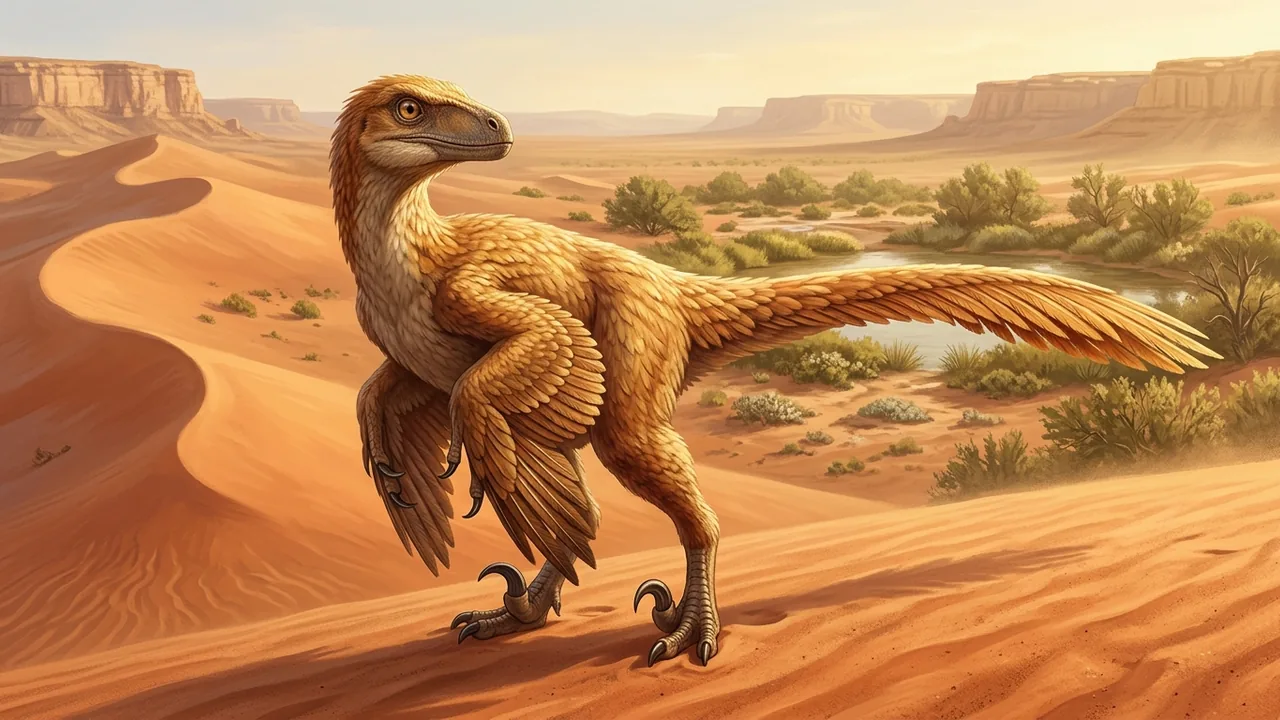
Few prehistoric animals spark curiosity quite like Velociraptor mongoliensis, yet real fossils reveal a predator far sleeker and more bird-like than movie monsters! As a classic member of the family—agile, warm-blooded theropods closely related to modern birds—an adult Velociraptor measured roughly 6.5 feet (2 meters) from snout to tail tip, stood just 1.6 feet tall at the hip, and weighed 33 to 45 pounds (15 to 20 kilograms).
More than half of that two-meter length belonged to a rigid, horizontal tail, while hollow air sacs inside its neck and back bones kept its frame remarkably light. Instead of bare lizard scales, Velociraptor wore insulating plumage across its torso and long vaned feathers along its forearms.
Scientists confirmed those wings by studying each tiny —a raised bony anchor bump along the lower arm bone where tough ligaments once held fourteen large wing feathers in place.
Although adults were too heavy to fly through the sky, winged forearms and bird-style wrist joints helped Velociraptor steer fast turns, shelter eggs, and balance atop prey. Compact, quick-thinking, and sharp-eyed, it packed genuine raptor power into a turkey-sized athlete!
Lost World Habitat: Energy in an Arid Sand Sea
Between 75 and 71 million years ago during the Late Cretaceous Period, central Asia sat deep inland, cut off from humid ocean breezes by distant mountain ranges. Towering orange sand dunes marched across vast basins broken only by spring-fed oases, winding seasonal creeks, and hardy patches of conifers, horsetails, and tough desert shrubs. Midday sand temperatures soared well past 100 degrees Fahrenheit before dropping briskly under clear desert skies.
Survival in this sun-baked ecosystem depended on efficient energy flow. Oasis plants captured solar energy at the base of the food web, feeding beetles, burrowing multituberculate mammals, swift lizards, and herds of tough-beaked Protoceratops.
Because roughly ninety percent of energy is burned for body heat and motion at each trophic step, an arid landscape could support far fewer meat-eating predators than plant-eaters.
Every solitary therefore patrolled wide dune ridges and shared oasis watering holes carefully alongside spike-armored Pinacosaurus, dome-headed Goyocephale, and crested Citipati. Resting quietly inside cool scrub shade during peak afternoon glare conserved precious body water until active twilight hunting hours arrived across the cooling red sand, keeping this desert food web in steady balance year after year!
What's on the Prehistoric Menu? Pinning & Pursuit
How did a 40-pound predator capture meals across loose desert sand? For decades people guessed raptors slashed prey open like sword blades, yet modern uncovered a much more accurate technique called Raptor Prey Restraint (RPR). Built with short, forceful foot bones rather than fragile stilt legs, Velociraptor pounced onto targets, ranging from iguanian lizards and baby oviraptorids to young Protoceratops, pinning them beneath its full body mass!
Once on top, Velociraptor drove its curved 2.5-inch second-toe talons inward like eagle crampons to prevent escape. Flapping its winged forearms furiously helped keep its center of gravity steady on top of wriggling quarry while its long, low jaws delivered rapid bites.
Lined with 52 to 56 backward-hooked serrated teeth, its narrow snout gripped slippery lizards and small mammals securely rather than crushing thick bone.
Occupying an essential upper role in the Gobi food web, Velociraptor wasted zero calories in lean months. Oversized scent bulbs inside its skull guided this keen tracker across moonlit dunes to scavenge drought-stricken carcasses, including fallen giant pterosaurs and adult plant-eating dinosaurs, recycling vital nutrients across the dry basin!
Superpowers: Sprint Levers, Eyes & Counterbalance
Every joint inside this desert operated like a finely tuned lever system. Hind-limb muscle reconstructions show Velociraptor accelerated up to roughly 24 miles per hour (39 km/h) in explosive ambush sprints! While ostrich-like dinosaurs evolved super-long shins for marathon running, Velociraptor's leg traded top straight-line speed for high-torque ankle grip and sudden vertical leaping power.
To execute hairpin turns around boulders and scrub bushes without wiping out on loose sand, Velociraptor relied on an ingenious tail . Bundles of paper-thin bony rods overlapped across ten vertebrae at a time, locking the back four-fifths of the tail into a stiff beam while flexible hip joints whipped the whole bar left or right.
Up front, crescent-shaped wrist bones let Velociraptor fold its three-fingered feathered arms neatly against its ribs, protecting long plumes anchored to each forearm .
Inside its lightweight skull, wide bony eye rings gathered faint starlight like a modern owl's eyes, while enlarged inner-ear balance loops kept its sharp gaze locked rock-steady on darting desert prey during every high-speed twist, leap, and sudden stop across wind-rippled desert dunes!
Flight vs. Fight Arena: Agility Meets Armor!
Step into the Late Cretaceous Gobi arena where Team Apex Hunter collided head-on with Team Fight! Velociraptor entered with 10-out-of-10 agility, binocular depth perception, a whip-smart tail , and retractable second-toe sickle claws curving through a 160-degree arc. Across the sand stood Protoceratops andrewsi, slower on four stocky legs, yet weighing up to 180 pounds and armored with a broad bony neck frill!
From a standpoint, body mass and jaw leverage mattered enormously in any desert standoff. Protoceratops anchored thick jaw-closing muscles high onto its neck shield, powering a narrow shearing beak strong enough to snap woody branches or crush hollow raptor arm bones in a single clamp!
Because a healthy adult Protoceratops outweighed this agile more than four to one, Velociraptor smartly avoided reckless frontal charges against grown defenders.
Instead, it relied on twilight stealth, high flanking leaps, and rapid feathered wing strokes to test a rival's footing on steep dune slopes. Whenever a braced defender spun quickly and snapped its powerful beak, Velociraptor sprang clear in a heartbeat to search for smaller, safer desert meals near the oasis!
Fossil Detective Secrets: Stones That Locked Action
Mongolia's wind-sculpted sandstones gifted science two of the greatest fossil discoveries on Earth. During an August 1923 expedition to the Flaming Cliffs, field technician Peter Kaisen spotted a crushed skull beside curved toe claws, allowing Henry Fairfield Osborn to name Velociraptor in 1924. Nearly five decades later in 1971, a Polish-Mongolian crew unearthed the breathtaking Fighting Dinosaurs fossil, preserving a and a Protoceratops buried mid-contest beneath a slumped sand dune!
Even tiny surface bumps on ancient stone bones unlocked huge evolutionary secrets. In 2007, paleontologists examining specimen IGM 100/981 under angled museum light discovered six evenly spaced marks, with each raised proving tough ligaments anchored large wing feathers directly to the forearm.
Combining fossil anatomy with modern hawk , researchers demonstrated that those non-flying wings helped Velociraptor steer tight sprints, stabilize pinned prey, and shelter nests from swirling desert sandstorms.
Step by step, careful fieldwork and museum CT scans replaced scaly monster myths with something far more inspiring: a warm-blooded, intelligent, eagle-feathered desert acrobat preserved forever inside glowing red Mongolian sandstone for curious young explorers everywhere to study and admire!